WHAT JESUS TAUGHT US

THE PARABLES CLARIFIED
With Modern-Day Summaries and Meanings
Matthew • Mark • Luke • John

Jesus of Nazareth

Introduction: Who Was Jesus of Nazareth?

Jesus of Nazareth was a Jewish teacher and preacher who lived in the region of Galilee and Judea in the 1st century AD, roughly between 4 BC and 30–33 AD. He is the central figure of Christianity, and is understood both as a historical figure and, in Christian belief, as far more than that.

Historically — even setting aside religious belief, most historians, Christian and non-Christian alike, agree Jesus was a real person: a Jewish preacher and healer from Nazareth in Galilee, likely trained as a carpenter, who gathered a following of disciples, taught in parables about the Kingdom of God, and was crucified by Roman authorities under Pontius Pilate around 30–33 AD, likely for being seen as a political or religious threat, given the charge “King of the Jews” placed above the cross. Non-Christian sources like the Jewish historian Josephus and the Roman historian Tacitus both mention him, which is part of why his existence isn't seriously disputed by mainstream scholars.

In Christian belief — Jesus is understood to be far more than a historical teacher: the Son of God, the second person of the Trinity, born of the Virgin Mary, who lived a sinless life, was crucified, and rose from the dead three days later. Christians believe his death and resurrection reconciled humanity with God, and his teachings, including the parables that follow in this book, form the core of Christian ethics and faith.

What we know of his life and teaching comes almost entirely from the four Gospels, Matthew, Mark, Luke, and John, written by his followers in the decades after his death. He taught things like loving one's enemies, caring for the poor and outcast, forgiveness, and humility, themes that run through every parable in this book, and was known for performing miracles: healings, exorcisms, and, according to the Gospels, raising the dead

Everything Jesus Taught Us

Everything Jesus taught us while He walked on earth, explained clearly and faithfully, using the accounts recorded in the four Gospels.

This website is about the parables Jesus told and the teachings He gave while He was on earth, as recorded in the four Gospels: Matthew, Mark, Luke and John.

The Parables

The stories Jesus told to explain God's Kingdom and teach people how to live.

Illustrations and Comparisons

Teachings such as the Salt of the Earth, the Light of the World and the Good Shepherd.

Direct Teachings

His instructions about love, forgiveness, prayer, faith, humility, money and how we should treat others.

Important Conversations and Statements

Important moments when Jesus taught people through His words, questions and responses.

The Four Evangelists

What is recorded below was done by the Four Evangelists (an evangelist is someone who “actively” proclaims the Good News).

  • Matthew: Tradition and church history identify him as an Apostle of Jesus (also called Levi), a former tax collector who wrote primarily for a Jewish audience to show how Jesus fulfilled Old Testament prophecies.
  • Mark: Traditionally viewed as a companion to the Apostle Peter (and Paul), he wrote a fast-paced Gospel believed by scholars to be the earliest of the four, recording Peter’s memories primarily for a Gentile/Roman audience.
  • Luke: Described in tradition as a physician and a travelling companion of the Apostle Paul, he wrote paying close attention to the humanity and compassion of Jesus.
  • John: Identified as John the Apostle (the son of Zebedee and the “beloved disciple”), he wrote the final canonical Gospel, which offers a deeply theological and spiritual perspective on Jesus as the divine Son of God.

Matthew and parallel accounts

The Sermon on the Mount

Matthew 5–7

Matthew 5–7 The Sermon on the Mount is one of Jesus’ most important collections of teachings. Across these three chapters, he teaches about the values of God’s Kingdom, prayer, forgiveness, love of enemies, generosity, trust in God, judging others and putting his words into practice.

The individual teachings are presented separately throughout this website, with their own Scripture readings and explanations, so that each can be considered more fully.

The Story: Seeing the crowds, Jesus goes up the mountain and teaches His disciples. He begins by describing the people who are blessed in God’s Kingdom, including the poor in spirit, mourners, the meek, those who hunger for righteousness, the merciful, the pure in heart and the peacemakers. The sermon then moves through many themes: being salt and light, a deeper righteousness, love of enemies, giving, prayer, trust in God, and care in judging others. It ends with the call to put His words into practice, like a wise builder on rock.

What It Means Today: Jesus turns ordinary ideas of status and success upside down. His Kingdom values humility, mercy, righteousness, purity and peacemaking rather than wealth, power or prestige. The Sermon on the Mount is not only a list of ideals; it describes the kind of life that grows in people who trust God and want to live His way. It challenges us to look at our motives as well as our actions, and invites us to read the teachings that follow in this book as one connected picture of what it means to follow Jesus.

Back to contents ↑

The Beatitudes

Matthew 5:1–12; Luke 6:20–23

Matthew 5:1–12; Luke 6:20–23 Blessed are the poor in spirit: for theirs is the kingdom of heaven. Blessed are the meek: for they shall possess the land. Blessed are they that mourn: for they shall be comforted. Blessed are they that hunger and thirst after justice: for they shall have their fill. Blessed are the merciful: for they shall obtain mercy. Blessed are the clean of heart: for they shall see God. Blessed are the peacemakers: for they shall be called the children of God. Blessed are they that suffer persecution for justice’ sake: for theirs is the kingdom of heaven.

The Story: Jesus begins the Sermon on the Mount by describing the people who are blessed in God’s kingdom, including the poor in spirit, mourners, the meek, those who hunger for righteousness, the merciful, the pure in heart and the peacemakers.

What It Means Today: Jesus turns ordinary ideas of status and success upside down. His kingdom values humility, mercy, righteousness, purity and peacemaking rather than wealth, power or prestige.

Back to contents ↑
Jesus teaching a crowd seated on a hillside above the Sea of Galilee
Reflections on the teachings of Jesus

Salt of the Earth

Matthew 5:13

Matthew 5:13 “You are the salt of the earth, but if the salt has lost its flavor, with what will it be salted? It is then good for nothing, but to be cast out and trodden under the feet of men.”

The Story: In the Sermon on the Mount, Jesus tells His disciples, “You are the salt of the earth.” Salt was valued for flavouring and preserving food, and He compares His followers to something small that nevertheless has a noticeable effect. He then warns that if salt loses its flavour, it is no longer good for anything. The picture reminds His listeners that their lives are meant to make a real difference in the world around them.

What It Means Today: Jesus’ followers are meant to have a positive influence through their character and actions. Like salt, a quiet and faithful life can add flavour, goodness and protection to the places where we live and work. Faith is not intended to be completely hidden from the world, nor to lose its distinct character by blending in with everything around it. The teaching invites us to ask whether our honesty, kindness and generosity are making a noticeable difference, and to stay close to the God who gives our lives their purpose.

Back to contents ↑

The Light of the World

Matthew 5:14–16

Matthew 5:14–16 “You are the light of the world. A city located on a hill can’t be hidden. Neither do you light a lamp and put it under a measuring basket, but on a stand; and it shines to all who are in the house. Even so, let your light shine before men, that they may see your good works and glorify your Father who is in heaven.”

The Story: Continuing the Sermon on the Mount, Jesus tells His disciples, “You are the light of the world.” He points out that a city set on a hill cannot be hidden, and that no one lights a lamp and then puts it under a basket; it is placed on a stand so that it gives light to everyone in the house. He then tells them to let their light shine before others, so that people may see their good works and glorify their Father in heaven.

What It Means Today: The teaching calls Jesus’ followers to let goodness become visible in their lives, so that their actions point people toward God rather than serving themselves. Faith is not meant to be a private possession kept out of sight, but a way of living that others can see and benefit from. Light is not for display; it exists to help people see. We are invited to use our gifts, our kindness and our integrity to help others, trusting that God is the source of the light and that He deserves the credit.

Back to contents ↑

Jesus and the Fulfilment of the Law

Matthew 5:17–20

Matthew 5:17–20 “Don’t think that I came to destroy the law or the prophets. I didn’t come to destroy, but to fulfill. For most certainly, I tell you, until heaven and earth pass away, not even one smallest letter or one tiny pen stroke shall in any way pass away from the law, until all things are accomplished. Therefore, whoever shall break one of these least commandments and teach others to do so, shall be called least in the Kingdom of Heaven; but whoever shall do and teach them shall be called great in the Kingdom of Heaven. For I tell you that unless your righteousness exceeds that of the scribes and Pharisees, there is no way you will enter into the Kingdom of Heaven.”

The Story: In the Sermon on the Mount, Jesus makes clear that He has not come to abolish the Law or the Prophets, but to fulfil them. He teaches that not the smallest letter of the law will pass away until everything is accomplished, and that those who break even the least of the commandments and teach others to do the same will be called least in the Kingdom of Heaven. Those who do and teach them will be called great. He also warns that unless their righteousness exceeds that of the scribes and Pharisees, His listeners will not enter the Kingdom.

What It Means Today: Jesus calls us to take God’s teaching seriously and to live it sincerely. The Law and the Prophets point to God’s purposes, and Jesus shows how they find their fulfilment in Him and in the way He teaches His followers to live. Faith is not just about knowing the commandments or appearing religious; it means putting God’s will into practice, with a heart and life shaped by His teaching. The righteousness He asks for goes deeper than rule-keeping, and the verses that follow show what that looks like in everyday relationships.

Back to contents ↑

Reconciliation with Others

Matthew 5:21–26

Matthew 5:21–26 “You have heard that it was said to the ancient ones, ‘You shall not murder;’ and ‘Whoever murders will be in danger of the judgment.’ But I tell you that everyone who is angry with his brother without a cause will be in danger of the judgment. Whoever says to his brother, ‘Raca!’ will be in danger of the council. Whoever says, ‘You fool!’ will be in danger of the fire of Gehenna. “If therefore you are offering your gift at the altar, and there remember that your brother has anything against you, leave your gift there before the altar, and go your way. First be reconciled to your brother, and then come and offer your gift. Agree with your adversary quickly while you are with him on the way; lest perhaps the prosecutor deliver you to the judge, and the judge deliver you to the officer, and you be cast into prison. Most certainly I tell you, you shall by no means get out of there until you have paid the last penny.”

The Story: Jesus takes the commandment against murder deeper than the outward act. He teaches that anger, insults and contempt can also damage relationships and divide people. He then gives a practical example: before presenting a gift to God, a person should first make peace with someone who has a grievance against them. Jesus urges people to settle disputes promptly, before they grow into something more serious.

What It Means Today: Following Jesus means more than avoiding physical harm. It means treating others with respect, refusing to nurture hatred or contempt, and taking responsibility when a relationship is damaged. Reconciliation may require humility, an apology, forgiveness or an honest conversation. Jesus reminds us that our relationship with God cannot be separated from the way we treat the people around us. We are invited to deal with conflict early, while it can still be healed, and to see peacemaking as part of worship rather than a distraction from it.

Back to contents ↑
An open Bible beside lit candles
Reflections on the teachings of Jesus

Purity of Heart and Thought

Matthew 5:27–30

Matthew 5:27–30 “You have heard that it was said, ‘You shall not commit adultery;’ but I tell you that everyone who gazes at a woman to lust after her has committed adultery with her already in his heart. If your right eye causes you to stumble, pluck it out and throw it away from you. For it is more profitable for you that one of your members should perish than for your whole body to be cast into Gehenna. If your right hand causes you to stumble, cut it off, and throw it away from you. For it is more profitable for you that one of your members should perish, than for your whole body to be cast into Gehenna.”

The Story: Jesus teaches that faithfulness is not only about avoiding the outward act of adultery. It begins in the heart, in the way a person looks at and thinks about another. He says that anyone who looks at a woman with lust has already committed adultery with her in his heart. He uses strong language about removing an eye or a hand that causes sin to show how seriously people should deal with whatever leads them towards wrongdoing, saying it is better to lose one part of the body than for the whole body to be thrown into Gehenna.

What It Means Today: Jesus calls us to respect the dignity of others and to guard our thoughts as well as our actions. We should not treat people as objects for our own desires. His vivid words are a warning to take temptation seriously and to remove habits, situations or influences that lead us away from what is good. They are not an instruction to harm our bodies, but a call to make a decisive change in our lives.

Back to contents ↑

Let Your Yes Be Yes

Matthew 5:33–37

Matthew 5:33–37 Again you have heard that it was said to the ancient ones, “You shall not make false vows, but shall perform to the Lord your vows,” but I tell you, don’t swear at all: neither by heaven, for it is the throne of God; nor by the earth, for it is the footstool of his feet; nor by Jerusalem, for it is the city of the great King. Neither shall you swear by your head, for you can’t make one hair white or black. But let your “Yes” be “Yes” and your “No” be “No.” Whatever is more than these is of the evil one.

The Story: Jesus reminds His listeners that they have heard it said that they should not swear falsely, but should keep their oaths to the Lord. He then goes further and tells them not to swear at all: not by heaven, because it is God’s throne; not by the earth, because it is His footstool; not by Jerusalem, because it is the city of the great King; and not even by their own heads, because they cannot make a single hair white or black. Instead, their ordinary words should be truthful: “Yes” should mean yes, and “No” should mean no.

What It Means Today: Jesus calls us to be people whose words can be trusted. We should speak honestly and keep our promises without needing dramatic assurances or elaborate oaths to convince others. If people know that we mean what we say, we do not need to add anything to persuade them. A life of integrity means that our everyday words match what we truly intend and what we do. The teaching also invites us to examine small habits of exaggeration, flattery or half-truths, and to let simple honesty shape our conversations, our commitments and our relationships.

Back to contents ↑

Turn the Other Cheek

Matthew 5:38–42

Matthew 5:38–42 “You have heard that it was said, ‘An eye for an eye, and a tooth for a tooth.’ But I tell you, don’t resist him who is evil; but whoever strikes you on your right cheek, turn to him the other also. If anyone sues you to take away your coat, let him have your cloak also. Whoever compels you to go one mile, go with him two. Give to him who asks you, and don’t turn away him who desires to borrow from you.”

The Story: Jesus contrasts the old principle of “an eye for an eye and a tooth for a tooth” with a radical refusal to answer personal injury with revenge. He tells His listeners not to resist an evil person, and gives examples: if someone strikes you on the right cheek, offer the other as well; if someone takes your coat, let them have your cloak also; if someone forces you to go one mile, go two. He also tells them to give to those who ask and not to turn away anyone who wants to borrow.

What It Means Today: The teaching challenges the natural instinct to retaliate. It is a call to break cycles of hostility and to respond to personal wrongs without allowing revenge to dictate our behaviour. It is not an instruction to accept abuse or to ignore injustice done to others, but to refuse to let anger and a desire for payback control us. Jesus shows that patience, generosity and a willingness to go beyond what is required can disarm conflict and reveal a different way of living, one shaped by trust in God rather than by fear or resentment.

Back to contents ↑

Love Your Enemies

Matthew 5:43–48; Luke 6:27–36

Matthew 5:43–48 “You have heard that it was said, ‘You shall love your neighbor, and hate your enemy.’ But I tell you, love your enemies, bless those who curse you, do good to those who hate you, and pray for those who mistreat you and persecute you, that you may be children of your Father who is in heaven. For he makes his sun to rise on the evil and the good, and sends rain on the just and the unjust. For if you love those who love you, what reward do you have? Don’t even the tax collectors do the same? If you only greet your friends, what more do you do than others? Don’t even the tax collectors do the same? Therefore you shall be perfect, just as your Father in heaven is perfect.”

Luke 6:27–36 “But I tell you who hear: love your enemies, do good to those who hate you, bless those who curse you, and pray for those who mistreat you. To him who strikes you on the cheek, offer also the other. From him who takes away your cloak, don’t withhold your coat also. Give to everyone who asks you, and don’t ask him who takes away your goods to give them back again. As you would like people to do to you, do exactly so to them. If you love those who love you, what credit is that to you? For even sinners love those who love them. If you do good to those who do good to you, what credit is that to you? For even sinners do the same. If you lend to those from whom you hope to receive, what credit is that to you? Even sinners lend to sinners, to receive back as much. But love your enemies, and do good, and lend, expecting nothing back; and your reward will be great, and you will be children of the Most High; for he is kind toward the unthankful and evil. Therefore be merciful, even as your Father is also merciful.”

The Story: Jesus goes beyond the ordinary expectation of loving friends and returning kindness to people who are kind to us. He quotes the saying, “You shall love your neighbour and hate your enemy,” and then tells His followers to love their enemies, bless those who curse them, do good to those who hate them, and pray for those who mistreat and persecute them. He points out that God sends sun and rain on both the evil and the good, and that even tax collectors love those who love them. His followers are to be perfect, or merciful, as their Father is.

What It Means Today: This is one of Jesus’ most demanding teachings. It does not require approving wrongdoing or pretending that harm has not been done; it calls us not to let hatred and revenge control our response. Jesus calls for prayer, goodness and mercy even toward opponents, because that is how God treats us. Praying for someone who has hurt us can change our own hearts, even when it does not change theirs. The teaching invites us to look for practical ways to show kindness and to seek the good of people we find difficult, trusting God with justice.

Back to contents ↑

Giving to the Needy

Matthew 6:1–4

Matthew 6:1–4 “Be careful that you don’t do your charitable giving before men, to be seen by them, or else you have no reward from your Father who is in heaven. Therefore, when you do merciful deeds, don’t sound a trumpet before yourself, as the hypocrites do in the synagogues and in the streets, that they may get glory from men. Most certainly I tell you, they have received their reward. But when you do merciful deeds, don’t let your left hand know what your right hand does, so that your merciful deeds may be in secret, then your Father who sees in secret will reward you openly.”

The Story: In the Sermon on the Mount, Jesus warns His listeners not to practise their righteousness in front of others in order to be seen by them. He says that when they give to the needy, they should not sound a trumpet as the hypocrites do in the synagogues and streets to be honoured by people. Instead, they should give so quietly that their left hand does not know what their right hand is doing. Their giving will then be in secret, and their Father, who sees in secret, will reward them.

What It Means Today: Helping others should be motivated by genuine compassion rather than the desire for applause. Jesus places value on the motive behind an act as well as the act itself, and warns that generosity done for recognition has already received its reward. The teaching invites us to ask honestly why we give, volunteer or help, and to practise quiet, ordinary kindness without needing credit. It does not forbid generosity from being seen at all; it asks that our giving flow from love for God and for the person in need, rather than from concern for our own image.

Back to contents ↑
Jesus praying alone on a hillside at sunrise
Reflections on the teachings of Jesus

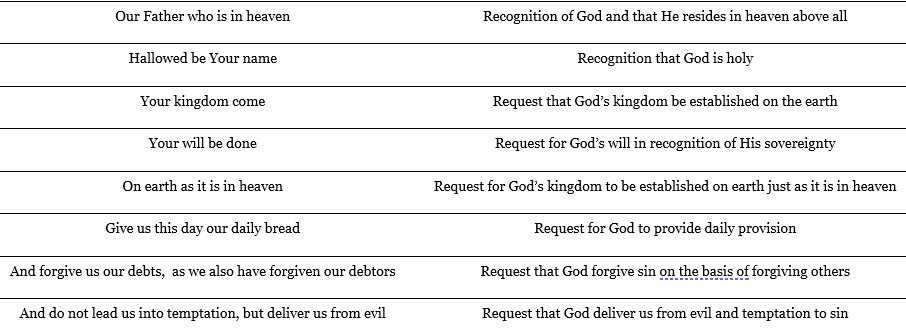
The Lord's Prayer

Matthew 6:9–13; Luke 11:1–4

Matthew 6:9–13 “Pray like this: ‘Our Father who is in heaven, Hallowed be Your name, Your kingdom come, Your will be done on earth as it is in heaven. Give us this day our daily bread and forgive us our debts, as we also have forgiven our debtors and do not lead us into temptation, but deliver us from evil. Amen.’”

Luke 11:1–4 When he finished praying in a certain place, one of his disciples said to him, “Lord, teach us to pray, just as John also taught his disciples.” He said to them, “When you pray, say, ‘Our Father in heaven, may your name be kept holy. May your Kingdom come. May your will be done on earth, as it is in heaven. Give us day by day our daily bread. Forgive us our sins, for we ourselves also forgive everyone who is indebted to us. Bring us not into temptation, but deliver us from the evil one.’”

The Story and What It Means Today:

Table explaining the Lord’s Prayer line by line: Our Father who is in heaven – recognition of God and that He resides in heaven above all; Hallowed be Your name – recognition that God is holy; Your kingdom come – request that God’s kingdom be established on the earth; Your will be done – request for God’s will in recognition of His sovereignty; On earth as it is in heaven – request for God’s kingdom to be established on earth just as it is in heaven; Give us this day our daily bread – request for God to provide daily provision; And forgive us our debts, as we also have forgiven our debtors – request that God forgive sin on the basis of forgiving others; And do not lead us into temptation, but deliver us from evil – request that God deliver us from evil and temptation to sin

Back to contents ↑

Treasures in Heaven

Matthew 6:19–21; Luke 12:33–34

Matthew 6:19–21 “Don’t lay up treasures for yourselves on the earth, where moth and rust consume, and where thieves break through and steal; but lay up for yourselves treasures in heaven, where neither moth nor rust consume, and where thieves don’t break through and steal; for where your treasure is, there your heart will be also.”

Luke 12:33–34 “Sell that which you have, and give gifts to the needy. Make for yourselves purses which don’t grow old, a treasure in the heavens that doesn’t fail, where no thief approaches, neither moth destroys. For where your treasure is, there will your heart be also.”

The Story: Jesus tells His listeners not to store up treasures for themselves on earth, where moth and rust consume and thieves break in and steal. Instead, they are to store up treasures in heaven, where nothing can destroy or take them away. He then says that where a person’s treasure is, there their heart will be also. Luke records a similar saying in connection with selling possessions and giving to the poor, and describes a purse that does not wear out and a treasure that cannot fail.

What It Means Today: The teaching asks us where our deepest investment lies. Possessions are temporary and can be lost, but what we value, serve and pursue reveals where our heart is. Treasure in heaven is stored up through love, generosity, faithfulness and justice, things that last beyond this life. Jesus does not condemn having possessions, but warns that they can quietly take control of our priorities. We are invited to examine how we use our time, money and energy, and to invest in what is truly lasting, such as caring for people and living in line with God’s will.

Back to contents ↑

You Cannot Serve God and Money

Matthew 6:24; Luke 16:13

Matthew 6:24 “No one can serve two masters, for either he will hate the one and love the other; or else he will be devoted to one and despise the other. You can’t serve both God and Mammon.”

Luke 16:13 “No servant can serve two masters, for either he will hate the one and love the other; or else he will hold to one and despise the other. You aren’t able to serve God and Mammon.”

The Story: Jesus teaches that a person cannot give wholehearted loyalty to two masters whose demands conflict. He explains that a servant will hate one and love the other, or be devoted to one and despise the other. He uses the example of God and Mammon, a word for wealth or possessions treated as the thing that rules a person’s life. Matthew places the saying within the Sermon on the Mount, and Luke follows the parable of the shrewd manager with it. The choice is about what has first place in the heart.

What It Means Today: Money is necessary for everyday life, but it should not become the measure of our worth or the thing that controls our decisions. Jesus asks us to put God first, to use what we have responsibly, and not to let the pursuit of wealth take the place of faith, compassion or generosity. The teaching invites us to consider what we are really serving: security, status, comfort or God. When God has first place, money becomes a tool for good, and we can hold it more loosely, sharing it more freely with others.

Back to contents ↑

Do Not Worry

Matthew 6:25–34; Luke 12:22–31

Matthew 6:25–34 “Therefore I tell you, don’t be anxious for your life: what you will eat, or what you will drink; nor yet for your body, what you will wear. Isn’t life more than food, and the body more than clothing? See the birds of the sky, that they don’t sow, neither do they reap, nor gather into barns. Your heavenly Father feeds them. Aren’t you of much more value than they? Which of you by being anxious, can add one moment to his lifespan? Why are you anxious about clothing? Consider the lilies of the field, how they grow. They don’t toil, neither do they spin, yet I tell you that even Solomon in all his glory was not dressed like one of these. But if God so clothes the grass of the field, which today exists and tomorrow is thrown into the oven, won’t he much more clothe you, you of little faith? Therefore don’t be anxious, saying, ‘What will we eat?’, ‘What will we drink?’ or, ‘With what will we be clothed?’ For the Gentiles seek after all these things; for your heavenly Father knows that you need all these things. But seek first God’s Kingdom and his righteousness; and all these things will be given to you as well. Therefore don’t be anxious for tomorrow, for tomorrow will be anxious for itself. Each day’s own evil is sufficient.”

Luke 12:22–31 He said to his disciples, “Therefore I tell you, don’t be anxious for your life, what you will eat, nor yet for your body, what you will wear. Life is more than food, and the body is more than clothing. Consider the ravens: they don’t sow, they don’t reap, they have no warehouse or barn, and God feeds them. How much more valuable are you than birds! Which of you by being anxious can add a cubit to his height? If then you aren’t able to do even the least things, why are you anxious about the rest? Consider the lilies, how they grow. They don’t toil, neither do they spin; yet I tell you, even Solomon in all his glory was not arrayed like one of these. But if this is how God clothes the grass in the field, which today exists and tomorrow is cast into the oven, how much more will he clothe you, O you of little faith? Don’t seek what you will eat or what you will drink; neither be anxious. For the nations of the world seek after all of these things, but your Father knows that you need these things. But seek God’s Kingdom, and all these things will be added to you.”

The Story: Jesus tells His disciples not to be anxious about their life, what they will eat or drink, or what they will wear. He points to the birds of the air, which do not sow or reap yet are fed by their heavenly Father, and to the wildflowers of the field, which are clothed more beautifully than Solomon in all his glory. He asks which of them can add anything to their life by worrying, and tells them to seek first God’s Kingdom and righteousness, trusting that these needs will be provided. He concludes by saying that each day has enough trouble of its own.

What It Means Today: Jesus is not teaching that practical planning is wrong, or that work and responsibility do not matter. He warns against allowing anxiety about the future to dominate life and crowd out trust in God. His emphasis is to seek God’s Kingdom first and deal faithfully with today. We are invited to bring our worries to a Father who knows our needs, and to focus on what is in front of us rather than being overwhelmed by what might happen. The teaching offers real comfort, though it does not remove the need for care, effort and wise choices.

Back to contents ↑
A woman reading the Bible outdoors
Reflections on the teachings of Jesus

Judge Not

Matthew 7:1–5; Luke 6:37–42

Matthew 7:1–5 “Don’t judge, so that you won’t be judged. For with whatever judgment you judge, you will be judged; and with whatever measure you measure, it will be measured to you. Why do you see the speck that is in your brother’s eye, but don’t consider the beam that is in your own eye? Or how will you tell your brother, ‘Let me remove the speck from your eye,’ and behold, the beam is in your own eye? You hypocrite! First remove the beam out of your own eye, and then you can see clearly to remove the speck out of your brother’s eye.”

Luke 6:37–42 “Don’t judge, and you won’t be judged. Don’t condemn, and you won’t be condemned. Set free, and you will be set free. Give, and it will be given to you: good measure, pressed down, shaken together, and running over, will be given to you. For with the same measure you measure it will be measured back to you.” He spoke a parable to them. “Can the blind guide the blind? Won’t they both fall into a pit? A disciple is not above his teacher, but everyone when he is fully trained will be like his teacher. Why do you see the speck of chaff that is in your brother’s eye, but don’t consider the beam that is in your own eye? Or how can you tell your brother, ‘Brother, let me remove the speck of chaff that is in your eye,’ when you yourself don’t see the beam that is in your own eye? You hypocrite! First remove the beam from your own eye, and then you can see clearly to remove the speck of chaff that is in your brother’s eye.”

The Story: In the Sermon on the Mount, Jesus tells His listeners not to judge, so that they will not be judged, because the measure they use will be used for them. He then uses the exaggerated picture of someone trying to remove a tiny speck from another person’s eye while carrying a beam in his own. He calls this hypocrisy and tells the person to take the beam out of his own eye first, so that he can see clearly to help his brother. Luke adds teachings about forgiving, giving, and the blind leading the blind.

What It Means Today: Jesus confronts hypocrisy and self-righteousness. Correction should begin with honest self-examination rather than a sense of superiority. The teaching does not mean that we can never recognise right from wrong or help others to grow; it warns against harsh, condemning attitudes that ignore our own faults. If we want mercy for ourselves, we are to offer it to others. We are invited to deal with our own failings first, to speak to others with humility and care, and to remember that God is the final judge, who sees what we cannot.

Back to contents ↑

Do Not Give What Is Holy to Dogs

Matthew 7:6

Matthew 7:6 “Don’t give that which is holy to the dogs, neither throw your pearls before the pigs, lest perhaps they trample them under their feet, and turn and tear you to pieces.”

The Story: Jesus tells His listeners not to give what is holy to dogs, and not to throw their pearls before pigs, or the animals may trample them under their feet and turn to attack them. He uses the images of holy things, pearls, dogs and pigs to teach them to treat what is sacred with care. His words warn against offering something precious where it will only be despised, trampled or met with hostility. The saying appears in the Sermon on the Mount between teaching about judging others and teaching about asking God.

What It Means Today: Jesus calls us to value what is holy and to use wisdom when sharing matters of faith. We should speak about what we believe with respect and kindness, while recognising that not everyone is ready or willing to receive it. This teaching is not permission to despise other people or to treat anyone as unworthy of love; it is a reminder to exercise discernment, patience and care. Sometimes the wisest response is to let our lives speak, to wait for a better moment, and to trust that God is also at work in people’s hearts.

Back to contents ↑

Ask, Seek and Knock

Matthew 7:7–11; Luke 11:9–13

Matthew 7:7–11 “Ask, and it will be given you. Seek, and you will find. Knock, and it will be opened for you. For everyone who asks receives. He who seeks finds. To him who knocks it will be opened. Or who is there among you who, if his son asks him for bread, will give him a stone? Or if he asks for a fish, who will give him a serpent? If you then, being evil, know how to give good gifts to your children, how much more will your Father who is in heaven give good things to those who ask him!”

Luke 11:9–13 “I tell you, keep asking, and it will be given you. Keep seeking, and you will find. Keep knocking, and it will be opened to you. For everyone who asks receives. He who seeks finds. To him who knocks it will be opened. Which of you fathers, if your son asks for bread, will give him a stone? Or if he asks for a fish, he won’t give him a snake instead of a fish, will he? Or if he asks for an egg, he won’t give him a scorpion, will he? If you then, being evil, know how to give good gifts to your children, how much more will your heavenly Father give the Holy Spirit to those who ask him?”

The Story: Jesus encourages His followers to keep asking, seeking and knocking, promising that what they ask will be given, what they seek they will find, and the door they knock on will be opened. He says that everyone who asks receives, and that the one who seeks finds. He then compares God to a father: no father would give his son a stone when he asks for bread, or a snake when he asks for a fish. If human parents know how to give good gifts, how much more will the heavenly Father give good things, or the Holy Spirit in Luke’s account, to those who ask Him.

What It Means Today: The teaching presents prayer as an active relationship with God. Persistence matters, and Jesus encourages people to approach God with trust rather than hesitation. God is not reluctant or hard to reach; He is a Father who cares for His children and gives what is good. This does not mean that we will always receive exactly what we ask for, but that we can trust His wisdom and love. We are invited to bring our needs, questions and longings to God honestly and to keep seeking Him, even when answers take time.

Back to contents ↑

The Golden Rule

Matthew 7:12; Luke 6:31

Matthew 7:12 “Therefore, whatever you desire for men to do to you, you shall also do to them; for this is the law and the prophets.”

Luke 6:31 “As you would like people to do to you, do exactly so to them.”

The Story: Jesus tells His followers to treat others as they would wish to be treated. In Matthew, He presents this as a summary of the Law and the Prophets, placing it after His teaching on asking God for good gifts. In Luke, it appears within the teaching on loving enemies and being merciful. The saying turns the focus from what others owe us to what we owe them, and it makes our own wishes a guide for how we treat everyone.

What It Means Today: This teaching asks us to consider other people’s needs and dignity before acting. It turns kindness, fairness and respect into a daily responsibility, in the home, at work, and in the way we speak about others. Because it begins with our own hopes, such as to be heard, treated honestly and shown mercy, it is easy to remember and difficult to avoid. We are invited to ask in each situation, “How would I want to be treated?” and to let the answer shape what we say and do, especially toward those who cannot repay us.

Back to contents ↑

The Narrow Gate

Matthew 7:13–14; Luke 13:23–24

Matthew 7:13–14 “Enter in by the narrow gate; for the gate is wide and the way is broad that leads to destruction, and there are many who enter in by it. How narrow is the gate and the way is restricted that leads to life! There are few who find it.”

Luke 13:23–24 Someone said to him, “Lord, are they few who are saved?” He said to them, “Strive to enter in by the narrow door, for many, I tell you, will seek to enter in, and will not be able.”

The Story: Jesus contrasts a broad road and wide gate taken by many with a narrow gate and hard road that lead to life and are found by few. He tells His listeners to enter by the narrow gate, because the wide gate and easy road lead to destruction. Luke records a similar teaching in which someone asks whether only a few will be saved, and Jesus tells them to strive to enter through the narrow door. The saying comes near the end of the Sermon on the Mount, as a call to decide how to respond to everything He has taught.

What It Means Today: Following Jesus is presented as a deliberate choice rather than simply going along with the crowd. The easiest or most popular path is not necessarily the right one, and faithfulness can require effort, humility and a willingness to be different. The teaching is not meant to frighten but to encourage clear and honest decision-making. We are invited to ask where our daily choices are leading, to resist the pull of convenience when it leads away from what is good, and to trust that the way Jesus offers leads to life.

Back to contents ↑

By Their Fruits

Matthew 7:15–20; Luke 6:43–45

Matthew 7:15–20 “Beware of false prophets, who come to you in sheep’s clothing, but inwardly are ravening wolves. By their fruits you will know them. Do you gather grapes from thorns, or figs from thistles? Even so, every good tree produces good fruit; but the corrupt tree produces evil fruit. A good tree can’t produce evil fruit, neither can a corrupt tree produce good fruit. Every tree that doesn’t grow good fruit is cut down and thrown into the fire. Therefore by their fruits you will know them.”

Luke 6:43–45 “For there is no good tree that produces rotten fruit, nor again a rotten tree that produces good fruit. For each tree is known by its own fruit. For people don’t gather figs from thorns, nor do they gather grapes from a bramble bush. The good man out of the good treasure of his heart brings out that which is good, and the evil man out of the evil treasure of his heart brings out that which is evil, for out of the abundance of the heart, his mouth speaks.”

The Story: Jesus warns His listeners to beware of false prophets who come in sheep’s clothing but are ravenous wolves inside. He tells them that they will recognise such people by their fruit. Grapes are not gathered from thorns, nor figs from thistles; a good tree bears good fruit, and a bad tree bears bad fruit. A tree that does not bear good fruit is cut down and thrown into the fire. Luke adds that a good person brings out good from the good treasure of the heart, because the mouth speaks from what fills the heart.

What It Means Today: Words and appearances can be misleading. Character is ultimately revealed by the fruit of a person’s life, which means their actions, choices and treatment of others. The teaching asks us to look carefully and patiently at the lives of those who teach or lead, and also at our own. It is not an invitation to judge harshly, but to be discerning. We are encouraged to be people who bear good fruit, such as honesty, kindness and faithfulness, by letting God shape what is within, because what is in the heart will eventually show.

Back to contents ↑

The Parable of the Wise and Foolish Builders

Matthew 7:24–27; Luke 6:46–49

Matthew 7:24–27 “Everyone therefore who hears these words of mine and does them, I will liken him to a wise man who built his house on the rock. The rain came down, the floods came, and the winds blew and beat on that house; and it didn’t fall, for it was founded on the rock. Everyone who hears these words of mine and doesn’t do them will be like a foolish man who built his house on the sand. The rain came down, the floods came, and the winds blew and beat on that house; and it fell—and its fall was great.”

Luke 6:46–49 “Why do you call me, ‘Lord, Lord,’ and don’t do the things which I say? Everyone who comes to me, and hears my words and does them, I will show you who he is like. He is like a man building a house, who dug and went deep and laid a foundation on the rock. When a flood arose, the stream broke against that house, and could not shake it, because it was founded on the rock. But he who hears and doesn’t do, is like a man who built a house on the earth without a foundation, against which the stream broke, and immediately it fell; and the ruin of that house was great.”

The Story: Jesus tells of a wise man who builds his house on rock. When the rain falls, the floods come and the winds blow and beat on the house, it does not fall, because it is founded on rock. A foolish man builds his house on sand, and when the same storm comes, it falls, and great is its fall. Jesus says that everyone who hears His words and does them is like the wise builder, while everyone who hears and does not do them is like the foolish one. Luke notes that the wise man dug deep before laying the foundation.

What It Means Today: Jesus contrasts people who hear His teaching and act on it with those who hear it but do not put it into practice. The foundation represents the choices and convictions on which a person builds their life. Storms such as loss, illness, temptation and disappointment come to everyone, and what holds firm is a life built on trust in Jesus and obedience to His word. It is not enough to admire His teaching or agree with it; it must shape what we do. We are invited to ask what our lives are really resting on, and to take practical steps to build on Him.

Back to contents ↑
Two houses in a storm: one on rock standing firm and one on sand collapsed
Reflections on the teachings of Jesus

The Cost of Following Jesus

Matthew 8:18–22; Luke 9:57–62

Matthew 8:18–22 Now when Jesus saw great multitudes around him, he gave the order to depart to the other side. A scribe came and said to him, “Teacher, I will follow you wherever you go.” Jesus said to him, “The foxes have holes and the birds of the sky have nests, but the Son of Man has nowhere to lay his head.” Another of his disciples said to him, “Lord, allow me first to go and bury my father.” But Jesus said to him, “Follow me, and leave the dead to bury their own dead.”

Luke 9:57–62 As they went on the way, a certain man said to him, “I want to follow you wherever you go.” Jesus said to him, “The foxes have holes, and the birds of the sky have nests, but the Son of Man has nowhere to lay his head.” He said to another, “Follow me!” But he said, “Lord, allow me first to go and bury my father.” But Jesus said to him, “Leave the dead to bury their own dead, but you go and announce the Kingdom of God.” Another also said, “I want to follow you, Lord, but first allow me to say goodbye to those who are at my house.” But Jesus said to him, “No one, having put his hand to the plow and looking back, is fit for God’s Kingdom.”

The Story: As Jesus prepares to continue His journey across the lake, several people speak of following Him. A scribe says he will follow Him wherever He goes, and Jesus replies that foxes have holes and the birds of the sky have nests, but the Son of Man has nowhere to lay His head. When one disciple asks to bury his father first, Jesus tells him to follow Him and leave the dead to bury their own dead. Luke also records a man who wishes to say goodbye to his family; Jesus teaches that no one who puts a hand to the plough and looks back is fit for the Kingdom of God.

What It Means Today: Jesus is not promising an easy or comfortable life to those who follow Him. He asks for a wholehearted commitment, putting God’s Kingdom first rather than allowing comfort, hesitation or competing priorities to keep us from doing what is right. His words are deliberately sharp, and they are not a rejection of family duty, but a challenge about what has first claim on our lives. They invite us to consider whether we are truly ready to live by the values we profess, and what excuses or delays may be holding us back.

Back to contents ↑

The Parable of New Cloth on an Old Garment

Matthew 9:16; Mark 2:21; Luke 5:36

Matthew 9:16 “No one puts a piece of unshrunk cloth on an old garment; for the patch would tear away from the garment, and a worse hole is made.”

Mark 2:21 “No one sews a piece of unshrunk cloth on an old garment, or else the patch shrinks and the new tears away from the old, and a worse hole is made.”

Luke 5:36 He also told a parable to them. “No one puts a piece from a new garment on an old garment, or else he will tear the new, and also the piece from the new will not match the old.”

The Story: Jesus uses the familiar example of repairing an old garment. A piece of new, unshrunk cloth is not a suitable patch for an old garment: when the new cloth changes, it can pull away and make the tear worse. Luke records Jesus explaining that a piece taken from a new garment will not match the old one. Jesus uses this picture while answering questions about why His disciples do not fast in the same way as the disciples of John and the Pharisees.

What It Means Today: Jesus is showing that His coming brings something new. His teaching cannot simply be treated as a small addition to old habits while everything else remains unchanged. Following Him calls for a genuine openness to God’s work and a willingness to let our lives be renewed. The three Gospel accounts use slightly different wording, and together they help us see the full picture of the illustration.

Back to contents ↑

The Parable of New Wine in Old Wineskins

Matthew 9:17; Mark 2:22; Luke 5:37–38

Matthew 9:17 “Neither do people put new wine into old wine skins, or else the skins would burst, and the wine be spilled, and the skins ruined. No, they put new wine into fresh wine skins, and both are preserved.”

Mark 2:22 “No one puts new wine into old wineskins; or else the new wine will burst the skins, and the wine pours out, and the skins will be destroyed; but they put new wine into fresh wineskins.”

Luke 5:37–38 “No one puts new wine into old wine skins, or else the new wine will burst the skins, and it will be spilled, and the skins will be destroyed. But new wine must be put into fresh wine skins, and both are preserved.”

The Story: Jesus describes what happens when new wine is put into old wineskins. As the wine ferments and expands, the old skins cannot contain it and may burst, spilling the wine and ruining the skins. New wine therefore needs fresh wineskins, and both are preserved. Matthew, Mark and Luke each record this illustration, with slightly different wording. Jesus gives it while responding to questions about why His disciples do not fast in the same way as others, and He pairs it with the picture of a patch of new cloth sewn onto an old garment.

What It Means Today: Jesus uses this picture to show that His coming brings something new that cannot simply be contained within old, rigid patterns. Following Him calls for an openness to renewal and a willingness to let God change the way we think and live. The teaching does not dismiss what is old; it recognises that God’s new work needs space to grow. We are invited to ask where we may be resisting change out of habit, and to welcome the fresh life that Jesus brings. The three Gospel accounts complement one another and help us appreciate the full illustration.

Back to contents ↑
An open book glowing in the darkness
Reflections on the teachings of Jesus

The Harvest Is Plentiful, but the Workers Are Few

Matthew 9:37–38; Luke 10:2

Matthew 9:37–38 Then he said to his disciples, “The harvest indeed is plentiful, but the laborers are few. Pray therefore that the Lord of the harvest will send out laborers into his harvest.”

Luke 10:2 Then he said to them, “The harvest is indeed plentiful, but the laborers are few. Pray therefore to the Lord of the harvest, that he may send out laborers into his harvest.”

The Story: In Matthew, Jesus looks at the crowds with compassion because they are distressed and scattered, like sheep without a shepherd. He tells His disciples that the harvest is plentiful but the workers are few, and asks them to pray that the Lord of the harvest will send workers. In Luke, Jesus gives the same instruction as He sends out a larger group of disciples ahead of Him to the towns and places He intends to visit. Both accounts show that many people are ready to hear God’s message, and that there is a need for people willing to share it.

What It Means Today: Jesus reminds us that there are many people who need hope, guidance and the Good News, but sharing that message requires willing hearts and hands. His first instruction is to pray: to ask God to raise up people who will serve, teach, encourage and care for others. The teaching also invites each of us to consider how we might take part in that work through our words, actions and compassion.

Back to contents ↑

Acknowledging Jesus Before Others

Matthew 10:32–33; Luke 12:8–9

Matthew 10:32–33 Everyone therefore who confesses me before men, I will also confess him before my Father who is in heaven. But whoever denies me before men, I will also deny him before my Father who is in heaven.

Luke 12:8–9 I tell you, everyone who confesses me before men, the Son of Man will also confess before the angels of God; but he who denies me in the presence of men will be denied in the presence of God’s angels.

The Story: Jesus tells His disciples that their relationship with Him must be acknowledged openly. Everyone who confesses Him before others will be acknowledged by Him before His Father in heaven, and before the angels of God in Luke’s account. But whoever denies Him before others will be denied before the Father. He speaks these words as He prepares His disciples to go out and teach, and as He warns them that following Him may bring opposition. His promise is as serious as His warning: what we do with Him now has lasting consequences.

What It Means Today: This teaching calls us to live our faith honestly and courageously, not hiding our belief in Jesus when it is difficult or unpopular. Acknowledging Him means more than speaking His name; it means allowing His teachings to shape our choices, our words and the way we treat others. The passage is a promise as well as a warning: Jesus stands by those who stand with Him. We can ask for the courage to remain faithful while showing respect and kindness to those who believe differently.

Back to contents ↑

Children in the Marketplace

Matthew 11:16–19; Luke 7:31–35

Matthew 11:16–19 “But to what shall I compare this generation? It is like children sitting in the marketplaces, who call to their companions and say, ‘We played the flute for you, and you didn’t dance. We mourned for you, and you didn’t lament.’ For John came neither eating nor drinking, and they say, ‘He has a demon.’ The Son of Man came eating and drinking, and they say, ‘Behold, a gluttonous man and a drunkard, a friend of tax collectors and sinners!’ But wisdom is justified by her children.”

Luke 7:31–35 “To what then should I compare the people of this generation? What are they like? They are like children who sit in the marketplace and call to one another, saying, ‘We piped to you, and you didn’t dance. We mourned, and you didn’t weep.’ For John the Baptizer came neither eating bread nor drinking wine, and you say, ‘He has a demon.’ The Son of Man has come eating and drinking, and you say, ‘Behold, a glutton and a drunkard, a friend of tax collectors and sinners!’ Wisdom is justified by all her children.”

The Story: Jesus compares the people of His generation to children in a marketplace who complain that their companions will not join in either a joyful game or a sad one. He uses this picture to describe people who refuse to respond to God’s message. John the Baptizer lived simply and abstained from ordinary food and drink, and people accused him of having a demon. Jesus came eating and drinking with others, and they criticised Him as a glutton and a friend of sinners. Whatever approach God’s messengers took, some people found an excuse to reject them.

What It Means Today: This teaching warns us against finding excuses to dismiss a message simply because we dislike the person or the way it is delivered. The people criticised John for being too austere and Jesus for being too welcoming. Their changing objections revealed closed minds rather than a genuine search for truth. Jesus invites us to look honestly at the wisdom and goodness of a message instead of judging it by our own expectations or prejudices.

Back to contents ↑

Come to Me, All Who Labour and Are Overburdened

Matthew 11:28–30

Matthew 11:28–30 “Come to me, all you who labor and are heavily burdened, and I will give you rest. Take my yoke upon you and learn from me, for I am gentle and humble in heart; and you will find rest for your souls. For my yoke is easy, and my burden is light.”

The Story: Jesus invites those who are weary and carrying heavy burdens to come to Him and receive rest. He asks them to take His yoke upon themselves and learn from Him, describing Himself as gentle and humble in heart. A yoke was a wooden frame that joined animals, or people, so that they could share a load. In this image, Jesus offers not simply relief from tiredness, but a different way of living under His guidance, and He says that His yoke is easy and His burden is light.

What It Means Today: These words offer comfort to anyone who feels overwhelmed, anxious or weighed down by life’s responsibilities. Jesus does not promise that life will be free of difficulties; He invites us to bring our burdens to Him, learn from His gentleness and humility, and trust Him to walk with us. His way is not meant to crush us, but to give our souls rest. We are invited to stop carrying everything alone, to take time to be with Him, and to find strength for each day in His company.

Back to contents ↑
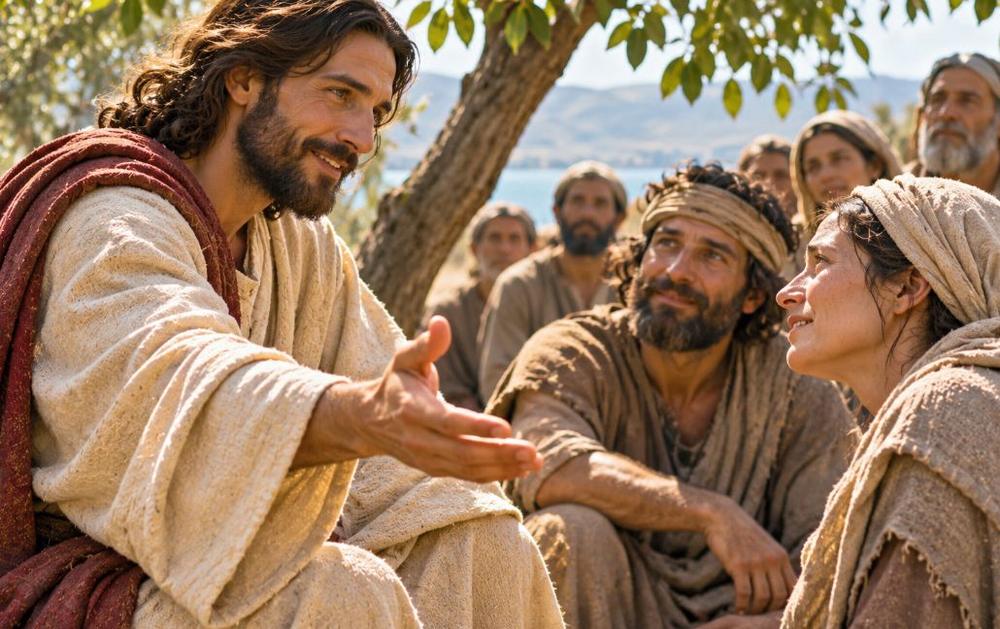
Jesus speaking kindly with weary people seated under an olive tree by the Sea of Galilee
Reflections on the teachings of Jesus

The Parable of the Strong Man

Matthew 12:29; Mark 3:23–27; Luke 11:21–22

Matthew 12:29 “Or how can one enter into the house of the strong man and plunder his goods, unless he first bind the strong man? Then he will plunder his house.”

Mark 3:23–27 He summoned them and said to them in parables, “How can Satan cast out Satan? If a kingdom is divided against itself, that kingdom cannot stand. If a house is divided against itself, that house cannot stand. If Satan has risen up against himself, and is divided, he can’t stand, but has an end. But no one can enter into the house of the strong man to plunder unless he first binds the strong man; then he will plunder his house.”

Luke 11:21–22 “When the strong man, fully armed, guards his own dwelling, his goods are safe. But when someone stronger attacks him and overcomes him, he takes from him his whole armor in which he trusted, and divides his plunder.”

The Story: Jesus gives this illustration after some people accuse Him of casting out demons by the power of Beelzebul, the ruler of demons. He first points out that a kingdom or household divided against itself cannot stand. He then describes a strong man guarding his house: his possessions cannot be taken until someone stronger overpowers and binds him. Matthew records the image briefly; Mark includes the surrounding argument about a divided kingdom, while Luke describes the strong man fully armed and the stronger attacker who takes away his armour and divides the spoils.

What It Means Today: Jesus is showing that His works of freeing people from evil are not evidence that He is working with evil. They reveal that God’s power is confronting and overcoming it. The strong man represents the power that holds people captive, while the one who is stronger points to Jesus and His authority. The three accounts together make the message clearer: Jesus has come not to cooperate with evil, but to defeat its power and set people free.

Back to contents ↑

The Sign of Jonah

Matthew 12:38–42; Luke 11:29–32

Matthew 12:38–42 Then certain of the scribes and Pharisees answered, “Teacher, we want to see a sign from you.” But he answered them, “An evil and adulterous generation seeks after a sign, but no sign will be given to it but the sign of Jonah the prophet. For as Jonah was three days and three nights in the belly of the huge fish, so will the Son of Man be three days and three nights in the heart of the earth. The men of Nineveh will stand up in the judgment with this generation and will condemn it, for they repented at the preaching of Jonah; and behold, someone greater than Jonah is here. The Queen of the South will rise up in the judgment with this generation and will condemn it, for she came from the ends of the earth to hear the wisdom of Solomon; and behold, someone greater than Solomon is here.”

Luke 11:29–32 When the multitudes were gathering together to him, he began to say, “This is an evil generation. It seeks after a sign. No sign will be given to it but the sign of Jonah the prophet. For even as Jonah became a sign to the Ninevites, so the Son of Man will also be to this generation. The Queen of the South will rise up in the judgment with the men of this generation and will condemn them, for she came from the ends of the earth to hear the wisdom of Solomon; and behold, one greater than Solomon is here. The men of Nineveh will stand up in the judgment with this generation, and will condemn it, for they repented at the preaching of Jonah; and behold, one greater than Jonah is here.”

The Story: Some of the scribes and Pharisees ask Jesus to show them a sign. He replies that they will be given no sign except the sign of Jonah. Just as Jonah’s experience became a sign to the people of Nineveh, the Son of Man will be a sign to His generation. Jesus points to the people of Nineveh, who repented when Jonah preached to them, and to the Queen of the South, who travelled a great distance to hear Solomon’s wisdom. He says that someone greater than Jonah and Solomon is now among them.

What It Means Today: Jesus challenges people who keep demanding proof while refusing to respond to the truth already placed before them. The people of Nineveh listened and changed their lives; the Queen of the South made a great effort to seek wisdom. Jesus calls us to respond with that same openness and willingness to change. For Christians, the sign of Jonah also points towards Jesus’ death and resurrection, as He explains through the image of three days and three nights in the heart of the earth.

Back to contents ↑

The Return of the Unclean Spirit

Matthew 12:43–45; Luke 11:24–26

Matthew 12:43–45 “When an unclean spirit has gone out of a man, he passes through waterless places seeking rest, and doesn’t find it. Then he says, ‘I will return into my house from which I came;’ and when he has come back, he finds it empty, swept, and put in order. Then he goes and takes with himself seven other spirits more evil than he is, and they enter in and dwell there. The last state of that man becomes worse than the first. Even so will it be also to this evil generation.”

Luke 11:24–26 “The unclean spirit, when he has gone out of the man, passes through dry places, seeking rest; and finding none, he says, ‘I will turn back to my house from which I came out.’ When he returns, he finds it swept and put in order. Then he goes and takes seven other spirits more evil than himself, and they enter in and dwell there. The last state of that man becomes worse than the first.”

The Story: Jesus describes an unclean spirit leaving a person and wandering through dry or waterless places in search of rest. Finding none, it decides to return to the place it left. It finds the house swept and put in order, but empty. The spirit then brings seven others more evil than itself, and they all take up residence there. Jesus concludes that the person’s final condition is worse than before. In Matthew, He applies the warning to that generation; Luke records the same image in the surrounding teaching about the power of evil and the need to respond to God.

What It Means Today: This teaching warns that it is not enough simply to turn away from something harmful; our lives also need to be filled with what is good. A lasting change requires more than an empty space where an old habit or influence once stood. We need to welcome God’s presence, listen to His word and put Jesus’ teaching into practice. The passage is a serious warning against leaving our inner lives unattended after making a change. Back to contents ↑

Who Are My Mother and Brothers?

Matthew 12:46–50; Mark 3:31–35; Luke 8:19–21

Matthew 12:46–50 While he was yet speaking to the multitudes, behold, his mother and his brothers stood outside, seeking to speak to him. One said to him, “Behold, your mother and your brothers stand outside, seeking to speak to you.” But he answered him who spoke to him, “Who is my mother? Who are my brothers?” He stretched out his hand toward his disciples, and said, “Behold, my mother and my brothers! For whoever does the will of my Father who is in heaven, he is my brother, and sister, and mother.”

Mark 3:31–35 His mother and his brothers came, and standing outside, they sent to him, calling him. A multitude was sitting around him, and they told him, “Behold, your mother, your brothers, and your sisters are outside looking for you.” He answered them, “Who are my mother and my brothers?” Looking around at those who sat around him, he said, “Behold, my mother and my brothers! For whoever does the will of God is my brother, my sister, and mother.”

Luke 8:19–21 His mother and brothers came to him, and they could not come near him for the crowd. It was told him by some saying, “Your mother and your brothers stand outside, desiring to see you.” But he answered them, “My mother and my brothers are these who hear the word of God, and do it.”

The Story: While Jesus was teaching a crowd, His mother and brothers came and waited outside because they could not reach Him through the people. When someone told Jesus that they were there and wanted to see Him, He asked, “Who is my mother and who are my brothers?” Then He looked toward His disciples and explained that His true family includes everyone who hears God’s word and does the will of His Father in heaven. In Luke’s account, He says that those who hear God’s word and do it are His mother and brothers.

What It Means Today: Jesus is not dismissing the importance of His mother or family. He is showing that belonging to God’s family is not limited by blood or background. Anyone who listens to God’s word and puts it into practice can belong to this wider family. Faith is shown not only by what we hear or say, but by how we live. The teaching invites us to welcome others into the community of faith, and to hold our human loyalties in light of our first loyalty to God and the people who share it.

Back to contents ↑

The Parable of the Sower

Matthew 13:1–23; Mark 4:1–20; Luke 8:4–15

Matthew 13:1–23 On that day Jesus went out of the house and sat by the seaside. Great multitudes gathered to him, so that he entered into a boat and sat; and all the multitude stood on the beach. He spoke to them many things in parables, saying, “Behold, a farmer went out to sow. As he sowed, some seeds fell by the roadside, and the birds came and devoured them. Others fell on rocky ground, where they didn’t have much soil, and immediately they sprang up, because they had no depth of earth. When the sun had risen, they were scorched. Because they had no root, they withered away. Others fell among thorns. The thorns grew up and choked them. Others fell on good soil, and yielded fruit: some one hundred times as much, some sixty, and some thirty. He who has ears to hear, let him hear.”

The disciples came, and said to him, “Why do you speak to them in parables?” He answered them, “To you it is given to know the mysteries of the Kingdom of Heaven, but it is not given to them. For whoever has, to him will be given, and he will have abundance, but whoever doesn’t have, from him will be taken away even that which he has. Therefore I speak to them in parables, because seeing they don’t see, and hearing they don’t hear, neither do they understand. In them the prophecy of Isaiah is fulfilled, which says, ‘By hearing you will hear, and will in no way understand; seeing you will see, and will in no way perceive: for this people’s heart has grown callous, their ears are dull of hearing, they have closed their eyes; or else perhaps they might perceive with their eyes, hear with their ears, understand with their heart, and would turn again, and I would heal them.’ But blessed are your eyes, for they see; and your ears, for they hear. For most certainly I tell you that many prophets and righteous men desired to see the things which you see, and didn’t see them; and to hear the things which you hear, and didn’t hear them.”

“Hear, then, the parable of the farmer. When anyone hears the word of the Kingdom and doesn’t understand it, the evil one comes and snatches away that which has been sown in his heart. This is what was sown by the roadside. What was sown on the rocky places, this is he who hears the word and immediately with joy receives it; yet he has no root in himself, but endures for a while. When oppression or persecution arises because of the word, immediately he stumbles. What was sown among the thorns, this is he who hears the word, but the cares of this age and the deceitfulness of riches choke the word, and he becomes unfruitful. What was sown on the good ground, this is he who hears the word and understands it, who most certainly bears fruit and produces, some one hundred times as much, some sixty, and some thirty.”

Mark 4:1–20 Again he began to teach by the seaside. A great multitude was gathered to him, so that he entered into a boat in the sea and sat down. All the multitude were on the land by the sea. He taught them many things in parables, and told them in his teaching, “Listen! Behold, the farmer went out to sow. As he sowed, some seed fell by the road, and the birds came and devoured it. Others fell on the rocky ground, where it had little soil, and immediately it sprang up, because it had no depth of soil. When the sun had risen, it was scorched; and because it had no root, it withered away. Others fell among the thorns, and the thorns grew up and choked it, and it yielded no fruit. Others fell into the good ground and yielded fruit, growing up and increasing. Some produced thirty times, some sixty, and some one hundred times as much.” He said, “Whoever has ears to hear, let him hear.”

When he was alone, those who were around him with the twelve asked him about the parables. He said to them, “To you is given the mystery of God’s Kingdom, but to those who are outside, all things are done in parables, that ‘seeing they may see and not perceive, and hearing they may hear and not understand, lest perhaps they should turn again, and their sins should be forgiven them.’” He said to them, “Don’t you understand this parable? How will you understand all of the parables? The farmer sows the word. The ones by the road are the ones where the word is sown; and when they have heard, immediately Satan comes and takes away the word which has been sown in them. These in the same way are those who are sown on the rocky places, who, when they have heard the word, immediately receive it with joy. They have no root in themselves, but are short-lived. When oppression or persecution arises because of the word, immediately they stumble. Others are those who are sown among the thorns. These are those who have heard the word, and the cares of this age, and the deceitfulness of riches, and the lusts of other things entering in choke the word, and it becomes unfruitful. Those which were sown on the good ground are those who hear the word, accept it, and bear fruit, some thirty times, some sixty, and some one hundred times.”

Luke 8:4–15 When a great multitude came together and people from every city were coming to him, he spoke by a parable: “The farmer went out to sow his seed. As he sowed, some fell along the road, and it was trampled under foot, and the birds of the sky devoured it. Some seed fell on the rock, and as soon as it grew, it withered away, because it had no moisture. Some fell amid the thorns, and the thorns grew with it and choked it. Some fell into the good ground and grew and produced one hundred times as much fruit.” As he said these things, he called out, “He who has ears to hear, let him hear!”

Then his disciples asked him what this parable meant. He said, “To you it is given to know the mysteries of God’s Kingdom, but to the rest it is given in parables, that ‘seeing they may not see, and hearing they may not understand.’ Now the parable is this: The seed is the word of God. Those along the road are those who hear; then the devil comes and takes away the word from their heart, that they may not believe and be saved. Those on the rock are they who, when they hear, receive the word with joy; but these have no root. They believe for a while, then fall away in time of temptation. What fell among the thorns, these are those who have heard, and as they go on their way are choked with cares, riches, and pleasures of life, and they bring no fruit to maturity. Those in the good ground, these are those who, with an honest and good heart, having heard the word, hold it tightly, and produce fruit with patience.”

The Story: A farmer goes out to sow and scatters seed on four types of ground. Some falls on a hard path, where birds eat it; some on rocky soil, where it springs up quickly but withers in the sun for lack of roots; some among thorns, which grow up and choke it; and some on good soil, where it produces a harvest, thirty, sixty or a hundred times what was sown. Jesus ends with the call, “He who has ears to hear, let him hear.” When His disciples ask what it means, He explains that the seed is the word of God and the soils are different ways in which people receive it.

What It Means Today: Jesus is describing different ways people respond to the message of God’s Kingdom. Some hear it without understanding, some receive it with joy but give up when trouble comes, and some let worries and the pursuit of wealth crowd it out, while others hear, understand and bear fruit. The teaching asks us to consider what kind of soil we are becoming: whether the message is quickly lost, crowded out, or allowed to take root. It invites us to listen carefully, to protect what we have received, and to let God’s word shape our lives until it bears lasting fruit.

Back to contents ↑
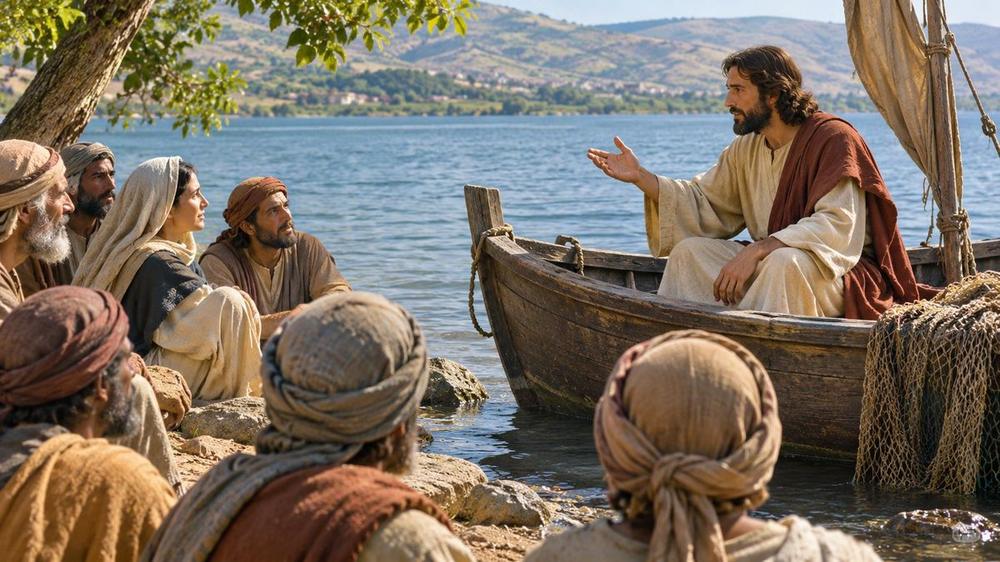
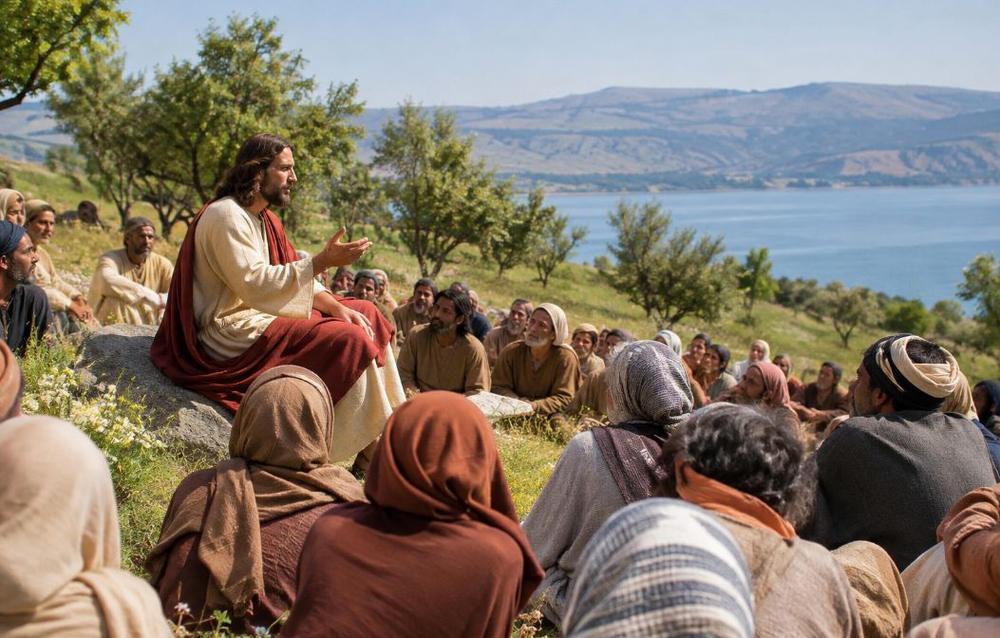
Jesus teaching his disciples and a crowd from a fishing boat on the Sea of Galilee
Reflections on the teachings of Jesus

The Parable of the Weeds (Tares)

Matthew 13:24–30, 36–43

Matthew 13:24–30 He set another parable before them, saying, “The Kingdom of Heaven is like a man who sowed good seed in his field, but while people slept, his enemy came and sowed darnel weeds also among the wheat, and went away. But when the blade sprang up and produced grain, then the darnel weeds appeared also. The servants of the householder came and said to him, ‘Sir, didn’t you sow good seed in your field? Where did these darnel weeds come from?’ He said to them, ‘An enemy has done this.’ The servants asked him, ‘Do you want us to go and gather them up?’ But he said, ‘No, lest perhaps while you gather up the darnel weeds, you root up the wheat with them. Let both grow together until the harvest, and in the harvest time I will tell the reapers, “First, gather up the darnel weeds, and bind them in bundles to burn them; but gather the wheat into my barn.”’”

Matthew 13:36–43 Then Jesus sent the multitudes away, and went into the house. His disciples came to him, saying, “Explain to us the parable of the darnel weeds of the field.” He answered them, “He who sows the good seed is the Son of Man, the field is the world, the good seeds are the children of the Kingdom, and the darnel weeds are the children of the evil one. The enemy who sowed them is the devil. The harvest is the end of the age, and the reapers are angels. As therefore the darnel weeds are gathered up and burned with fire; so will it be at the end of this age. The Son of Man will send out his angels, and they will gather out of his Kingdom all things that cause stumbling and those who do iniquity, and will cast them into the furnace of fire. There will be weeping and gnashing of teeth. Then the righteous will shine like the sun in the Kingdom of their Father. He who has ears to hear, let him hear.”

The Story: A farmer sows good seed in his field, but while people sleep an enemy secretly scatters weeds among the wheat. When both begin to grow, the farmer’s servants ask whether they should pull the weeds out. He tells them not to, because they might uproot the wheat as well, and says that both should grow together until the harvest. At harvest time, the weeds will be gathered and burned, and the wheat will be brought into the barn. Later, Jesus explains to His disciples that the field is the world, the good seed are the people of the Kingdom, and the harvest is the end of the age.

What It Means Today: Jesus teaches that good and evil may exist side by side for a time, and that we cannot always tell them apart with certainty. Final judgement belongs to God, who sees clearly and will bring things to their proper conclusion. The parable calls us to patience rather than to hasty condemnation of others. It also offers reassurance that evil will not have the last word, and that those who belong to God will shine in His Kingdom. We are invited to focus on living faithfully, trusting God’s timing and justice rather than taking judgement into our own hands.

Back to contents ↑

The Parable of the Mustard Seed

Matthew 13:31–32; Mark 4:30–32; Luke 13:18–19

Matthew 13:31–32 He set another parable before them, saying, “The Kingdom of Heaven is like a grain of mustard seed which a man took, and sowed in his field, which indeed is smaller than all seeds. But when it is grown, it is greater than the herbs and becomes a tree, so that the birds of the air come and lodge in its branches.”

Mark 4:30–32 He said, “How will we liken God’s Kingdom? Or with what parable will we illustrate it? It’s like a grain of mustard seed, which, when it is sown in the earth, though it is less than all the seeds that are on the earth, yet when it is sown, grows up, and becomes greater than all the herbs, and puts out great branches, so that the birds of the sky can lodge under its shadow.”

Luke 13:18–19 He said, “What is God’s Kingdom like? To what shall I compare it? It is like a grain of mustard seed which a man took and put in his own garden. It grew and became a large tree, and the birds of the sky lived in its branches.”

The Story: A man takes a tiny mustard seed and sows it in his field. It is the smallest of all seeds, but when it has grown it becomes the greatest of the garden plants, even a tree, so that the birds of the sky come and find shelter in its branches. Jesus tells this parable to describe the Kingdom of Heaven. Those who heard it would have known how small the seed is and how large the plant becomes.

What It Means Today: Jesus shows that God’s Kingdom can begin in a way that seems small and insignificant, yet grow into something far greater than anyone could imagine. Small acts of faith, kindness or courage can likewise have a lasting effect, even when we cannot see the results. The image of birds finding shelter suggests that the Kingdom is a place of welcome and refuge for many people. We are encouraged not to despise small beginnings, to be faithful with what is in front of us, and to trust God to bring about growth in His own time.

Back to contents ↑

The Parable of the Yeast

Matthew 13:33; Luke 13:20–21

Matthew 13:33 He spoke another parable to them. “The Kingdom of Heaven is like yeast, which a woman took, and hid in three measures of flour, until it was all leavened.”

Luke 13:20–21 Again he said, “To what shall I compare God’s Kingdom? It is like yeast, which a woman took and hid in three measures of flour, until it was all leavened.”

The Story: Jesus compares the Kingdom of Heaven to yeast that a woman takes and hides in three measures of flour, until the whole batch of dough is leavened. The amount of flour is large, enough to feed many people, while the yeast is small and hidden. The change happens gradually, from within, as the yeast works through the whole dough. Jesus gives no further explanation, leaving the listener to consider what the picture reveals about God’s Kingdom.

What It Means Today: God’s Kingdom can begin quietly and almost unnoticed, yet work through people and communities until its influence becomes far-reaching. Real change often happens slowly and from within, through patient faithfulness rather than dramatic displays. The parable encourages us not to measure the value of our witness by how visible it is. Ordinary kindness, honesty and prayer can influence families, workplaces and communities in ways we may never see. It also invites us to let God’s work transform our own lives from the inside out, so that His influence reaches every part of us.

Back to contents ↑

The Parable of the Hidden Treasure

Matthew 13:44

Matthew 13:44 “Again, the Kingdom of Heaven is like a treasure hidden in the field, which a man found and hid. In his joy, he goes and sells all that he has, and buys that field.”

The Story: A man discovers treasure hidden in a field. He hides it again, and in his joy goes and sells everything he has in order to buy that field. Jesus tells the parable briefly, without explaining it, and compares the Kingdom of Heaven to this treasure. The man’s actions show how highly he values what he has found, since he gives up everything else to possess it.

What It Means Today: Jesus teaches that the Kingdom of Heaven is worth more than anything else. Recognising its value changes our priorities and makes wholehearted commitment worthwhile. The man acts out of joy, not reluctant duty, suggesting that following God is not meant to be a grim sacrifice but a response to something wonderful. We are invited to ask what we are most ready to give up for what truly matters, and whether we treat God’s Kingdom as a treasure or an afterthought. What we give up is small compared with what we gain.

Back to contents ↑

The Parable of the Pearl of Great Price

Matthew 13:45–46

Matthew 13:45–46 “Again, the Kingdom of Heaven is like a merchant seeking fine pearls, who, having found one pearl of great price, went and sold all that he had, and bought it.”

The Story: A merchant searching for fine pearls finds one of extraordinary value. He goes away and sells everything he has so that he can buy it. Jesus tells this parable straight after the story of the hidden treasure, and again compares the Kingdom of Heaven to what the person discovers. Unlike the man who stumbles upon treasure, the merchant has been actively searching, and he recognises the worth of the pearl as soon as he sees it.

What It Means Today: Jesus shows that discovering the true value of God’s Kingdom calls for a wholehearted response. Nothing we possess compares with it. Some people find God’s Kingdom unexpectedly, and others find it after a long search, but in both cases the response is the same: to give ourselves fully to it. The parable invites us to examine our own search, to ask what we have been seeking, and to consider whether we have recognised the pearl. It also encourages us to hold our possessions, plans and achievements more loosely, so that nothing hinders us from receiving what matters most.

Back to contents ↑
A pearl resting in an oyster shell
Reflections on the teachings of Jesus

The Parable of the Dragnet

Matthew 13:47–50

Matthew 13:47–50 “Again, the Kingdom of Heaven is like a dragnet that was cast into the sea and gathered some fish of every kind, which, when it was filled, they drew up on the beach. They sat down and gathered the good into containers, but the bad they threw away. So it will be in the end of the age. The angels will come forth and separate the wicked from among the righteous, and will cast them into the furnace of fire. There will be weeping and gnashing of teeth.”

The Story: Jesus compares the Kingdom of Heaven to a net cast into the sea that gathers fish of every kind. When it is full, the fishermen draw it up on the shore, sit down and sort the catch, gathering the good fish into containers and throwing away those that are unsuitable. Jesus explains that it will be like this at the end of the age, when the angels will separate the wicked from the righteous. The parable closes with a warning about judgement.

What It Means Today: Jesus uses the sorting of the catch to speak about the final judgement. The invitation of God’s Kingdom is wide, and many are gathered in, but our lives and choices matter. The parable reminds us that God’s Kingdom is not only a place of welcome but also one of justice, where good and evil are finally distinguished. We are not asked to do the sorting ourselves; that belongs to God. We are invited to respond to the invitation sincerely, to live faithfully, and to be open to the change God wants to bring about in us before the end.

Back to contents ↑

The Householder Bringing Out Treasures New and Old

Matthew 13:51–52

Matthew 13:51–52 Jesus said to them, “Have you understood all these things?” They answered him, “Yes, Lord.” He said to them, “Therefore every scribe who has been made a disciple in the Kingdom of Heaven is like a man who is a householder, who brings out of his treasure things new and old.”

The Story: Jesus asks His disciples whether they have understood all the parables He has been teaching. When they answer yes, He tells them that every scribe who has been trained for the Kingdom of Heaven is like a householder who brings out of his treasure things new and old. The saying draws together the parables of the Kingdom He has just told. A teacher or disciple who understands these things does not discard what God has already given, but also shares what is newly revealed.

What It Means Today: A true understanding of Jesus’ teaching draws on the wisdom already received while remaining open to the new life and understanding brought by God’s Kingdom. Both the old and the new are valuable, and each helps explain the other. We are called to value and share the riches of that teaching, rather than hoarding it or treating it as a finished subject. The householder pictures someone who has learned from Scripture, tradition and experience, and who can offer others something fresh, helpful and generous from that treasury.

Back to contents ↑

What Defiles a Person

Matthew 15:10–20; Mark 7:14–23

Matthew 15:10–20 He summoned the multitude, and said to them, “Hear, and understand. That which enters into the mouth doesn’t defile the man; but that which proceeds out of the mouth, this defiles the man.” Then the disciples came and said to him, “Do you know that the Pharisees were offended when they heard this saying?” But he answered, “Every plant which my heavenly Father didn’t plant will be uprooted. Leave them alone. They are blind guides of the blind. If the blind guide the blind, both will fall into a pit.” Peter answered him, “Explain the parable to us.” So Jesus said, “Do you also still not understand? Don’t you understand that whatever goes into the mouth passes into the belly and then out of the body? But the things which proceed out of the mouth come out of the heart, and they defile the man. For out of the heart come evil thoughts, murders, adulteries, sexual sins, thefts, false testimony, and blasphemies. These are the things which defile the man; but to eat with unwashed hands doesn’t defile the man.”

Mark 7:14–23 He called all the multitude to himself and said to them, “Hear me, all of you, and understand. There is nothing from outside of the man that going into him can defile him; but the things which proceed out of the man are those that defile the man. If anyone has ears to hear, let him hear!” When he had entered into a house away from the multitude, his disciples asked him about the parable. He said to them, “Are you also without understanding? Don’t you perceive that whatever goes into the man from outside can’t defile him, because it doesn’t go into his heart, but into his stomach, then into the latrine, making all foods clean?” He said, “That which proceeds out of the man, that defiles the man. For from within, out of the hearts of men, proceed evil thoughts, adulteries, sexual sins, murders, thefts, covetings, wickedness, deceit, lustful desires, an evil eye, blasphemy, pride, and foolishness. All these evil things come from within and defile the man.”

The Story: Some Pharisees and scribes criticise Jesus’ disciples for eating without washing their hands according to tradition. Jesus calls the crowd to Him and tells them that it is not what goes into the mouth that makes a person unclean, but what comes out. When the disciples ask Him to explain, He says that what comes out of the mouth comes from the heart, and lists evil thoughts, murder, adultery, sexual immorality, theft, false testimony and slander. These, He says, are what defile a person, not eating with unwashed hands.

What It Means Today: Jesus directs attention to the source of our behaviour. External appearances and rules are not enough if the heart remains unchanged. The teaching calls for honest examination of our motives, thoughts and choices. It also challenges us not to place more weight on religious customs than on mercy, honesty and love. Cleanliness before God is a matter of the heart. We are invited to ask God to change what is within us, so that our words and actions come from goodness rather than from bitterness, pride or selfishness.

Back to contents ↑

Blind Leading the Blind

Matthew 15:14; Luke 6:39

Matthew 15:14 “Leave them alone. They are blind guides of the blind. If the blind guide the blind, both will fall into a pit.”

Luke 6:39 He spoke a parable to them. “Can the blind guide the blind? Won’t they both fall into a pit?”

The Story: Jesus warns His listeners about following leaders who cannot see clearly themselves. He compares them to blind guides: if a blind person tries to lead another blind person, both will fall into a pit. In Matthew, Jesus says this after the Pharisees take offence at His teaching, telling His disciples to leave them alone and describing them as blind guides. In Luke, He gives the saying within His teaching on judging others and asks whether a blind person can guide another. The warning applies to anyone who guides others without understanding the way.

What It Means Today: We should be careful about whom we trust to guide us. A person cannot lead others wisely without understanding and living by the truth. Jesus also calls us to examine our own understanding and conduct before trying to correct or direct someone else. The warning applies to parents, teachers, leaders and friends, and invites us to seek wisdom humbly, listen to Jesus’ teaching, and learn from people whose lives show good fruit. It reminds us that guidance is a serious responsibility, and that sound judgement begins with honest self-awareness.

Back to contents ↑

Take Up Your Cross

Matthew 16:24–26; Mark 8:34–38; Luke 9:23–25

Matthew 16:24–26 Then Jesus said to his disciples, “If anyone desires to come after me, let him deny himself, take up his cross, and follow me. For whoever desires to save his life will lose it, and whoever will lose his life for my sake will find it. For what will it profit a man if he gains the whole world and forfeits his life? Or what will a man give in exchange for his life?”

Mark 8:34–38 He called the multitude to himself with his disciples, and said to them, “Whoever wants to come after me, let him deny himself, take up his cross, and follow me. For whoever wants to save his life will lose it; and whoever will lose his life for my sake and the Good News’s will save it. For what does it profit a man to gain the whole world and forfeit his life? For what will a man give in exchange for his life? For whoever will be ashamed of me and of my words in this adulterous and sinful generation, the Son of Man also will be ashamed of him when he comes in the glory of his Father with the holy angels.”

Luke 9:23–25 He said to all, “If anyone desires to come after me, let him deny himself, take up his cross daily, and follow me. For whoever desires to save his life will lose it, but whoever will lose his life for my sake, the same will save it. For what does it profit a man if he gains the whole world, and loses or forfeits his own self?”

The Story: Jesus tells His disciples that if anyone wants to follow Him, they must deny themselves, take up their cross and follow Him. He says that whoever wants to save their life will lose it, but whoever loses their life for His sake will find it. He then asks what profit there is in gaining the whole world but losing one’s soul, or what a person could give in exchange for it. Mark and Luke add a warning about being ashamed of Jesus and His words. Jesus speaks these words after Peter has just recognised Him as the Christ.

What It Means Today: Following Jesus is more than agreeing with His words. It means allowing His way of life to shape our choices, even when obedience is difficult or costly. Taking up the cross is not about seeking suffering, but about being willing to put God’s will above personal comfort, status and ambition. The teaching asks what we are really living for, and invites us to trust that a life given to Christ is not wasted. The paradox is that those who lose their lives for His sake find the life that matters most.

Back to contents ↑
Jesus carrying a cross and turning to the people following him
Reflections on the teachings of Jesus

Becoming Like Little Children

Matthew 18:1–5; Mark 9:33–37; Luke 9:46–48

Matthew 18:1–5 In that hour the disciples came to Jesus, saying, “Who then is greatest in the Kingdom of Heaven?” Jesus called a little child to himself, and set him in the middle of them and said, “Most certainly I tell you, unless you turn and become as little children, you will in no way enter into the Kingdom of Heaven. Whoever therefore humbles himself as this little child is the greatest in the Kingdom of Heaven. Whoever receives one such little child in my name receives me.”

Mark 9:33–37 They came to Capernaum. When he was in the house, he asked them, “What were you arguing among yourselves on the way?” But they were silent, for they had disputed with one another on the way about who was the greatest. He sat down and called the twelve; and he said to them, “If any man wants to be first, he shall be last of all, and servant of all.” He took a little child and set him in the middle of them. Taking him in his arms, he said to them, “Whoever receives one such little child in my name receives me, and whoever receives me, doesn’t receive me, but him who sent me.”

Luke 9:46–48 An argument arose among them about which of them was the greatest. Jesus, perceiving the reasoning of their hearts, took a little child and set him by his side, and said to them, “Whoever receives this little child in my name receives me. Whoever receives me receives him who sent me. For whoever is least among you all, this one will be great.”

The Story: The disciples ask Jesus who is greatest in the Kingdom of Heaven. Jesus places a little child among them and teaches that unless they change and become like children, they will not enter the Kingdom. Whoever humbles himself like this child is the greatest in the Kingdom. Mark adds that the disciples had been arguing about greatness on the road, and Jesus tells them that whoever wants to be first must become the servant of all. Luke records that Jesus places the child beside Him and teaches that welcoming such a child in His name is welcoming Him, and the One who sent Him.

What It Means Today: Greatness in God’s Kingdom is not measured by status, power or being more important than others. Jesus calls us to humility, a childlike openness to God, and a willingness to serve. Children depend on others and do not pretend to be self-sufficient, which is the attitude Jesus asks of His disciples before God. We honour Christ when we welcome and care for those who may seem small, overlooked or unimportant. The teaching invites us to let go of competition and pride, and to measure success by how well we love and serve others.

Back to contents ↑

Danger of Causing Others to Sin

Matthew 18:6–9; Mark 9:42–48; Luke 17:1–2

Matthew 18:6–9 “But whoever causes one of these little ones who believe in me to stumble, it would be better for him that a huge millstone should be hung around his neck, and that he should be sunk in the depths of the sea. Woe to the world because of occasions of stumbling! For it must be that the occasions come, but woe to that person through whom the occasion comes! If your hand or your foot causes you to stumble, cut it off, and throw it away from you. It is better for you to enter into life maimed or crippled, rather than having two hands or two feet to be cast into the eternal fire. If your eye causes you to stumble, pluck it out, and throw it away from you. It is better for you to enter into life with one eye, rather than having two eyes to be cast into the Gehenna of fire.”

Mark 9:42–48 “Whoever will cause one of these little ones who believe in me to stumble, it would be better for him if a huge millstone were hung around his neck, and he were thrown into the sea. If your hand causes you to stumble, cut it off. It is better for you to enter into life maimed, rather than having your two hands to go into Gehenna, into the unquenchable fire, where their worm doesn’t die, and the fire is not quenched. If your foot causes you to stumble, cut it off. It is better for you to enter into life crippled, rather than having your two feet to be cast into Gehenna, into the fire that will never be quenched, where their worm doesn’t die, and the fire is not quenched. If your eye causes you to stumble, throw it out. It is better for you to enter into God’s Kingdom with one eye, rather than having two eyes to be cast into the Gehenna of fire, where their worm doesn’t die, and the fire is not quenched.”

Luke 17:1–2 He said to the disciples, “It is impossible that no occasions of stumbling should come, but woe to him through whom they come! It would be better for him if a millstone were hung around his neck, and he were thrown into the sea, rather than that he should cause one of these little ones to stumble.”

The Story: Jesus gives a serious warning about leading others, especially those who are young or vulnerable in faith, into sin. He says it would be better to suffer a terrible fate than to cause one of these little ones to stumble. He then uses strong images—cutting off a hand or foot, or removing an eye—to teach how firmly we must reject whatever leads us into sin. These are forceful images emphasising the seriousness of the choice, not instructions to harm our bodies.

What It Means Today: Our actions and example can deeply affect other people. We must take care not to encourage, pressure or mislead anyone into wrongdoing, particularly those who are vulnerable. Jesus also calls us to be decisive about removing harmful habits, influences and choices from our lives. The message is about taking sin seriously and protecting others, not physically injuring ourselves. It reminds us that those who care for the young, the weak and the new in faith have a particular responsibility, and that God cares deeply about how they are treated.

Back to contents ↑

The Parable of the Lost Sheep

Matthew 18:12–14; Luke 15:3–7

Matthew 18:12–14 “What do you think? If a man has one hundred sheep, and one of them goes astray, doesn’t he leave the ninety-nine, go to the mountains, and seek that which has gone astray? If he finds it, most certainly I tell you, he rejoices over it more than over the ninety-nine which have not gone astray. Even so it is not the will of your Father who is in Heaven that one of these little ones should perish.”

Luke 15:3–7 He told them this parable. “Which of you men, if you had one hundred sheep, and lost one of them, wouldn’t leave the ninety-nine in the wilderness, and go after the one that was lost, until he found it? When he has found it, he carries it on his shoulders, rejoicing. When he comes home, he calls together his friends and his neighbors, saying to them, ‘Rejoice with me, for I have found my sheep which was lost!’ I tell you that even so there will be more joy in Heaven over one sinner who repents, than over ninety-nine righteous people who need no repentance.”

The Story: A shepherd with a hundred sheep loses one of them. He leaves the ninety-nine on the hills and goes to search for the one that wandered off, and when he finds it, he rejoices over it more than over the ninety-nine that did not go astray. In Matthew, Jesus ends by saying that it is not His Father’s will that one of these little ones should perish. In Luke, He says that there will be more joy in heaven over one sinner who repents than over ninety-nine righteous people who need no repentance.

What It Means Today: This shows the value Jesus places on the individual who has wandered away. No person is expendable; restoration of the lost is a cause for joy. God does not give up on people, and He actively seeks those who have strayed. The parable invites us to receive His care when we feel lost or far away, and it calls those who follow Him to look for people who have been left behind. We are to welcome back those who return with joy rather than suspicion or criticism.

Back to contents ↑
Jesus holding a lamb
Reflections on the teachings of Jesus

Correcting a Brother Who Sins

Matthew 18:15–20

Matthew 18:15–20 If your brother sins against you, go, show him his fault between you and him alone. If he listens to you, you have gained back your brother. But if he doesn’t listen, take one or two more with you, that at the mouth of two or three witnesses every word may be established. If he refuses to listen to them, tell it to the assembly. If he refuses to hear the assembly also, let him be to you as a Gentile or a tax collector. Most certainly I tell you, whatever things you bind on earth will have been bound in heaven, and whatever things you release on earth will have been released in heaven. Again, assuredly I tell you, that if two of you will agree on earth concerning anything that they will ask, it will be done for them by my Father who is in heaven. For where two or three are gathered together in my name, there I am in the middle of them.

The Story: Jesus explains how His followers should respond when someone in their community sins against them. Rather than beginning with public accusation or gossip, they should speak privately and try to restore the relationship. If the person will not listen, one or two others should help; if necessary, the matter can be brought before the community. Jesus then speaks about the responsibility entrusted to His followers, the power of united prayer, and His presence among those gathered in His name.

What It Means Today: This teaching calls us to deal with hurt and wrongdoing honestly, but with humility and a desire for reconciliation. We should avoid gossip, retaliation and rushing to judge; where it is safe and appropriate, begin with a respectful private conversation. If the problem continues, wise and fair support from others may be needed. The passage also reminds us that decisions in the Christian community should be made prayerfully and responsibly, with mercy as well as truth. Jesus promises to be present when people gather in His name. This is not a command to remain in an unsafe situation or to conceal abuse; seeking appropriate help and protection can be essential.

Back to contents ↑

The Parable of the Unforgiving Servant

Matthew 18:21–35

Matthew 18:21–35 Then Peter came and said to him, “Lord, how often shall my brother sin against me, and I forgive him? Until seven times?” Jesus said to him, “I don’t tell you until seven times, but, until seventy times seven. Therefore the Kingdom of Heaven is like a certain king who wanted to settle accounts with his servants. When he had begun to settle, one was brought to him who owed him ten thousand talents. But because he couldn’t pay, his lord commanded him to be sold, with his wife, his children, and all that he had, and payment to be made. The servant therefore fell down and knelt before him, saying, ‘Lord, have patience with me, and I will repay you all!’ The lord of that servant, being moved with compassion, released him and forgave him the debt. But that servant went out and found one of his fellow servants who owed him one hundred denarii, and he grabbed him and took him by the throat, saying, ‘Pay me what you owe!’ So his fellow servant fell down at his feet and begged him, saying, ‘Have patience with me, and I will repay you!’ He would not, but went and cast him into prison until he should pay back that which was due. So when his fellow servants saw what was done, they were exceedingly sorry, and came and told their lord all that was done. Then his lord called him in and said to him, ‘You wicked servant! I forgave you all that debt because you begged me. Shouldn’t you also have had mercy on your fellow servant, even as I had mercy on you?’ His lord was angry, and delivered him to the tormentors until he should pay all that was due to him. So my heavenly Father will also do to you, if you don’t each forgive your brother from your hearts for his misdeeds.”

The Story: Peter asks how often he should forgive a brother who sins against him, and suggests as many as seven times. Jesus answers, “seventy times seven,” and tells a parable. A servant who owes his king an enormous debt, ten thousand talents, begs for time and is forgiven completely. But he then finds a fellow servant who owes him a much smaller amount, and refuses to forgive him, throwing him into prison. When the king hears of this, he is angry and hands the first servant over to be punished.

What It Means Today: Having received mercy, we are called to show mercy. Jesus warns against accepting forgiveness for ourselves while refusing to forgive others. The size of the first servant’s debt compared with the second shows how much God has forgiven us, which is far more than anyone could owe us. The parable does not say that forgiveness is easy or that harm does not matter, but that a heart that has known mercy should not remain closed to others. We are invited to forgive from the heart, to let go of resentment, and to treat others as God has treated us.

Back to contents ↑

Let the Little Children Come to Me

Matthew 19:13–15; Mark 10:13–16; Luke 18:15–17

Matthew 19:13–15 Then little children were brought to him, that he should lay his hands on them and pray; and the disciples rebuked them. But Jesus said, “Allow the little children, and don’t forbid them to come to me; for the Kingdom of Heaven belongs to ones like these.” He laid his hands on them, and departed from there.

Mark 10:13–16 They were bringing to him little children, that he should touch them, but the disciples rebuked those who were bringing them. But when Jesus saw it, he was moved with indignation, and said to them, “Allow the little children to come to me! Don’t forbid them, for God’s Kingdom belongs to such as these. Most certainly I tell you, whoever will not receive God’s Kingdom like a little child, he will in no way enter into it.” He took them in his arms and blessed them, laying his hands on them.

Luke 18:15–17 They were also bringing their babies to him, that he might touch them. But when the disciples saw it, they rebuked them. Jesus summoned them, saying, “Allow the little children to come to me, and don’t forbid them, for God’s Kingdom belongs to such as these. Most certainly, I tell you, whoever doesn’t receive God’s Kingdom like a little child, he will in no way enter into it.”

The Story: People bring their little children to Jesus so that He may touch and bless them. The disciples rebuke those who bring them, but Jesus is displeased and tells them to let the children come to Him and not to hinder them. He says that the Kingdom of God belongs to such as these, and that whoever does not receive it like a little child will not enter it. Mark adds that Jesus takes the children in His arms, lays His hands on them and blesses them.

What It Means Today: Jesus shows that children are precious and should never be treated as unimportant or kept away from God’s love. He also teaches us to approach God with humility, trust and openness, rather than pride or a sense of our own importance. Children receive gifts without trying to earn them, which is the way we are meant to receive God’s Kingdom. We are invited to welcome children and protect their place in our families, communities and faith, and to become more like them in dependence and trust.

Back to contents ↑

The Rich Young Man

Matthew 19:16–30; Mark 10:17–31; Luke 18:18–30

Matthew 19:16–30 Behold, one came to him and said, “Good teacher, what good thing shall I do, that I may have eternal life?” He said to him, “Why do you call me good? No one is good but one, that is, God. But if you want to enter into life, keep the commandments.” He said to him, “Which ones?” Jesus said, “You shall not murder. You shall not commit adultery. You shall not steal. You shall not offer false testimony. Honor your father and your mother. And, You shall love your neighbor as yourself.” The young man said to him, “All these things I have observed from my youth. What do I still lack?” Jesus said to him, “If you want to be perfect, go, sell what you have, and give to the poor, and you will have treasure in heaven; and come, follow me.” But when the young man heard this, he went away sad, for he was one who had great possessions. Jesus said to his disciples, “Most certainly I say to you, a rich man will enter into the Kingdom of Heaven with difficulty. Again I tell you, it is easier for a camel to go through a needle’s eye than for a rich man to enter into God’s Kingdom.” When the disciples heard it, they were exceedingly astonished, saying, “Who then can be saved?” Looking at them, Jesus said, “With men this is impossible, but with God all things are possible.” Then Peter answered, “Behold, we have left everything and followed you. What then will we have?” Jesus said to them, “Most certainly I tell you that you who have followed me, in the regeneration when the Son of Man will sit on the throne of his glory, you also will sit on twelve thrones, judging the twelve tribes of Israel. Everyone who has left houses, or brothers, or sisters, or father, or mother, or wife, or children, or lands, for my name’s sake, will receive one hundred times, and will inherit eternal life. But many will be last who are first, and first who are last.”

Mark 10:17–31 As he was going out into the way, one ran to him, knelt before him, and asked him, “Good Teacher, what shall I do that I may inherit eternal life?” Jesus said to him, “Why do you call me good? No one is good except one—God. You know the commandments: Do not murder, Do not commit adultery, Do not steal, Do not give false testimony, Do not defraud, Honor your father and mother.” He said to him, “Teacher, I have observed all these things from my youth.” Jesus looking at him loved him, and said to him, “One thing you lack. Go, sell whatever you have and give to the poor, and you will have treasure in heaven; and come, follow me, taking up the cross.” But his face fell at that saying, and he went away sorrowful, for he was one who had great possessions. Jesus looked around and said to his disciples, “How difficult it is for those who have riches to enter into God’s Kingdom!” The disciples were amazed at his words. But Jesus answered again, “Children, how hard it is for those who trust in riches to enter into God’s Kingdom! It is easier for a camel to go through a needle’s eye than for a rich man to enter into God’s Kingdom.” They were exceedingly astonished, saying to him, “Then who can be saved?” Jesus, looking at them, said, “With men it is impossible, but not with God, for all things are possible with God.” Peter began to tell him, “Behold, we have left all and have followed you.” Jesus said, “Most certainly I tell you, there is no one who has left house, or brothers, or sisters, or father, or mother, or wife, or children, or land, for my sake, and for the sake of the Good News, but he will receive one hundred times more now in this time: houses, brothers, sisters, mothers, children, and land, with persecutions; and in the age to come eternal life. But many who are first will be last, and the last first.”

Luke 18:18–30 A certain ruler asked him, saying, “Good Teacher, what shall I do to inherit eternal life?” Jesus asked him, “Why do you call me good? No one is good, except one: God. You know the commandments: Don’t commit adultery, Don’t murder, Don’t steal, Don’t give false testimony, Honor your father and your mother.” He said, “I have observed all these things from my youth up.” When Jesus heard these things, he said to him, “You still lack one thing. Sell all that you have and distribute it to the poor. Then you will have treasure in heaven; then come, follow me.” But when he heard these things, he became very sad, for he was very rich. Jesus, seeing that he became very sad, said, “How hard it is for those who have riches to enter into God’s Kingdom! For it is easier for a camel to enter in through a needle’s eye than for a rich man to enter into God’s Kingdom.” Those who heard it said, “Then who can be saved?” But he said, “The things which are impossible with men are possible with God.” Peter said, “Look, we have left everything and followed you.” He said to them, “Most certainly I tell you, there is no one who has left house, or wife, or brothers, or parents, or children, for God’s Kingdom’s sake, who will not receive many times more in this time, and in the world to come, eternal life.”

The Story: A wealthy man asks Jesus what he must do to inherit eternal life. Jesus reminds him of the commandments. The man says he has kept them, and Jesus looks at him with love before inviting him to sell what he owns, give to the poor and follow him. The man goes away sad because he has great possessions. Jesus then speaks about how difficult it is for those who trust in riches to enter God’s Kingdom. The disciples are astonished, but Jesus reminds them that what is impossible for human beings is possible with God. Peter points out that the disciples have left everything to follow him, and Jesus promises that those who make such sacrifices for his sake will receive far more and inherit eternal life.

What It Means Today: Jesus is not simply asking whether we obey outward rules; he asks what holds first place in our hearts. Wealth and possessions can become obstacles when we rely on them, cling to them or put them before God and the needs of others. Jesus’ invitation is to live generously, care for the poor and follow him wholeheartedly. The disciples’ question also reminds us that salvation is not something we achieve by our own power: what is impossible for us is possible with God.

Back to contents ↑

The Camel and the Eye of the Needle

Matthew 19:24; Mark 10:25; Luke 18:25

Matthew 19:24 “Again I tell you, it is easier for a camel to go through a needle’s eye than for a rich man to enter into God’s Kingdom.”

Mark 10:25 “It is easier for a camel to go through a needle’s eye than for a rich man to enter into God’s Kingdom.”

Luke 18:25 “For it is easier for a camel to enter in through a needle’s eye than for a rich man to enter into God’s Kingdom.”

The Story: After a rich young man goes away sorrowful, Jesus says to His disciples that it is easier for a camel to go through the eye of a needle than for a rich man to enter the Kingdom of God. The image is deliberately extreme, picturing the largest animal known in the region passing through the smallest of openings. The disciples are astonished and ask who then can be saved. Jesus answers that what is impossible for people is possible for God. All three Gospels preserve this vivid saying.

What It Means Today: Jesus warns about attachment to wealth and the danger of trusting possessions rather than God. The illustration asks whether our possessions control us or whether we are willing to put God first. It is not a condemnation of having money, but a recognition that comfort and security can make it hard to depend on God and to be generous with what we have. The closing promise matters too: salvation is never something we achieve by our own strength or resources, but a gift that only God can give.

Back to contents ↑
A wealthy young man turning away from Jesus, with a camel on the road behind
Reflections on the teachings of Jesus

The First Will Be Last

Matthew 19:30; 20:16; Mark 10:31; Luke 13:30

Matthew 19:30 But many will be last who are first, and first who are last.

Matthew 20:16 So the last will be first, and the first last. For many are called, but few are chosen.

Mark 10:31 But many who are first will be last, and the last first.

Luke 13:30 Behold, there are some who are last who will be first, and there are some who are first who will be last.

The Story: Jesus tells His disciples that the way God sees people is different from the way the world measures importance. Those who appear first, powerful or successful may not be first in God’s Kingdom, while those who seem overlooked or less important may be given a place of honour. In Matthew’s Gospel, the saying also follows Jesus’ promise that those who leave things behind to follow Him will receive their reward.

What It Means Today: This teaching reminds us not to judge our worth or anyone else’s by wealth, status, influence or recognition. God sees the heart. We should resist pride, jealousy and the desire to be more important than others, and instead practise humility, generosity and service. Those who feel unnoticed or left behind can take comfort that they are not forgotten by God. The invitation is to remain faithful and trust in God’s judgement rather than competing for first place in the eyes of the world.

Back to contents ↑

The Parable of the Workers in the Vineyard

Matthew 20:1–16

Matthew 20:1–16 “For the Kingdom of Heaven is like a man who was the master of a household, who went out early in the morning to hire laborers for his vineyard. When he had agreed with the laborers for a denarius a day, he sent them into his vineyard. He went out about the third hour, and saw others standing idle in the marketplace. He said to them, ‘You also go into the vineyard, and whatever is right I will give you.’ So they went their way. Again he went out about the sixth and the ninth hour and did likewise. About the eleventh hour he went out and found others standing idle. He said to them, ‘Why do you stand here all day idle?’ They said to him, ‘Because no one has hired us.’ He said to them, ‘You also go into the vineyard, and you will receive whatever is right.’

“When evening had come, the lord of the vineyard said to his manager, ‘Call the laborers and pay them their wages, beginning from the last to the first.’ When those who were hired at about the eleventh hour came, they each received a denarius. When the first came, they supposed that they would receive more; and they likewise each received a denarius. When they received it, they murmured against the master of the household, saying, ‘These last have spent one hour, and you have made them equal to us who have borne the burden of the day and the scorching heat!’

“But he answered one of them, ‘Friend, I am doing you no wrong. Didn’t you agree with me for a denarius? Take that which is yours, and go your way. It is my desire to give to this last just as much as to you. Isn’t it lawful for me to do what I want to with what I own? Or is your eye evil, because I am good?’ So the last will be first, and the first last. For many are called, but few are chosen.”

The Story: A landowner goes out early in the morning to hire workers for his vineyard and agrees to pay them a denarius for the day. He goes out again at nine, at noon, at three, and finally at five in the afternoon, hiring more workers each time. When evening comes, he pays every worker the same full day’s wage, beginning with those hired last. Those who worked all day complain that they have been treated unfairly. The landowner answers that he has done them no wrong and asks whether they resent his generosity. Jesus ends, “So the last will be first, and the first last.”

What It Means Today: Jesus challenges resentment and entitlement. God’s generosity is not limited by human ideas about seniority or merit. The parable shows that God’s Kingdom is a gift, not a wage that we earn, and that those who come late are welcomed as fully as those who have served for a lifetime. It invites us to rejoice when others receive mercy rather than comparing ourselves with them. We are called to be grateful for what God has given us, and to respond with generosity, not jealousy, when God is generous to others.

Back to contents ↑

The Parable of the Two Sons

Matthew 21:28–32

Matthew 21:28–32 “But what do you think? A man had two sons, and he came to the first, and said, ‘Son, go work today in my vineyard.’ He answered, ‘I will not,’ but afterward he changed his mind, and went. He came to the second, and said likewise. He answered, ‘I go, sir,’ but he didn’t go. Which of the two did the will of his father?” They said to him, “The first.” Jesus said to them, “Most certainly I tell you that the tax collectors and the prostitutes are entering into the Kingdom of God before you. For John came to you in the way of righteousness, and you didn’t believe him, but the tax collectors and the prostitutes believed him. When you saw it, you didn’t even repent afterward, that you might believe him.”

The Story: A father asks two sons to go and work in his vineyard. One answers “I will not,” but later changes his mind and goes. The other says, “I will go, sir,” but does not go. Jesus asks the chief priests and elders which of the two did the will of his father, and they answer that it was the first. Jesus then tells them that tax collectors and prostitutes are entering the Kingdom of God ahead of them, because they believed John the Baptist and repented, while the religious leaders did not.

What It Means Today: Jesus teaches that genuine obedience is shown by what we actually do, not merely by what we say. A changed heart followed by action is more meaningful than empty promises. The parable is a challenge to those who appear religious but do not respond to God, and an encouragement to those who feel that they have failed or said no in the past. It is never too late to change our minds and go to work. We are invited to ask whether our faith is only words, and to let our lives show that we mean what we say.

Back to contents ↑

The Parable of the Wicked Tenants

Matthew 21:33–46

Matthew 21:33–46 “Hear another parable. There was a man who was a master of a household who planted a vineyard, set a hedge about it, dug a wine press in it, built a tower, leased it out to farmers, and went into another country. When the season for the fruit came near, he sent his servants to the farmers to receive his fruit. The farmers took his servants, beat one, killed another, and stoned another. Again, he sent other servants more than the first; and they treated them the same way. But afterward he sent to them his son, saying, ‘They will respect my son.’ But the farmers, when they saw the son, said amongst themselves, ‘This is the heir. Come, let’s kill him and seize his inheritance.’ So they took him and threw him out of the vineyard, then killed him. When therefore the lord of the vineyard comes, what will he do to those farmers?”

They told him, “He will miserably destroy those miserable men, and will lease out the vineyard to other farmers who will give him the fruit in its season.”

Jesus said to them, “Did you never read in the Scriptures,

‘The stone which the builders rejected
was made the head of the corner.
This was from the Lord.
It is marvelous in our eyes’?

“Therefore I tell you, God’s Kingdom will be taken away from you and will be given to a nation producing its fruit. He who falls on this stone will be broken to pieces, but on whomever it will fall, it will scatter him as dust.”

When the chief priests and the Pharisees heard his parables, they perceived that he spoke about them. When they sought to seize him, they feared the multitudes, because they considered him to be a prophet.

The Story: A landowner plants a vineyard, builds a wall and a winepress, and rents it to tenants before going away. When harvest time comes, he sends servants to collect the fruit, but the tenants beat one, kill another and stone a third. He sends more servants, and they are treated the same way. Finally, he sends his son, thinking that they will respect him, but the tenants kill him too, thinking they can take the inheritance for themselves. Jesus asks what the owner will do, quotes the saying about the stone the builders rejected becoming the cornerstone, and the chief priests realise that He is speaking about them.

What It Means Today: Jesus warns that those entrusted with responsibility will be held accountable for how they use it. The vineyard image also points toward the rejection and death of Jesus. More broadly, it challenges us not to treat positions, gifts or responsibilities as things to exploit for ourselves. Everything we have has been entrusted to us by God, and He expects fruit in return. The parable also carries hope, because the rejected stone becomes the cornerstone. We are invited to receive God’s messengers and His Son with humility, and to ask what fruit our lives are producing.

Back to contents ↑

The Wedding Feast

Matthew 22:1–10

Matthew 22:1–10 Jesus answered and spoke to them again in parables, saying, “The Kingdom of Heaven is like a certain king, who made a marriage feast for his son, and sent out his servants to call those who were invited to the marriage feast; but they would not come. Again he sent out other servants, saying, ‘Tell those who are invited, “Behold, I have made ready my dinner. My cattle and my fatlings are killed, and all things are ready. Come to the marriage feast!”’ But they made light of it, and went their ways, one to his own farm, another to his merchandise, and the rest grabbed his servants, treated them shamefully, and killed them. When the king heard that, he was angry, and sent his armies, destroyed those murderers, and burned their city.

“Then he said to his servants, ‘The wedding is ready, but those who were invited weren’t worthy. Go therefore to the intersections of the highways, and as many as you may find, invite to the marriage feast.’ Those servants went out into the highways, and gathered together as many as they found, both bad and good. The wedding was filled with guests.”

The Story: Jesus tells of a king who prepares a wedding feast for his son. He sends his servants to call those who were invited, but they refuse to come. He sends other servants to say that everything is ready, but the guests make light of it: one goes to his farm and another to his business, while others seize the servants, mistreat and kill them. The king is angry, sends his army to destroy those murderers, and then sends his servants out to the roads to invite everyone they can find. The hall is filled with guests, both good and bad.

What It Means Today: God’s invitation is generous and reaches far beyond the people who first receive it. The parable challenges us not to become so absorbed in work, possessions or personal plans that we ignore God’s call. It also reminds us to welcome others rather than deciding that some people are unworthy of an invitation. The feast is already prepared and the invitation is sincere; what remains is our response. We are invited to accept God’s welcome with joy, and to share that invitation with people who may feel that they have no place at the table.

Back to contents ↑
A painting depicting the wedding at Cana
Reflections on the teachings of Jesus

The Wedding Garment

Matthew 22:11–14

Matthew 22:11–14 “But when the king came in to see the guests, he saw there a man who didn’t have on wedding clothing, and he said to him, ‘Friend, how did you come in here not wearing wedding clothing?’ He was speechless. Then the king said to the servants, ‘Bind him hand and foot, take him away, and throw him into the outer darkness; there is where the weeping and grinding of teeth will be.’ For many are called, but few chosen.”

The Story: After the wedding hall has been filled with guests, the king comes in to see them. He notices a man who is not wearing wedding clothing and asks him how he entered without it. The man has no answer. The king orders his servants to bind him hand and foot and throw him into the outer darkness, where there will be weeping and grinding of teeth. Jesus concludes, “For many are called, but few chosen.” The parable follows directly from the wedding feast and completes it.

What It Means Today: Being invited into God’s Kingdom is a gift, but Jesus teaches that we must respond to that invitation sincerely. It is not enough simply to be present or to claim the name of a believer; our lives should reflect a genuine willingness to follow God. The wedding garment can be understood as an image of the response and changed life that the invitation calls for. The parable is a serious warning, but also a reminder that the invitation is open to everyone. We are invited to receive God’s welcome, and to allow it to change how we live.

Back to contents ↑

Give to Caesar What Is Caesar’s

Matthew 22:15–22; Mark 12:13–17; Luke 20:20–26

Matthew 22:15–22 Then the Pharisees went and took counsel how they might entrap him in his talk. They sent their disciples to him, along with the Herodians, saying, “Teacher, we know that you are honest, and teach the way of God in truth, no matter whom you teach; for you aren’t partial to anyone. Tell us therefore, what do you think? Is it lawful to pay taxes to Caesar, or not?” But Jesus perceived their wickedness, and said, “Why do you test me, you hypocrites? Show me the tax money.” They brought to him a denarius. He asked them, “Whose is this image and inscription?” They said to him, “Caesar’s.” Then he said to them, “Give therefore to Caesar the things that are Caesar’s, and to God the things that are God’s.” When they heard it, they marveled, and left him and went away.

Mark 12:13–17 They sent some of the Pharisees and Herodians to him, that they might trap him with words. When they had come, they asked him, “Teacher, we know that you are honest, and don’t defer to anyone; for you aren’t partial to anyone, but truly teach the way of God. Is it lawful to pay taxes to Caesar, or not? Shall we give, or shall we not give?” But he, knowing their hypocrisy, said to them, “Why do you test me? Bring me a denarius, that I may see it.” They brought it. He said to them, “Whose is this image and inscription?” They said to him, “Caesar’s.” Jesus answered them, “Give to Caesar the things that are Caesar’s, and to God the things that are God’s.” They marveled greatly at him.

Luke 20:20–26 They watched him and sent out spies, who pretended to be righteous, that they might trap him in something he said, so as to deliver him up to the power and authority of the governor. They asked him, “Teacher, we know that you say and teach what is right, and aren’t partial to anyone, but truly teach the way of God. Is it lawful for us to pay taxes to Caesar, or not?” But he perceived their craftiness, and said to them, “Why do you test me? Show me a denarius. Whose image and inscription are on it?” They answered, “Caesar’s.” He said to them, “Then give to Caesar the things that are Caesar’s, and to God the things that are God’s.” They weren’t able to trap him in his words before the people. They marveled at his answer and were silent.

The Story: Some Pharisees, together with supporters of Herod, try to trap Jesus with a question about whether it is lawful to pay taxes to Caesar. Whichever way He answers, He risks offending either the Romans or the people. Jesus asks them to show Him the coin used for the tax and asks whose image and inscription are on it. When they answer, “Caesar’s,” He tells them to give to Caesar what belongs to Caesar, and to God what belongs to God. They are amazed at His answer and go away.

What It Means Today: Jesus distinguishes civic obligations from our deeper responsibility to God. Our loyalty to God must not be confused with the claims of worldly power. The coin bears Caesar’s image, but people bear the image of God, so what we owe God is far greater: our whole selves. The teaching invites us to be responsible citizens while remembering that no government or authority has the final claim on us. It also warns us against using clever questions to test others rather than seeking the truth, and calls us to give God what is rightfully His.

Back to contents ↑

The Resurrection of the Dead

Matthew 22:23–33; Mark 12:18–27; Luke 20:27–40

Matthew 22:23–33 Some of the Sadducees, who say that there is no resurrection, came to him. They asked him, saying, “Teacher, Moses wrote to us, ‘If a man’s brother dies and leaves a wife behind him, and leaves no children, that his brother should take his wife and raise up offspring for his brother.’ Now there were seven brothers. The first married and died, and having no offspring left his wife to his brother. In the same way, the second also, and the third, to the seventh. After them all, the woman died. In the resurrection therefore, whose wife will she be of the seven? For they all had her.” But Jesus answered them, “You are mistaken, not knowing the Scriptures, nor the power of God. For in the resurrection they neither marry nor are given in marriage, but are like God’s angels in heaven. But concerning the resurrection of the dead, haven’t you read that which was spoken to you by God, saying, ‘I am the God of Abraham, and the God of Isaac, and the God of Jacob’? God is not the God of the dead, but of the living.” When the multitudes heard it, they were astonished at his teaching.

Mark 12:18–27 Some Sadducees, who say that there is no resurrection, came to him. They asked him, saying, “Teacher, Moses wrote to us, ‘If a man’s brother dies and leaves a wife behind him, and leaves no children, that his brother should take his wife and raise up offspring for his brother.’ There were seven brothers. The first took a wife, and dying left no offspring. The second took her, and died, leaving no children behind him. The third likewise; and the seven took her and left no children. Last of all the woman also died. In the resurrection, when they rise, whose wife will she be of them? For the seven had her as a wife.” Jesus answered them, “Isn’t this because you are mistaken, not knowing the Scriptures nor the power of God? For when they will rise from the dead, they neither marry nor are given in marriage, but are like angels in heaven. But about the dead, that they are raised, haven’t you read in the book of Moses about the Bush, how God spoke to him, saying, ‘I am the God of Abraham, the God of Isaac, and the God of Jacob’? He is not the God of the dead, but of the living. You are therefore badly mistaken.”

Luke 20:27–40 Some of the Sadducees came to him, those who deny that there is a resurrection. They asked him, “Teacher, Moses wrote to us that if a man’s brother dies having a wife, and he is childless, his brother should take the wife and raise up children for his brother. There were therefore seven brothers. The first took a wife, and died childless. The second took her as wife, and he died childless. The third took her, and likewise the seven all left no children, and died. Afterward the woman also died. Therefore in the resurrection whose wife of them will she be? For the seven had her as a wife.” Jesus said to them, “The children of this age marry and are given in marriage. But those who are considered worthy to attain to that age and the resurrection from the dead neither marry nor are given in marriage. For they can’t die any more, for they are like the angels and are children of God, being children of the resurrection. But that the dead are raised, even Moses showed at the bush, when he called the Lord ‘The God of Abraham, the God of Isaac, and the God of Jacob.’ Now he is not the God of the dead, but of the living, for all are alive to him.” Some of the scribes answered, “Teacher, you speak well.” They didn’t dare to ask him any more questions.

The Story: Some Sadducees, who do not believe in the resurrection, challenge Jesus with a question about a woman who had been married in turn to seven brothers. They ask whose wife she would be in the resurrection. Jesus tells them that they are mistaken, because they do not know the Scriptures or the power of God. He explains that life in the resurrection is not simply a continuation of earthly marriage, since those who rise are like angels in heaven. He then points to God’s words to Moses about Abraham, Isaac and Jacob to show that God is the God of the living, not of the dead. The crowds are astonished at His teaching.

What It Means Today: Jesus teaches that life with God reaches beyond the limits and arrangements of our present earthly life. His answer also reminds us that God’s power is greater than our ability to imagine, and that those who belong to God are held in His life. The resurrection is not merely a return to the old way of living, but a new life in God. The teaching offers hope to those who grieve, and invites us to trust God with what we cannot yet understand. It also shows that questions meant to trap or mock can be answered with patience and with Scripture.

Back to contents ↑

The Two Greatest Commandments

Matthew 22:34–40; Mark 12:28–34; Luke 10:25–28

Matthew 22:34–40 But the Pharisees, when they heard that he had silenced the Sadducees, gathered themselves together. One of them, a lawyer, asked him a question, testing him. “Teacher, which is the greatest commandment in the law?” Jesus said to him, “‘You shall love the Lord your God with all your heart, with all your soul, and with all your mind.’ This is the first and great commandment. A second likewise is this, ‘You shall love your neighbor as yourself.’ The whole law and the prophets depend on these two commandments.”

Mark 12:28–34 One of the scribes came and heard them questioning together, and knowing that he had answered them well, asked him, “Which commandment is the greatest of all?” Jesus answered, “The greatest is: ‘Hear, Israel, the Lord our God, the Lord is one. You shall love the Lord your God with all your heart, with all your soul, with all your mind, and with all your strength.’ This is the first commandment. The second is like this: ‘You shall love your neighbor as yourself.’ There is no other commandment greater than these.” The scribe said to him, “Truly, teacher, you have said well that he is one, and there is none other but he; and to love him with all the heart, with all the understanding, all the soul, and with all the strength, and to love his neighbor as himself, is more important than all whole burnt offerings and sacrifices.” When Jesus saw that he answered wisely, he said to him, “You are not far from God’s Kingdom.” No one dared ask him any question after that.

Luke 10:25–28 Behold, a certain lawyer stood up and tested him, saying, “Teacher, what shall I do to inherit eternal life?” He said to him, “What is written in the law? How do you read it?” He answered, “You shall love the Lord your God with all your heart, with all your soul, with all your strength, and with all your mind; and your neighbor as yourself.” He said to him, “You have answered correctly. Do this, and you will live.”

The Story: A lawyer, testing Jesus, asks which commandment in the law is the greatest. Jesus answers that the first is to love the Lord your God with all your heart, soul, mind and strength. The second, He says, is like it: to love your neighbour as yourself. He tells them that the whole Law and the Prophets depend on these two commandments. In Luke’s account, the lawyer himself gives this answer, and Jesus tells him that if he does this, he will live. In Mark, a scribe agrees with Jesus, and He tells him that he is not far from the Kingdom of God.

What It Means Today: Love of God and love of other people belong together. Religious practice is incomplete if it is not expressed in genuine love, care and respect. Jesus gathers many commands into two, showing that everything God asks of us comes back to love. The teaching invites us to ask whether our prayer, worship and daily choices come from wholehearted love, and whether our treatment of others shows it. Loving our neighbour is not a separate task from loving God; it is one of the main ways we express it.

Back to contents ↑
Jesus speaking with a scribe on the temple steps
Reflections on the teachings of Jesus

Warnings Against the Scribes and Pharisees

Matthew 23:1–36; Mark 12:38–40; Luke 20:45–47

Matthew 23:1–36 Then Jesus spoke to the multitudes and to his disciples, saying, “The scribes and the Pharisees sit on Moses’ seat. All things therefore whatever they tell you to observe, observe and do, but don’t do their works; for they say, and don’t do. For they bind heavy burdens that are grievous to be borne, and lay them on men’s shoulders; but they themselves will not lift a finger to help them. But they do all their works to be seen by men. They make their phylacteries broad and enlarge the fringes of their garments, and love the place of honor at feasts, the best seats in the synagogues, the salutations in the marketplaces, and to be called ‘Rabbi, Rabbi’ by men. But you are not to be called ‘Rabbi’, for one is your teacher, the Christ, and all of you are brothers. Call no man on the earth your father, for one is your Father, he who is in heaven. Neither be called masters, for one is your master, the Christ. But he who is greatest among you will be your servant. Whoever exalts himself will be humbled, and whoever humbles himself will be exalted.

“Woe to you, scribes and Pharisees, hypocrites! For you devour widows’ houses, and as a pretense you make long prayers. Therefore you will receive greater condemnation. But woe to you, scribes and Pharisees, hypocrites! Because you shut up the Kingdom of Heaven against men; for you don’t enter in yourselves, neither do you allow those who are entering in to enter. Woe to you, scribes and Pharisees, hypocrites! For you travel around by sea and land to make one proselyte; and when he becomes one, you make him twice as much a son of Gehenna as yourselves.

“Woe to you, you blind guides, who say, ‘Whoever swears by the temple, it is nothing; but whoever swears by the gold of the temple, he is obligated.’ You blind fools! For which is greater, the gold or the temple that sanctifies the gold? And, ‘Whoever swears by the altar, it is nothing; but whoever swears by the gift that is on it, he is obligated.’ You blind fools! For which is greater, the gift, or the altar that sanctifies the gift? He therefore who swears by the altar, swears by it and by everything on it. He who swears by the temple, swears by it and by him who has been living in it. He who swears by heaven, swears by the throne of God and by him who sits on it.

“Woe to you, scribes and Pharisees, hypocrites! For you tithe mint, dill, and cumin, and have left undone the weightier matters of the law: justice, mercy, and faith. But you ought to have done these, and not to have left the other undone. You blind guides, who strain out a gnat, and swallow a camel!

“Woe to you, scribes and Pharisees, hypocrites! For you clean the outside of the cup and of the platter, but within they are full of extortion and unrighteousness. You blind Pharisee, first clean the inside of the cup and of the platter, that its outside may become clean also.

“Woe to you, scribes and Pharisees, hypocrites! For you are like whitened tombs, which outwardly appear beautiful, but inwardly are full of dead men’s bones and of all uncleanness. Even so you also outwardly appear righteous to men, but inwardly you are full of hypocrisy and iniquity.

“Woe to you, scribes and Pharisees, hypocrites! For you build the tombs of the prophets and decorate the tombs of the righteous, and say, ‘If we had lived in the days of our fathers, we wouldn’t have been partakers with them in the blood of the prophets.’ Therefore you testify to yourselves that you are children of those who killed the prophets. Fill up, then, the measure of your fathers. You serpents, you offspring of vipers, how will you escape the judgment of Gehenna? Therefore, behold, I send to you prophets, wise men, and scribes. Some of them you will kill and crucify; and some of them you will scourge in your synagogues and persecute from city to city, that on you may come all the righteous blood shed on the earth, from the blood of righteous Abel to the blood of Zachariah son of Barachiah, whom you killed between the sanctuary and the altar. Most certainly I tell you, all these things will come upon this generation.”

Mark 12:38–40 In his teaching he said to them, “Beware of the scribes, who like to walk in long robes, and to get greetings in the marketplaces, and to get the best seats in the synagogues and the best places at feasts, those who devour widows’ houses, and for a pretense make long prayers. These will receive greater condemnation.”

Luke 20:45–47 In the hearing of all the people, he said to his disciples, “Beware of those scribes who like to walk in long robes, and love greetings in the marketplaces, the best seats in the synagogues, and the best places at feasts; who devour widows’ houses, and for a pretense make long prayers. These will receive greater condemnation.”

The Story: Jesus speaks to the crowds and His disciples about the scribes and Pharisees. He warns them not to imitate leaders who demand respect and recognition but do not practise what they teach. He criticises those who burden others, seek places of honour, neglect justice, mercy and faith, and exploit vulnerable people while appearing religious. Mark and Luke record the same warning against scribes who seek status and take advantage of widows.

What It Means Today: Jesus calls us to make our faith sincere rather than a performance. Religious knowledge, public prayer or positions of responsibility mean little if they are not accompanied by humility, compassion and justice. We should practise what we encourage others to do, avoid seeking praise, and never use influence or authority for personal gain. His words also challenge us to notice and protect people who are vulnerable, rather than burdening or exploiting them. The heart of faithful living is not outward appearance, but love of God expressed through mercy, fairness and care for our neighbour.

Back to contents ↑

The Greatest Must Be a Servant

Matthew 23:11–12; Mark 10:42–45; Luke 22:24–27

Matthew 23:11–12 But he who is greatest among you will be your servant. Whoever exalts himself will be humbled, and whoever humbles himself will be exalted.

Mark 10:42–45 Jesus summoned them and said to them, “You know that they who are recognized as rulers over the nations lord it over them, and their great ones exercise authority over them. But it shall not be so among you, but whoever wants to become great among you shall be your servant. Whoever of you wants to become first among you shall be bondservant of all. For the Son of Man also came not to be served but to serve, and to give his life as a ransom for many.”

Luke 22:24–27 A dispute also arose among them, which of them was considered to be greatest. He said to them, “The kings of the nations lord it over them, and those who have authority over them are called ‘benefactors.’ But not so with you. Rather, the one who is greater among you, let him become as the younger, and one who is governing, as one who serves. For who is greater, one who sits at the table, or one who serves? Isn’t it he who sits at the table? But I am among you as one who serves.”

The Story: Jesus contrasts worldly leadership, which seeks status and authority, with the way His followers should act. In Matthew, He says that the greatest among them will be their servant, and that those who exalt themselves will be humbled while those who humble themselves will be exalted. In Mark, He says that rulers lord it over others, but among His followers whoever wants to be great must be a servant, because even the Son of Man came not to be served but to serve and to give His life as a ransom for many. In Luke, He says the same at the Last Supper after the disciples argue about who is greatest, and tells them, “I am among you as one who serves.”

What It Means Today: True greatness is not measured by position or power, but by humility and service. Leadership means putting the needs of others first. Jesus does not only teach this; He lives it, showing that serving others and even giving His life is what makes Him great. The teaching challenges us in families, workplaces, churches and communities to ask whether we are using our influence to serve or to be served. We are invited to follow His example, and to find real dignity in humble acts of care that others may never notice.

Back to contents ↑

The Budding Fig Tree

Matthew 24:32–35; Mark 13:28–31; Luke 21:29–33

Matthew 24:32–35 Now from the fig tree learn this parable: When its branch has now become tender and produces its leaves, you know that the summer is near. Even so you also, when you see all these things, know that he is near, even at the doors. Most certainly I tell you, this generation will not pass away until all these things are accomplished. Heaven and earth will pass away, but my words will not pass away.

Mark 13:28–31 Now from the fig tree, learn this parable. When the branch has now become tender and produces its leaves, you know that the summer is near; even so you also, when you see these things coming to pass, know that it is near, at the doors. Most certainly I say to you, this generation will not pass away until all these things happen. Heaven and earth will pass away, but my words will not pass away.

Luke 21:29–33 He told them a parable. “See the fig tree and all the trees. When they are already budding, you see it and know by your own selves that the summer is already near. Even so you also, when you see these things happening, know that God’s Kingdom is near. Most certainly I tell you, this generation will not pass away until all things are accomplished. Heaven and earth will pass away, but my words will by no means pass away.”

The Story: Jesus points to the fig tree and the other trees. When their branches become tender and begin to put out leaves, people know that summer is near. In the same way, He tells His disciples that when they see these things happening, they should know that the Kingdom of God, or He Himself, is near, at the very doors. He says that this generation will not pass away until all these things are accomplished, and that heaven and earth will pass away but His words will not. He gives this teaching after speaking about the signs of the end, as part of His discourse on the Mount of Olives.

What It Means Today: Jesus reminds us that His words are trustworthy and that we should pay attention to what He teaches. The image of the changing seasons encourages watchfulness, faith and readiness, rather than fear or speculation about dates and times. A fig tree gives a natural and familiar sign, and Jesus asks His disciples to read the signs of the times with the same attention. His final promise offers great reassurance: though everything in this world is passing, His word will never pass away. We are invited to trust that word and to live in light of it today.

Back to contents ↑

Watch and Be Ready

Matthew 24:42–44; Mark 13:33–37; Luke 12:35–40

Matthew 24:42–44 Watch therefore, for you don’t know in what hour your Lord comes. But know this, that if the master of the house had known in what watch of the night the thief was coming, he would have watched, and would not have allowed his house to be broken into. Therefore also be ready, for in an hour that you don’t expect, the Son of Man will come.

Mark 13:33–37 Watch, keep alert, and pray; for you don’t know when the time is. It is like a man traveling to another country, having left his house and given authority to his servants, and to each one his work, and also commanded the doorkeeper to keep watch. Watch therefore, for you don’t know when the lord of the house is coming—whether at evening, or at midnight, or when the rooster crows, or in the morning; lest, coming suddenly, he might find you sleeping. What I tell you, I tell all: Watch!

Luke 12:35–40 Let your waist be dressed and your lamps burning. Be like men watching for their lord when he returns from the wedding feast, that when he comes and knocks, they may immediately open to him. Blessed are those servants whom the lord will find watching when he comes. Most certainly I tell you that he will dress himself, make them recline, and will come and serve them. They will be blessed if he comes in the second or third watch and finds them so. But know this, that if the master of the house had known in what hour the thief was coming, he would have watched and not allowed his house to be broken into. Therefore be ready also, for the Son of Man is coming in an hour that you don’t expect him.

The Story: Jesus tells His followers to stay awake and be ready because they do not know on what day or at what hour their Lord is coming. He uses the image of a householder who would have watched if he had known when the thief was coming, and tells them to be ready, because the Son of Man comes at an hour they do not expect. In Mark, He compares the disciples to servants whose master has gone on a journey, leaving a doorkeeper to keep watch. In Luke, He tells them to be dressed for service with their lamps burning, and says that the master will serve those servants whom he finds watching.

What It Means Today: Jesus calls for steady faithfulness rather than fear or speculation. Being ready means living responsibly, compassionately and faithfully each day. The teaching is not about anxiously scanning for signs, but about doing what we have been given to do, so that whenever the master comes, he finds us faithful. Luke’s picture is especially encouraging: the master who returns turns the tables and serves those who were watching. We are invited to live in hope, to stay awake to God’s presence, and to treat each day as an opportunity to love, serve and trust.

Back to contents ↑
A servant keeping watch at night with a lit lantern
Reflections on the teachings of Jesus

Faithful and Unfaithful Servants

Matthew 24:45–51; Luke 12:42–46

Matthew 24:45–51 Who then is the faithful and wise servant, whom his lord has set over his household, to give them their food in due season? Blessed is that servant whom his lord finds doing so when he comes. Most certainly I tell you that he will set him over all that he has. But if that evil servant should say in his heart, ‘My lord is delaying his coming,’ and begins to beat his fellow servants, and eat and drink with the drunkards, the lord of that servant will come in a day when he doesn’t expect it and in an hour when he doesn’t know it, and will cut him in pieces and appoint his portion with the hypocrites. That is where the weeping and grinding of teeth will be.

Luke 12:42–46 The Lord said, “Who then is the faithful and wise steward, whom his lord will set over his household, to give them their portion of food at the right times? Blessed is that servant whom his lord will find doing so when he comes. Truly I tell you that he will set him over all that he has. But if that servant says in his heart, ‘My lord delays his coming,’ and begins to beat the menservants and the maidservants, and to eat and drink and to be drunken, then the lord of that servant will come in a day when he isn’t expecting him and in an hour that he doesn’t know, and will cut him in two, and place his portion with the unfaithful.”

The Story: Jesus describes a servant entrusted with caring for his master’s household while the master is away. A faithful servant continues to do his duty and provide for the household at the proper time, and the master will put him in charge of all his possessions. An unfaithful servant assumes the master will be delayed and begins to mistreat the others and behave irresponsibly, eating and drinking with drunkards. The master returns unexpectedly and holds the servant accountable, and Jesus says that he will be punished.

What It Means Today: Jesus teaches that responsibility and authority must be exercised with faithfulness, care and fairness. We should not use another person’s absence or trust as an opportunity to act selfishly or mistreat others. We are called to remain dependable and ready to give an account of how we have treated those entrusted to our care. The parable applies to leaders, parents, employers and anyone with influence over others, and it reminds us that the way we behave when no one is watching reveals our true character. Faithful service is rewarded, and Jesus invites us to practise it every day.

Back to contents ↑

The Parable of the Ten Virgins

Matthew 25:1–13

Matthew 25:1–13 “Then the Kingdom of Heaven will be like ten virgins who took their lamps and went out to meet the bridegroom. Five of them were foolish, and five were wise. Those who were foolish, when they took their lamps, took no oil with them, but the wise took oil in their vessels with their lamps. Now while the bridegroom delayed, they all slumbered and slept. But at midnight there was a cry, ‘Behold! The bridegroom is coming! Come out to meet him!’ Then all those virgins arose, and trimmed their lamps. The foolish said to the wise, ‘Give us some of your oil, for our lamps are going out.’ But the wise answered, saying, ‘What if there isn’t enough for us and you? You go rather to those who sell, and buy for yourselves.’ While they went away to buy, the bridegroom came, and those who were ready went in with him to the wedding feast, and the door was shut. Afterward the other virgins also came, saying, ‘Lord, Lord, open to us.’ But he answered, ‘Most certainly I tell you, I don’t know you.’ Watch therefore, for you don’t know the day nor the hour in which the Son of Man is coming.”

The Story: Jesus tells of ten young women who take their lamps and go out to meet the bridegroom. Five are foolish and take no oil with them; five are wise and take oil in their vessels. The bridegroom is delayed, and they all become drowsy and fall asleep. At midnight a cry goes up that the bridegroom is coming. The foolish ask the wise for oil, but are told there is not enough, and go to buy some. While they are away, the bridegroom arrives, and those who are ready go in with him to the wedding feast. When the others return, the door is shut, and the bridegroom says that he does not know them. Jesus ends with the call to watch, because no one knows the day or the hour.

What It Means Today: Jesus calls His followers to remain spiritually prepared. Faithfulness cannot simply be borrowed from someone else at the last moment. All ten fell asleep, so the difference is not that some were more alert, but that some were ready. The parable reminds us that preparation is made in ordinary days through prayer, love and faithful living, and not only in a crisis. The delay is a test of patience. We are invited to keep our lamps burning by staying close to God and doing what He asks, so that we are ready whenever He comes.

Back to contents ↑
Ten young women holding oil lamps at night as they wait for the bridegroom
Reflections on the teachings of Jesus

The Parable of the Talents

Matthew 25:14–30

Matthew 25:14–30 “For it is like a man going into another country, who called his own servants and entrusted his goods to them. To one he gave five talents, to another two, to another one, to each according to his own ability. Then he went on his journey. Immediately he who received the five talents went and traded with them, and made another five talents. In the same way, he also who got the two gained another two. But he who received the one talent went away and dug in the earth and hid his lord’s money. “Now after a long time the lord of those servants came, and settled accounts with them. He who received the five talents came and brought another five talents, saying, ‘Lord, you delivered to me five talents. Behold, I have gained another five talents in addition to them.’ “His lord said to him, ‘Well done, good and faithful servant. You have been faithful over a few things, I will set you over many things. Enter into the joy of your lord.’ “He also who got the two talents came and said, ‘Lord, you delivered to me two talents. Behold, I have gained another two talents in addition to them.’ “His lord said to him, ‘Well done, good and faithful servant. You have been faithful over a few things. I will set you over many things. Enter into the joy of your lord.’ “He also who had received the one talent came and said, ‘Lord, I knew you that you are a hard man, reaping where you didn’t sow, and gathering where you didn’t scatter. I was afraid, and went away and hid your talent in the earth. Behold, you have what is yours.’ “But his lord answered him, ‘You wicked and slothful servant. You knew that I reap where I didn’t sow, and gather where I didn’t scatter. You ought therefore to have deposited my money with the bankers, and at my coming I should have received back my own with interest. Take away therefore the talent from him and give it to him who has the ten talents. For to everyone who has will be given, and he will have abundance, but from him who doesn’t have, even that which he has will be taken away. Throw out the unprofitable servant into the outer darkness, where there will be weeping and gnashing of teeth.’”

The Story: A master going on a journey entrusts his property to three servants, giving five talents to one, two to another, and one to the third, each according to his ability. The first two servants put the money to work and double it. The third digs a hole in the ground and hides his master’s money. When the master returns after a long time, he praises the first two as good and faithful servants and invites them to share his joy. The third servant says that he was afraid, and returns the money unused. The master calls him wicked and lazy, takes the talent from him and gives it to the one who has ten.

What It Means Today: Jesus teaches that we are responsible for using the abilities and opportunities entrusted to us. Faithfulness means acting wisely and courageously rather than burying what we have been given. The parable does not ask for the same results from everyone; the servants are commended for faithfulness with what they were given, not for how much they had. The third servant’s fear led to inaction, which Jesus treats as a failure. We are invited to ask what gifts, time and resources God has entrusted to us, and how we can use them for good and for the benefit of others.

Back to contents ↑

The Parable of the Sheep and the Goats

Matthew 25:31–46

Matthew 25:31–46 “But when the Son of Man comes in his glory, and all the holy angels with him, then he will sit on the throne of his glory. Before him all the nations will be gathered, and he will separate them one from another, as a shepherd separates the sheep from the goats. He will set the sheep on his right hand, but the goats on the left. Then the King will tell those on his right hand, ‘Come, blessed of my Father, inherit the Kingdom prepared for you from the foundation of the world; for I was hungry and you gave me food to eat. I was thirsty and you gave me drink. I was a stranger and you took me in. I was naked and you clothed me. I was sick and you visited me. I was in prison and you came to me.’ Then the righteous will answer him, saying, ‘Lord, when did we see you hungry and feed you, or thirsty and give you a drink? When did we see you as a stranger and take you in, or naked and clothe you? When did we see you sick or in prison and come to you?’ The King will answer them, ‘Most certainly I tell you, because you did it to one of the least of these my brothers, you did it to me.’ Then he will say also to those on the left hand, ‘Depart from me, you cursed, into the eternal fire which is prepared for the devil and his angels; for I was hungry, and you didn’t give me food to eat; I was thirsty, and you gave me no drink; I was a stranger, and you didn’t take me in; naked, and you didn’t clothe me; sick, and in prison, and you didn’t visit me.’ Then they will also answer, saying, ‘Lord, when did we see you hungry, or thirsty, or a stranger, or naked, or sick, or in prison, and didn’t help you?’ Then he will answer them, saying, ‘Most certainly I tell you, because you didn’t do it to one of the least of these, you didn’t do it to me.’ These will go away into eternal punishment, but the righteous into eternal life.”

The Story: Jesus describes the Son of Man coming in glory and sitting on His throne, with all the nations gathered before Him. He separates people as a shepherd separates sheep from goats, placing the sheep on His right and the goats on His left. To those on the right, He says they gave Him food when He was hungry, drink when He was thirsty, welcome when He was a stranger, clothing when He was naked, and visits when He was sick or in prison. They ask when they did this, and He answers that whatever they did for the least of His brothers, they did for Him. The goats failed to do these things, and Jesus says that whatever they failed to do for the least, they failed to do for Him.

What It Means Today: Jesus identifies Himself with people in need. The teaching makes practical compassion an important test of genuine discipleship. Neither group knew when they were serving or ignoring Christ, which suggests that He is present in everyday encounters with those who are overlooked or in difficulty. We are invited to see Christ in the hungry, the lonely, the sick and the imprisoned, and to respond with real acts of care. Faith is not only about what we believe; it is shown in how we treat the people God places in front of us, especially those who cannot repay us.

Back to contents ↑

The Great Commission

Matthew 28:18–20

Matthew 28:18–20 Jesus came to them and spoke to them, saying, “All authority has been given to me in heaven and on earth. Go and make disciples of all nations, baptizing them in the name of the Father and of the Son and of the Holy Spirit, teaching them to observe all things that I commanded you. Behold, I am with you always, even to the end of the age.” Amen.

The Story: After His resurrection, Jesus speaks to His eleven disciples. He declares that all authority in heaven and on earth has been given to Him. He then sends them to make disciples of all nations, baptizing them in the name of the Father, the Son and the Holy Spirit, and teaching them to follow everything He has commanded. He promises to remain with them always, to the end of the age.

What It Means Today: The Great Commission is a call to share the Good News of Jesus with people everywhere. It asks Christians not only to speak about their faith, but also to help others become disciples by living and teaching His message. Baptism brings people into the life of the Father, the Son and the Holy Spirit. The promise that Jesus is always with His followers offers courage when faith feels difficult or the task seems overwhelming. We carry out this mission through love, service, patience and the example of our lives, respecting the freedom and dignity of every person.

Back to contents ↑

Mark

Repentance and the Kingdom of God

Mark 1:14–15

Mark 1:14–15 Now after John was taken into custody, Jesus came into Galilee, preaching the Good News of God’s Kingdom, and saying, “The time is fulfilled, and God’s Kingdom is at hand! Repent, and believe in the Good News.”

The Story: After John the Baptist is taken into custody, Jesus comes to Galilee and begins proclaiming the Good News of God’s Kingdom. He announces that the time of fulfilment has arrived and that God’s Kingdom is near. He calls people to repent and believe the Good News. These are the first words of Jesus recorded in Mark’s Gospel, and they set out the heart of His message at the beginning of His public work.

What It Means Today: Jesus’ message is both an announcement and an invitation. God’s Kingdom is drawing near, and we are called to respond by turning away from sin and choosing a new direction in life. Repentance is more than feeling sorry; it means allowing God to change our hearts, priorities and actions. To believe the Good News is to trust in Jesus and put His teaching into practice each day. It is good news because God has taken the first step, and we are invited to respond with open hands.

Back to contents ↑

The Healing of a Paralyzed Man

Mark 2:1–12

Mark 2:1–12 When he entered again into Capernaum after some days, it was heard that he was at home. Immediately many were gathered together, so that there was no more room, not even around the door; and he spoke the word to them. Four people came, carrying a paralytic to him. When they could not come near to him for the crowd, they removed the roof where he was. When they had broken it up, they let down the mat that the paralytic was lying on. Jesus, seeing their faith, said to the paralytic, “Son, your sins are forgiven you.” But there were some of the scribes sitting there and reasoning in their hearts, “Why does this man speak blasphemies like that? Who can forgive sins but God alone?” Immediately Jesus, perceiving in his spirit that they so reasoned within themselves, said to them, “Why do you reason these things in your hearts? Which is easier, to tell the paralytic, ‘Your sins are forgiven;’ or to say, ‘Arise, and take up your bed, and walk’? But that you may know that the Son of Man has authority on earth to forgive sins”—he said to the paralytic—“I tell you, arise, take up your mat, and go to your house.” He arose, and immediately took up the mat and went out in front of them all, so that they were all amazed and glorified God, saying, “We never saw anything like this!”

The Story: Jesus is teaching in a crowded house in Capernaum when four men arrive carrying a paralysed man on a mat. Unable to get through the crowd, they climb onto the roof, open it and lower their friend down in front of Jesus. Seeing their faith, Jesus first tells the man that his sins are forgiven. Some scribes question this in their hearts, believing that only God can forgive sins. Jesus knows what they are thinking and challenges them, asking whether it is easier to forgive sins or to tell the man to get up and walk. To show that He has authority to forgive sins, Jesus tells the paralysed man to rise, take up his mat and go home. The man immediately gets up and walks out in front of everyone. The crowd is astonished and gives glory to God.

What It Means Today: This Gospel reminds us of the importance of faith, friendship and bringing others to Jesus. The four men did not give up when the crowd blocked their way. Their determination shows what genuine love and concern for another person can achieve. Jesus also teaches that He has authority not only to heal the body but to forgive sins and bring healing to the whole person. Sometimes our deepest needs are not immediately visible to others. We may need physical healing, forgiveness, hope or a fresh beginning. The passage encourages us to have faith in Jesus, to support those who are struggling and never to underestimate the difference that kindness, prayer and perseverance can make.

Back to contents ↑

The Sabbath Was Made for Man

Mark 2:23–28

Mark 2:23–28 He was going on the Sabbath day through the grain fields; and his disciples began, as they went, to pluck the ears of grain. The Pharisees said to him, “Behold, why do they do that which is not lawful on the Sabbath day?” He said to them, “Did you never read what David did when he had need and was hungry—he, and those who were with him? How he entered into God’s house at the time of Abiathar the high priest, and ate the show bread, which is not lawful to eat except for the priests, and gave also to those who were with him?” He said to them, “The Sabbath was made for man, not man for the Sabbath. Therefore the Son of Man is lord even of the Sabbath.”

The Story: As Jesus and His disciples walk through grain fields on the Sabbath, the disciples begin picking ears of grain. The Pharisees question why they are doing something they consider unlawful on that day. Jesus answers by recalling how David, when hungry, ate the sacred bread in the house of God and shared it with his companions. He then teaches that the Sabbath was made for the good of people, not people made to serve the Sabbath, and declares that the Son of Man is Lord even of the Sabbath.

What It Means Today: Jesus reminds us that God’s commandments are meant to lead us towards love, life and holiness, not become burdens that make us indifferent to human need. Rest and worship matter, but religious observance must never lose sight of compassion and mercy. This teaching challenges us to look beyond rigid rule-keeping and ask whether our actions reflect God’s purpose. It does not dismiss the importance of the Sabbath; it restores its meaning as a gift for people and places human dignity and genuine need at the heart of faithful living.

Back to contents ↑

The Parable of the Growing Seed

Mark 4:26–29

Mark 4:26–29 He said, “God’s Kingdom is as if a man should cast seed on the earth, and should sleep and rise night and day, and the seed should spring up and grow, though he doesn’t know how. For the earth bears fruit by itself: first the blade, then the ear, then the full grain in the ear. But when the fruit is ripe, immediately he puts in the sickle, because the harvest has come.”

The Story: Jesus compares God’s Kingdom to a man who scatters seed on the ground. The man carries on with his daily life, sleeping and rising night and day, while the seed quietly sprouts and grows. He does not understand how the growth happens. The earth produces the crop by itself in stages, first the blade, then the ear, then the full grain in the ear. When the crop is ready, the man immediately puts in the sickle, because the harvest has come. This parable appears only in Mark’s Gospel, between the parable of the sower and the mustard seed.

What It Means Today: This parable reminds us that the growth of God’s Kingdom is often quiet and beyond our control. We can share the Gospel, live faithfully and nurture what has been entrusted to us, but we cannot force faith to grow in another person or dictate the timing of God’s work. Like the farmer, we are called to patience and trust. Small beginnings may lead to a harvest in ways we cannot yet see. The parable also reminds us that growth has a purpose and that, in God’s time, the harvest will come.

Back to contents ↑

The Woman Who Touched Jesus’ Clothes

Mark 5:25–34

Mark 5:25–34 A certain woman who had a discharge of blood for twelve years, and had suffered many things by many physicians, and had spent all that she had, and was no better, but rather grew worse, having heard the things concerning Jesus, came up behind him in the crowd and touched his clothes. For she said, “If I just touch his clothes, I will be made well.” Immediately the flow of her blood was dried up, and she felt in her body that she was healed of her affliction. Immediately Jesus, perceiving in himself that the power had gone out from him, turned around in the crowd and asked, “Who touched my clothes?” His disciples said to him, “You see the multitude pressing against you, and you say, ‘Who touched me?’” He looked around to see her who had done this thing. But the woman, fearing and trembling, knowing what had been done to her, came and fell down before him, and told him all the truth. He said to her, “Daughter, your faith has made you well. Go in peace, and be cured of your disease.”

The Story: A woman had suffered from a discharge of blood for twelve years. She had endured much, spent all she had on treatments, and yet her condition had grown worse. Hearing about Jesus, she believed that touching his clothes would make her well. She came up behind him in the crowd and touched his clothes. Immediately she was healed. Jesus realized that power had gone out from him and asked who had touched him. The woman came forward in fear and trembling, fell before him, and told him the whole truth. Jesus spoke kindly to her, calling her “Daughter,” and told her that her faith had made her well. He sent her away in peace, healed of her disease.

What It Means Today: This passage reminds us that we can bring our suffering and deepest needs to Jesus with faith, even when we feel exhausted or have almost lost hope. The woman’s healing shows Jesus’ compassion for someone who had endured years of illness and hardship. He does not leave her hidden in the crowd; he gives her his attention, speaks to her with tenderness, and restores her dignity as well as her health. Her story encourages us to approach Jesus honestly and trust in his care. It also calls us to notice and treat with compassion people who may be suffering quietly around us.

Back to contents ↑
A woman reaching in faith to touch the fringe of Jesus’ garment
Reflections on the teachings of Jesus

The Widow's Offering

Mark 12:41–44

Mark 12:41–44 Jesus sat down opposite the treasury and saw how the multitude cast money into the treasury. Many who were rich cast in much. A poor widow came and she cast in two small brass coins, which equal a quadrans coin. He called his disciples to himself and said to them, “Most certainly I tell you, this poor widow gave more than all those who are giving into the treasury, for they all gave out of their abundance, but she, out of her poverty, gave all that she had to live on.”

The Story: Jesus sits opposite the temple treasury and watches people placing their offerings into it. Many wealthy people give large amounts. Then a poor widow comes forward and puts in two very small coins. Jesus calls His disciples and explains that her gift is greater than all the others, because they gave from their surplus, while she gave from her poverty everything she had to live on.

What It Means Today: Jesus teaches us that generosity is not measured simply by the size of a gift, but by the love, trust and sacrifice behind it. The widow’s offering was small in monetary value, yet it represented everything she had. Her example challenges us to give sincerely and compassionately, according to our means, and to recognise the quiet generosity of people whose gifts may go unnoticed. This passage should never be used to pressure people who are poor or vulnerable to give beyond what they can afford; it calls us to honour generosity, not exploit it.

Back to contents ↑

Luke

The Blessings and Woes

Luke 6:20–26

Luke 6:20–26 He lifted up his eyes to his disciples, and said: “Blessed are you who are poor, for God’s Kingdom is yours. Blessed are you who hunger now, for you will be filled. Blessed are you who weep now, for you will laugh. Blessed are you when men hate you, and when they exclude and mock you, and throw out your name as evil, for the Son of Man’s sake. Rejoice in that day and leap for joy, for behold, your reward is great in heaven, for their fathers did the same thing to the prophets. But woe to you who are rich! For you have received your consolation. Woe to you, you who are full now, for you will be hungry. Woe to you who laugh now, for you will mourn and weep. Woe, when men speak well of you, for their fathers did the same thing to the false prophets.”

The Story: Jesus turns to His disciples and describes who is blessed in God’s Kingdom: the poor, the hungry, those who weep, and those who are hated or rejected because they follow Him. He tells them to rejoice because their reward in heaven is great, just as the prophets before them were also rejected. Jesus then gives four warnings, or woes, to the rich, those who are comfortably satisfied, those who laugh without concern, and those who are praised by everyone. He warns that present comfort and popularity do not necessarily mean that a person is living in the way God desires.

What It Means Today: Jesus challenges the usual measures of success. Wealth, comfort, laughter and popularity are not the same as God’s blessing. He assures people who are poor, hungry, grieving or persecuted that God sees them and that their faithfulness matters. His warnings ask us not to become complacent, selfish or dependent on the approval of others. We are called to care for people in need, remain faithful when doing what is right is difficult, and place our hope in God’s Kingdom rather than in temporary advantages.

Back to contents ↑

The Parable of the Two Debtors

Luke 7:41–43

Luke 7:41–43 “A certain lender had two debtors. The one owed five hundred denarii, and the other fifty. When they couldn’t pay, he forgave them both. Which of them therefore will love him most?” Simon answered, “He, I suppose, to whom he forgave the most.” He said to him, “You have judged correctly.”

Luke 7:41–43

The Story: Jesus is eating at the home of Simon the Pharisee when a woman known in the town as a sinner comes and shows Him great love and humility. Simon silently questions why Jesus allows her to approach Him. Jesus responds with a short parable about a lender who forgives two debtors: one owes five hundred denarii and the other fifty. Neither can repay, so the lender cancels both debts. Jesus asks Simon which debtor will love the lender more. Simon answers that it must be the one who was forgiven the greater debt, and Jesus agrees. He uses the parable to help Simon understand the woman’s actions and the relationship between forgiveness and love.

What It Means Today: This parable reminds us that recognising the mercy and forgiveness we have received should awaken gratitude and deepen our love for God. It is not about comparing ourselves with others or deciding who is more deserving. Instead, it invites us to approach God with humility, acknowledge our need for forgiveness and respond with sincere love. It also warns against judging people by their past or looking down on those who come seeking mercy. A grateful heart is moved to show compassion, forgiveness and kindness to others.

Back to contents ↑

The Good Samaritan

Luke 10:25–37

Luke 10:25–37 Behold, a certain lawyer stood up and tested him, saying, “Teacher, what shall I do to inherit eternal life?” He said to him, “What is written in the law? How do you read it?” He answered, “You shall love the Lord your God with all your heart, with all your soul, with all your strength, and with all your mind; and your neighbor as yourself.” He said to him, “You have answered correctly. Do this, and you will live.” But he, desiring to justify himself, asked Jesus, “Who is my neighbor?” Jesus answered, “A certain man was going down from Jerusalem to Jericho, and he fell among robbers, who both stripped him and beat him, and departed, leaving him half dead. By chance a certain priest was going down that way. When he saw him, he passed by on the other side. In the same way a Levite also, when he came to the place and saw him, passed by on the other side. But a certain Samaritan, as he traveled, came where he was. When he saw him, he was moved with compassion, came to him, and bound up his wounds, pouring on oil and wine. He set him on his own animal, brought him to an inn, and took care of him. On the next day, when he departed, he took out two denarii, gave them to the host, and said to him, ‘Take care of him. Whatever you spend beyond that, I will repay you when I return.’ Now which of these three do you think seemed to be a neighbor to him who fell among the robbers?” He said, “He who showed mercy on him.” Then Jesus said to him, “Go and do likewise.”

Luke 10:25–37

The Story: A lawyer asks Jesus what he must do to inherit eternal life. Jesus asks him what the Law says, and the man answers that he must love God with all his heart, soul, strength and mind, and love his neighbour as himself. Wanting to justify himself, he then asks Jesus, “Who is my neighbour?” Jesus tells of a man travelling from Jerusalem to Jericho who is attacked by robbers and left badly wounded. A priest sees him but passes by, and a Levite does the same. A Samaritan, however, is moved with compassion. He tends the injured man’s wounds, places him on his own animal, takes him to an inn and pays for his care. Jesus asks which of the three acted as a neighbour. The lawyer replies, “He who showed mercy on him.” Jesus tells him, “Go and do likewise.”

What It Means Today: Jesus teaches that loving our neighbour means showing practical compassion, not simply knowing what is right or speaking about goodness. The Samaritan helps a stranger who belongs to a people often regarded with hostility, reminding us that mercy must reach beyond familiar boundaries, backgrounds and differences. The priest and the Levite see the injured man but do not stop; the Samaritan allows compassion to move him into action. This parable challenges us to notice people who are suffering, respond where we can, and treat every person with dignity. It also reminds us that being a neighbour is not merely about who belongs to our community, but about how we choose to love and care for others.

Back to contents ↑
A person helping someone who is sitting on the ground
Reflections on the teachings of Jesus

The Parable of the Friend at Midnight

Luke 11:5–8

Luke 11:5–8 He said to them, “Which of you, if you go to a friend at midnight and tell him, ‘Friend, lend me three loaves of bread, for a friend of mine has come to me from a journey, and I have nothing to set before him,’ and he from within will answer and say, ‘Don’t bother me. The door is now shut, and my children are with me in bed. I can’t get up and give it to you’? I tell you, although he will not rise and give it to him because he is his friend, yet because of his persistence, he will get up and give him as many as he needs.

The Story: Jesus describes a man who goes to a friend at midnight to ask for three loaves of bread because a friend of his has arrived from a journey and he has nothing to set before him. The friend answers from inside that the door is shut, his children are in bed with him, and he cannot get up to help. Jesus says that even if he will not get up because of friendship, he will rise because of the man’s persistence and give him as much as he needs. The parable follows the Lord’s Prayer and leads into the teaching to ask, seek and knock.

What It Means Today: This is a teaching on persistence in prayer. Jesus is arguing from a lesser case to a greater one: if even a reluctant friend responds to persistent asking, how much more will God, who is generous and not reluctant, respond to persistent prayer. It encourages boldness and perseverance rather than giving up after an unanswered request. God is not annoyed by our asking, and prayer does not wear Him down. Rather, persistence expresses trust, and it shapes our hearts as we wait. We are invited to keep bringing our needs, and the needs of others, to God.

Back to contents ↑

The Parable of the Rich Fool

Luke 12:16–21

Luke 12:16–21 Luke 12:16–21 He spoke a parable to them, saying, “The ground of a certain rich man produced abundantly. He reasoned within himself, saying, ‘What will I do, because I don’t have room to store my crops?’ He said, ‘This is what I will do. I will pull down my barns, build bigger ones, and there I will store all my grain and my goods. I will tell my soul, “Soul, you have many goods laid up for many years. Take your ease, eat, drink, and be merry.”’ But God said to him, ‘You foolish one, tonight your soul is required of you. The things which you have prepared—whose will they be?’ So is he who lays up treasure for himself, and is not rich toward God.”

The Story: Someone in the crowd asks Jesus to tell his brother to divide the inheritance with him, and Jesus warns the crowd to guard against every kind of greed, because life does not consist of the abundance of possessions. He then tells of a rich man whose land produces so abundantly that he has nowhere to store the crops. He decides to tear down his barns, build bigger ones, and tell himself to relax, eat, drink and be merry. God says to him, “You foolish one, tonight your soul is required of you.” Jesus asks whose the things he has prepared will be, and ends by saying that this is how it is with anyone who stores up treasure for himself and is not rich toward God.

What It Means Today: This is a warning against building your life around accumulating wealth and material security while ignoring your relationship with God and the shortness of life. The man’s fatal mistake was not wealth itself, but treating it as the ultimate goal and a guarantee of a secure future, forgetting that life is not something money can secure. Notice that he spoke only to himself and never mentioned anyone else. The parable is a call to be “rich toward God,” through generosity, love and trust, and to hold our possessions as gifts to share, not as a fortress that we trust.

Back to contents ↑

Repent or Perish

Luke 13:1–5

Luke 13:1–5 Now there were some present at the same time who told him about the Galileans whose blood Pilate had mixed with their sacrifices. Jesus answered them, “Do you think that these Galileans were worse sinners than all the other Galileans, because they suffered such things? I tell you, no, but unless you repent, you will all perish in the same way. Or those eighteen on whom the tower in Siloam fell and killed them—do you think they were worse offenders than all the men who dwell in Jerusalem? I tell you, no, but, unless you repent, you will all perish in the same way.”

The Story: Some people tell Jesus about Galileans who were killed by Pilate while offering sacrifices. Jesus asks whether they were greater sinners than others and answers that they were not. He then recalls eighteen people killed when the tower of Siloam fell, making the same point: tragedy does not prove that its victims were more sinful than anyone else. Jesus uses both events to call everyone to repentance, saying twice that unless they repent, they will all perish in the same way.

What It Means Today: Jesus warns us against judging other people or assuming that suffering is proof of someone’s guilt. Instead of speculating about why tragedy happens, we should examine our own lives and turn back to God. Repentance is not something to postpone; it is a daily change of heart that leads us away from sin and toward the life God asks us to live. Life is uncertain, and none of us knows how much time we have. Jesus’ words call us to humility and urgency, and invite us to respond to tragedy with compassion rather than blame.

Back to contents ↑

The Parable of the Barren Fig Tree

Luke 13:6–9

Luke 13:6–9 He spoke this parable. “A certain man had a fig tree planted in his vineyard, and he came seeking fruit on it and found none. He said to the vine dresser, ‘Behold, these three years I have come looking for fruit on this fig tree, and found none. Cut it down! Why does it waste the soil?’ He answered, ‘Lord, leave it alone this year also, until I dig around it and fertilize it. If it bears fruit, fine; but if not, after that, you can cut it down.’”

The Story: Jesus tells of a man who has a fig tree planted in his vineyard. For three years he comes looking for fruit, but finds none. He tells the gardener to cut it down because it is using the soil without producing anything. The gardener asks him to leave it for one more year. He will dig around it and add fertiliser, giving it another opportunity to bear fruit. If it still produces nothing, it can then be cut down.

What It Means Today: This parable speaks of God’s patience and mercy, and of the opportunity we are given to change and grow. Like the gardener tending the tree, God does not abandon us at the first sign of failure. He gives us time, care and the chance to become more fruitful in faith, love and good actions. But the parable also reminds us that this opportunity should not be taken for granted. We are invited to respond to God’s patience by turning our lives towards Him and allowing our faith to show itself in the way we treat others.

Back to contents ↑

The Narrow Door

Luke 13:22–30

Luke 13:22–30 He went on his way through cities and villages, teaching, and traveling on to Jerusalem. One said to him, “Lord, are they few who are saved?” He said to them, “Strive to enter in by the narrow door, for many, I tell you, will seek to enter in and will not be able. When once the master of the house has risen up and has shut the door, and you begin to stand outside and to knock at the door, saying, ‘Lord, Lord, open to us!’ then he will answer and tell you, ‘I don’t know you or where you come from.’ Then you will begin to say, ‘We ate and drank in your presence, and you taught in our streets.’ He will say, ‘I tell you, I don’t know where you come from. Depart from me, all you workers of iniquity.’ There will be weeping and gnashing of teeth when you see Abraham, Isaac, Jacob, and all the prophets in God’s Kingdom, and yourselves being thrown outside. They will come from the east, west, north, and south, and will sit down in God’s Kingdom. Behold, there are some who are last who will be first, and there are some who are first who will be last.”

The Story: As Jesus travels through towns and villages towards Jerusalem, someone asks whether only a few people will be saved. Jesus does not give a number. Instead, he urges everyone to strive to enter through the narrow door. He describes a time when the master of the house shuts the door and people outside plead to be admitted, claiming that they heard him teach and shared meals in his presence. The master says he does not know them. Jesus then pictures people arriving from every direction to share in God’s Kingdom, while some who thought they were first find themselves last.

What It Means Today: Knowing about Jesus or being near religious life is not enough by itself. Jesus calls us to live his teaching sincerely, with repentance, faith and action. The narrow door reminds us not to take God’s invitation for granted or delay responding to it. God’s Kingdom is open to people from every nation and background, and our place in it is not secured by status, familiarity or appearances, but by a life that genuinely turns towards God.

Back to contents ↑

Jesus' Lament over Jerusalem

Luke 13:34–35; Matthew 23:37–39

Luke 13:34–35; Matthew 23:37–39 “Jerusalem, Jerusalem, the city that kills the prophets and stones those who are sent to her! How often I wanted to gather your children together, like a hen gathers her own brood under her wings, and you refused! Behold, your house is left to you desolate. I tell you, you will not see me until you say, ‘Blessed is he who comes in the name of the Lord!’”

The Story: Jesus speaks with deep sorrow about Jerusalem, the city that has rejected and killed the prophets sent to it. He compares his longing to gather its people to a hen sheltering her chicks beneath her wings. Yet the people have refused his care. He warns that their house will be left desolate and says they will not see him again until they welcome the one who comes in the name of the Lord.

What It Means Today: These words reveal both the tenderness of Jesus and the pain of rejected love. He does not turn away from people in anger; he longs to protect, gather and guide them. But he does not force anyone to accept him. The passage invites us to recognise God’s loving call, respond while we can, and welcome Christ with open hearts rather than repeatedly refusing his invitation.

Back to contents ↑
A close-up of a Bible
Reflections on the teachings of Jesus

Choosing Places at the Table

Luke 14:7–11

Luke 14:7–11 He spoke a parable to those who were invited, when he noticed how they chose the best seats, and said to them, “When you are invited by anyone to a wedding feast, don’t sit in the best seat, since perhaps someone more honorable than you might be invited by him, and he who invited both of you would come and tell you, ‘Make room for this person.’ Then you would begin, with shame, to take the lowest place. But when you are invited, go and sit in the lowest place, so that when he who invited you comes, he may tell you, ‘Friend, move up higher.’ Then you will be honored in the presence of all who sit at the table with you. For everyone who exalts himself will be humbled, and whoever humbles himself will be exalted.”

The Story: Jesus notices that guests at a meal are choosing the places of greatest honour. He tells them not to take the most important seat in case someone more distinguished has been invited and the host has to ask them to move. Instead, they should choose a humble place and allow the host to invite them forward. Jesus then explains that those who exalt themselves will be humbled, while those who humble themselves will be exalted.

What It Means Today: Jesus teaches that true greatness is found in humility, not in seeking status, praise or recognition. We should not assume that we deserve the most important place or put ourselves above others. Humility means recognising the dignity and worth of every person, serving without demanding attention and allowing our actions to speak for themselves. Jesus also reminds us that God sees beyond outward rank and honours a sincere and humble heart.

Back to contents ↑

The Great Banquet

Luke 14:15–24

Luke 14:15–24 When one of those who sat at the table with him heard these things, he said to him, “Blessed is he who will feast in God’s Kingdom!” But he said to him, “A certain man made a great supper, and he invited many people. He sent out his servant at supper time to tell those who were invited, ‘Come, for everything is ready now.’ They all as one began to make excuses. The first said to him, ‘I have bought a field, and I must go and see it. Please have me excused.’ Another said, ‘I have bought five yoke of oxen, and I must go try them out. Please have me excused.’ Another said, ‘I have married a wife, and therefore I can’t come.’ That servant came, and told his lord these things. Then the master of the house, being angry, said to his servant, ‘Go out quickly into the streets and lanes of the city, and bring in the poor, maimed, blind, and lame.’ The servant said, ‘Lord, it is done as you commanded, and there is still room.’ The lord said to the servant, ‘Go out into the highways and hedges, and compel them to come in, that my house may be filled. For I tell you that none of those men who were invited will taste of my supper.’”

The Story: During a meal, someone remarks that the person who eats in God’s Kingdom will be blessed. Jesus responds with a parable about a man who prepares a great supper and invites many guests. When the meal is ready, those invited begin making excuses: one has bought a field, another has bought oxen, and another has just married. The host is angered by their refusals and sends his servant into the streets and lanes to bring in the poor, the disabled, the blind and the lame. There is still room, so the servant is sent further afield to invite others until the house is filled. The host makes clear that those who rejected the invitation will not share in the feast.

What It Means Today: The great banquet represents the joy and welcome of God’s Kingdom. The invitation is generous and wide, but Jesus warns that people can become so occupied with possessions, work and personal concerns that they neglect what matters most. The parable encourages us to make room for God in our lives and to respond to His invitation rather than continually putting it off. It also reminds us that God’s welcome extends beyond the people society may overlook or exclude. We are called to share that welcome by showing compassion, including others and treating every person with dignity.

Back to contents ↑

The Tower Builder

Luke 14:28–30

Luke 14:28–30 For which of you, desiring to build a tower, doesn’t first sit down and count the cost, to see if he has enough to complete it? Or perhaps, when he has laid a foundation and isn’t able to finish, everyone who sees begins to mock him, saying, “This man began to build and wasn’t able to finish.”

The Story: Jesus asks His listeners to imagine someone planning to build a tower. Before beginning, the builder sits down and works out the cost to make sure there will be enough money and materials to finish the project. If the builder lays the foundation but cannot complete the tower, people will see the unfinished work and mock him for starting something he could not finish.

What It Means Today: Jesus uses the example of the tower builder to teach us to think seriously about the commitment involved in following Him. Faith is not meant to be a passing enthusiasm or a decision made without reflection. Discipleship calls for perseverance, trust and a willingness to put God first, even when the journey is demanding. The parable invites us to consider honestly what following Jesus asks of us and to live out that commitment faithfully, rather than beginning with enthusiasm and giving up when difficulties arise.

Back to contents ↑

The King Preparing for Battle

Luke 14:31–33

Luke 14:31–33 Or what king, as he goes to encounter another king in war, will not sit down first and consider whether he is able with ten thousand to meet him who comes against him with twenty thousand? Or else, while the other is yet a great way off, he sends an envoy and asks for conditions of peace. So therefore, whoever of you who doesn’t renounce all that he has, he can’t be my disciple.

The Story: Jesus asks His listeners to imagine a king preparing to go to war against another king. Before entering the conflict, the king sits down and considers whether his ten thousand soldiers can face an opposing army of twenty thousand. If he realises that he cannot win, he sends representatives while the other king is still far away to seek terms of peace. Jesus uses this example, together with the tower builder, to make clear that becoming His disciple requires serious thought and a willingness to give everything.

What It Means Today: This teaching asks us to consider honestly what it means to follow Jesus. Discipleship is not something to take up casually and abandon when it becomes difficult. Jesus calls for wholehearted commitment, placing God above possessions, status and even our own plans. Renouncing everything does not mean that everyone must literally give away every possession; it means that nothing must take the place of God or become more important than doing His will. We are invited to examine what holds us back, make wise and sincere choices, and follow Christ with trust and perseverance.

Back to contents ↑

The Parable of the Lost Coin

Luke 15:8–10

Luke 15:8–10 Or what woman, if she had ten drachma coins, if she lost one drachma coin, wouldn’t light a lamp, sweep the house, and seek diligently until she found it? When she has found it, she calls together her friends and neighbors, saying, “Rejoice with me, for I have found the drachma which I had lost!” Even so, I tell you, there is joy in the presence of the angels of God over one sinner repenting.

The Story: A woman has ten silver coins and loses one. She lights a lamp, sweeps the house, and searches carefully until she finds it. When she has found it, she calls together her friends and neighbours and asks them to rejoice with her, because she has found the coin she had lost. Jesus tells this parable together with the lost sheep and the prodigal son, in response to Pharisees who complain that He welcomes sinners and eats with them. He says that there is joy in the presence of the angels of God over one sinner who repents.

What It Means Today: Alongside the lost sheep and the prodigal son, this parable emphasises the same central idea: God actively and diligently searches for what, or who, is lost, and celebrates when it is found. The woman’s thorough search for one coin shows the seriousness with which God pursues even a single person who has strayed. No one is unimportant to God. The parable invites us to receive that care when we feel lost, and calls us to share God’s joy when someone turns back to Him, instead of grumbling about those whom God welcomes.

Back to contents ↑

The Parable of the Prodigal Son

Luke 15:11–32

Luke 15:11–32 He said, “A certain man had two sons. The younger of them said to his father, ‘Father, give me my share of your property.’ So he divided his livelihood between them. Not many days after, the younger son gathered all of this together and traveled into a far country. There he wasted his property with riotous living. When he had spent all of it, there arose a severe famine in that country, and he began to be in need. He went and joined himself to one of the citizens of that country, and he sent him into his fields to feed pigs. He wanted to fill his belly with the pods that the pigs ate, but no one gave him any.

“But when he came to himself, he said, ‘How many hired servants of my father’s have bread enough to spare, and I’m dying with hunger! I will get up and go to my father, and will tell him, “Father, I have sinned against heaven and in your sight. I am no more worthy to be called your son. Make me as one of your hired servants.”’ He arose and came to his father. But while he was still far off, his father saw him and was moved with compassion, and ran, fell on his neck, and kissed him. The son said to him, ‘Father, I have sinned against heaven and in your sight. I am no longer worthy to be called your son.’

“But the father said to his servants, ‘Bring out the best robe and put it on him. Put a ring on his hand and sandals on his feet. Bring the fattened calf, kill it, and let’s eat and celebrate; for this, my son, was dead and is alive again. He was lost and is found.’ Then they began to celebrate.

“Now his elder son was in the field. As he came near to the house, he heard music and dancing. He called one of the servants to him and asked what was going on. He said to him, ‘Your brother has come, and your father has killed the fattened calf, because he has received him back safe and healthy.’ But he was angry and would not go in. Therefore his father came out and begged him. But he answered his father, ‘Behold, these many years I have served you, and I never disobeyed a commandment of yours, but you never gave me a goat, that I might celebrate with my friends. But when this your son came, who has devoured your living with prostitutes, you killed the fattened calf for him.’ He said to him, ‘Son, you are always with me, and all that is mine is yours. But it was appropriate to celebrate and be glad, for this, your brother, was dead, and is alive again. He was lost, and is found.’”

The Story: A man has two sons, and the younger asks for his share of the property. He travels to a far country, wastes his money on reckless living, and when a famine comes, ends up feeding pigs, hungry enough to want what the pigs eat. When he comes to his senses, he decides to return and ask his father to take him back as a hired servant. While he is still far off, his father sees him, is filled with compassion, runs to him, embraces and kisses him, and orders a robe, ring and sandals and a feast to celebrate his return. The older son, who stayed and worked faithfully, is angry and refuses to join in, and his father goes out and pleads with him.

What It Means Today: This is one of the best-known parables about grace, repentance and forgiveness. The father represents God’s generous and undeserved welcome for anyone who returns, no matter how far they have gone. The older brother’s resentment represents a joyless, self-righteous attitude that struggles to accept mercy shown to someone else. The parable challenges both the wayward and the dutiful: repentance is always met with joy, and resentment toward mercy shown to others reflects a heart that has not fully understood grace. We are invited to return to the Father, and to share His joy when others come home.

Back to contents ↑
A father running to embrace his returning son
Reflections on the teachings of Jesus

The Parable of the Shrewd (Unjust) Manager

Luke 16:1–13

Luke 16:1–13 He also said to his disciples, “There was a certain rich man who had a manager. An accusation was made to him that this man was wasting his possessions. He called him, and said to him, ‘What is this that I hear about you? Give an accounting of your management, for you can no longer be manager.’ The manager said within himself, ‘What will I do, seeing that my lord is taking away the management position from me? I don’t have strength to dig. I am ashamed to beg. I know what I will do, so that when I am removed from management, they may receive me into their houses.’ Calling each one of his lord’s debtors to him, he said to the first, ‘How much do you owe to my lord?’ He said, ‘A hundred batos of oil.’ He said to him, ‘Take your bill, and sit down quickly and write fifty.’ Then he said to another, ‘How much do you owe?’ He said, ‘A hundred cors of wheat.’ He said to him, ‘Take your bill, and write eighty.’ His lord commended the dishonest manager because he had done wisely, for the children of this world are, in their own generation, wiser than the children of the light. I tell you, make for yourselves friends by means of unrighteous mammon, so that when you fail, they may receive you into the eternal tents. He who is faithful in a very little is faithful also in much. He who is dishonest in a very little is also dishonest in much. If therefore you have not been faithful in the unrighteous mammon, who will commit to your trust the true riches? If you have not been faithful in that which is another’s, who will give you that which is your own? No servant can serve two masters, for either he will hate the one and love the other; or else he will hold to one and despise the other. You aren’t able to serve God and Mammon.”

The Story: Jesus tells of a manager who has been accused of wasting his master’s property. Told that he will lose his position, he considers that he is not strong enough to dig and is ashamed to beg. He therefore summons his master’s debtors and reduces what each owes, so that they will welcome him into their homes once he is dismissed. The master commends the dishonest manager for acting shrewdly. Jesus then says that the people of this world are wiser in their dealings than the people of light, and that His followers should use worldly wealth to make friends. He concludes that no servant can serve two masters, God and money.

What It Means Today: Jesus is not praising the manager’s dishonesty. He draws attention to the man’s foresight and decisive action, challenging His disciples to be just as thoughtful and committed in using their resources for what matters eternally. Money and possessions are entrusted to us and should be used responsibly and generously, especially to help others. Jesus also teaches that faithfulness in small responsibilities reveals whether we can be trusted with greater ones. Wealth must remain our servant, never our master. We cannot give our deepest loyalty to both God and money; we must choose which one will guide our lives.

Back to contents ↑

The Parable of the Rich Man and Lazarus

Luke 16:19–31

Luke 16:19–31 Now there was a certain rich man, and he was clothed in purple and fine linen, living in luxury every day. A certain beggar, named Lazarus, was taken to his gate, full of sores, and desiring to be fed with the crumbs that fell from the rich man’s table. Yes, even the dogs came and licked his sores. The beggar died, and he was carried away by the angels to Abraham’s bosom. The rich man also died and was buried. In Hades, he lifted up his eyes, being in torment, and saw Abraham far off, and Lazarus at his bosom. He cried and said, ‘Father Abraham, have mercy on me, and send Lazarus, that he may dip the tip of his finger in water and cool my tongue! For I am in anguish in this flame.’ But Abraham said, ‘Son, remember that you, in your lifetime, received your good things, and Lazarus, in the same way, bad things. But here he is now comforted and you are in anguish. Besides all this, between us and you there is a great gulf fixed, that those who want to pass from here to you are not able, and that no one may cross over from there to us.’ He said, ‘I ask you therefore, father, that you would send him to my father’s house—for I have five brothers—that he may testify to them, so they won’t also come into this place of torment.’ But Abraham said, ‘They have Moses and the prophets. Let them listen to them.’ He said, ‘No, father Abraham, but if one goes to them from the dead, they will repent.’ He said to him, ‘If they don’t listen to Moses and the prophets, neither will they be persuaded if one rises from the dead.’

The Story: Jesus tells of a wealthy man who lives in comfort while a poor, sick beggar named Lazarus lies hungry at his gate. The rich man never helps him. Both men die: Lazarus is carried to Abraham, while the rich man finds himself in torment. He asks Abraham to send Lazarus with water and later to warn his five brothers. Abraham explains that a great gulf separates them and reminds him that his brothers already have the teaching of Moses and the prophets.

What It Means Today: Jesus warns us not to become so absorbed in comfort and possessions that we fail to notice people suffering around us. The rich man’s failure was not simply that he was wealthy, but that he ignored Lazarus, who was in desperate need at his very gate. The parable calls us to practical compassion: share what we have, recognise the dignity of people who are poor or vulnerable, and respond while we have the opportunity. It also reminds us to listen to God’s word and let it change how we live, rather than waiting for a dramatic sign before choosing mercy, justice and generosity.

Back to contents ↑

The Servant’s Duty

Luke 17:7–10

Luke 17:7–10 But who is there among you, having a servant plowing or keeping sheep, that will say when he comes in from the field, ‘Come immediately and sit down at the table’? Wouldn’t he rather tell him, ‘Prepare my supper, clothe yourself properly, and serve me while I eat and drink. Afterward you shall eat and drink’? Does he thank that servant because he did the things that were commanded? I think not. Even so you also, when you have done all the things that are commanded you, say, ‘We are unworthy servants. We have done our duty.’

The Story: Jesus asks His disciples to imagine a servant who has been working in the fields. When the servant returns, the master does not immediately invite him to sit down and be served; the servant first prepares the meal and serves his master. Jesus asks whether the master owes the servant special thanks for carrying out the work assigned to him. He then applies the example to His disciples and their service to God.

What It Means Today: Jesus teaches that serving God is not a way of earning special praise or placing God in our debt. We are called to do what is right with humility, faithfulness and love, without making service about recognition or reward. The phrase ‘unworthy servants’ is a call to humility, not a statement that people have no value. Our dignity comes from God, and our response is to serve gratefully because love and faithfulness are the right expression of discipleship.

Back to contents ↑

The Kingdom of God and the Coming of the Son of Man

Luke 17:20–25

Luke 17:20–25 Being asked by the Pharisees when God’s Kingdom would come, he answered them, “God’s Kingdom doesn’t come with observation; neither will they say, ‘Look, here!’ or, ‘Look, there!’ for behold, God’s Kingdom is within you.” He said to the disciples, “The days will come when you will desire to see one of the days of the Son of Man, and you will not see it. They will tell you, ‘Look, here!’ or, ‘Look, there!’ Don’t go away or follow after them, for as the lightning, when it flashes out of one part under the sky, shines to another part under the sky, so will the Son of Man be in his day. But first, he must suffer many things and be rejected by this generation.”

The Story: The Pharisees ask Jesus when the Kingdom of God will come. He explains that it will not arrive in a way that people can point to by saying it is here or there. He then turns to His disciples and warns them that they will long to see the day of the Son of Man. They must not be misled by people claiming that the moment has arrived in some hidden place. His coming will be as unmistakable as lightning across the sky. Before that day, however, Jesus says that He must suffer and be rejected.

What It Means Today: Jesus teaches that God’s Kingdom is not simply a visible event or a date to be calculated. God is already at work among His people, and we are called to recognise His presence and live according to His ways. We should not be led astray by dramatic claims or false predictions about the future. Instead, we are to remain faithful, trust Christ, and remember that the path to His glory first passes through suffering.

Back to contents ↑

The Days of Noah and the Coming of the Son of Man

Luke 17:26–37

Luke 17:26–37 As it was in the days of Noah, even so it will also be in the days of the Son of Man. They ate, they drank, they married, and they were given in marriage until the day that Noah entered into the ship, and the flood came and destroyed them all. Likewise, even as it was in the days of Lot: they ate, they drank, they bought, they sold, they planted, they built; but in the day that Lot went out from Sodom, it rained fire and sulfur from the sky and destroyed them all. It will be the same way in the day that the Son of Man is revealed. In that day, he who will be on the housetop and his goods in the house, let him not go down to take them away. Let him who is in the field likewise not turn back. Remember Lot’s wife! Whoever seeks to save his life loses it, but whoever loses his life preserves it. I tell you, in that night there will be two people in one bed. One will be taken and the other will be left. There will be two grinding grain together. One will be taken and the other will be left. They, answering, asked him, ‘Where, Lord?’ He said to them, ‘Where the body is, there the vultures will also be gathered together.’

The Story: Jesus tells His disciples that the days of the Son of Man will be like the days of Noah and Lot. People will be carrying on with ordinary life—eating, drinking, marrying, buying, selling, planting and building—when judgement comes suddenly. He warns them not to turn back for possessions or cling to the life they are trying to preserve. Remembering Lot’s wife, they are to be ready to respond without delay. Jesus describes people together in ordinary tasks, yet facing different outcomes, and concludes with a vivid image about where the body is found.

What It Means Today: Jesus reminds us that ordinary routines can make us forget how important it is to be ready for God. His warning is not an invitation to guess dates or live in panic; it is a call to avoid becoming so attached to possessions, comfort or daily concerns that we neglect our relationship with Him. We should live faithfully now, make choices that reflect God’s priorities, and be ready to follow Him without looking back when He calls.

Back to contents ↑

The Parable of the Persistent Widow

Luke 18:1–8

Luke 18:1–8 He also spoke a parable to them that they must always pray and not give up, saying, “There was a judge in a certain city who didn’t fear God and didn’t respect man. A widow was in that city, and she often came to him, saying, ‘Defend me from my adversary!’ He wouldn’t for a while; but afterward he said to himself, ‘Though I neither fear God nor respect man, yet because this widow bothers me, I will defend her, or else she will wear me out by her continual coming.’” The Lord said, “Listen to what the unrighteous judge says. Won’t God avenge his chosen ones who are crying out to him day and night, and yet he exercises patience with them? I tell you that he will avenge them quickly. Nevertheless, when the Son of Man comes, will he find faith on the earth?”

The Story: Jesus tells of a widow who repeatedly approaches a judge, asking him to give her justice against someone who is wronging her. The judge does not fear God or care about people, and at first he refuses to help her. But because she keeps coming to him, he finally decides to grant her justice so that she will stop wearing him down. Jesus points out that if even an unjust judge eventually responds, God will surely hear the cries of His chosen people.

What It Means Today: Jesus encourages us to persevere in prayer and not lose heart when an answer does not come as quickly as we hope. The parable is not suggesting that God is reluctant or uncaring like the judge. Rather, it teaches the opposite: God hears those who call upon Him and cares about justice. We are invited to keep faith, bring our concerns honestly to God and trust in His wisdom and timing. The widow’s persistence also challenges us not to give up when seeking what is right, especially when standing up for those who are vulnerable or treated unfairly.

Back to contents ↑
A widow pleading with a judge seated on the steps of a stone courthouse
Reflections on the teachings of Jesus

The Parable of the Pharisee and the Tax Collector

Luke 18:9–14

Luke 18:9–14 He also spoke this parable to certain people who were convinced of their own righteousness, and who despised all others: “Two men went up into the temple to pray; one was a Pharisee, and the other was a tax collector. The Pharisee stood and prayed by himself like this: ‘God, I thank you that I am not like the rest of men: extortionists, unrighteous, adulterers, or even like this tax collector. I fast twice a week. I give tithes of all that I get.’ But the tax collector, standing far away, wouldn’t even lift up his eyes to heaven, but beat his chest, saying, ‘God, be merciful to me, a sinner!’ I tell you, this man went down to his house justified rather than the other; for everyone who exalts himself will be humbled, but he who humbles himself will be exalted.”

The Story: Jesus tells of two men who go to the Temple to pray. A Pharisee stands confidently and thanks God that he is not like other people, listing his religious practices and looking down on the tax collector nearby. The tax collector stands at a distance, unable even to raise his eyes to heaven. He beats his chest and asks God to be merciful to him, a sinner. Jesus says that it is the tax collector, rather than the Pharisee, who returns home justified before God.

What It Means Today: Jesus teaches that prayer must come from a humble and honest heart. The Pharisee is so focused on his own goodness that he judges and despises another person. The tax collector recognises his faults and asks for God's mercy. Jesus reminds us that we should not compare ourselves with others or believe that religious observance makes us superior. We are all in need of God's forgiveness. True humility means being honest about ourselves, treating others with compassion and approaching God with trust rather than pride.

Back to contents ↑

Zacchaeus and the Coming of Salvation

Luke 19:1–10

Luke 19:1–10 He entered and was passing through Jericho. There was a man named Zacchaeus. He was a chief tax collector, and he was rich. He was trying to see who Jesus was, and couldn’t because of the crowd, because he was short. He ran on ahead and climbed up into a sycamore tree to see him, for he was going to pass that way. When Jesus came to the place, he looked up and saw him, and said to him, “Zacchaeus, hurry and come down, for today I must stay at your house.” He hurried, came down, and received him joyfully. When they saw it, they all murmured, saying, “He has gone in to lodge with a man who is a sinner.” Zacchaeus stood and said to the Lord, “Behold, Lord, half of my goods I give to the poor. If I have wrongfully exacted anything of anyone, I restore four times as much.” Jesus said to him, “Today, salvation has come to this house, because he also is a son of Abraham. For the Son of Man came to seek and to save that which was lost.”

The Story: As Jesus passes through Jericho, a wealthy chief tax collector named Zacchaeus tries to see Him, but the crowd is too large and Zacchaeus is short. He climbs a sycamore tree. When Jesus reaches the spot, He looks up, calls Zacchaeus by name and tells him to come down because He must stay at his house that day. Zacchaeus welcomes Him joyfully, although the crowd complains that Jesus is visiting a sinner. Zacchaeus then promises to give half his possessions to the poor and repay four times over anyone he has cheated. Jesus declares that salvation has come to the house, explaining that the Son of Man came to seek and save the lost.

What It Means Today: Jesus does not write people off because of their past, reputation or the mistakes they have made. He sees Zacchaeus personally and offers him the chance to change. Zacchaeus’s response shows that genuine repentance is more than feeling sorry: it leads to practical acts of generosity, honesty and making amends. This passage invites us to welcome Christ into our lives, examine how our actions affect others, and put right what we can when we have caused harm. No one is beyond the reach of God’s saving love.

Back to contents ↑

The Parable of the Pounds (Minas)

Luke 19:11–27

Luke 19:11–27 As they heard these things, he went on and told a parable, because he was near Jerusalem, and they supposed that God’s Kingdom would be revealed immediately. He said therefore, “A certain nobleman went into a far country to receive for himself a kingdom and to return. He called ten servants of his and gave them ten mina coins, and told them, ‘Conduct business until I come.’ But his citizens hated him, and sent an envoy after him, saying, ‘We don’t want this man to reign over us.’ When he had come back again, having received the kingdom, he commanded these servants, to whom he had given the money, to be called to him, that he might know what they had gained by conducting business. The first came before him, saying, ‘Lord, your mina has made ten more minas.’ He said to him, ‘Well done, you good servant! Because you were found faithful with very little, you shall have authority over ten cities.’ The second came, saying, ‘Your mina, Lord, has made five minas.’ So he said to him, ‘And you are to be over five cities.’ Another came, saying, ‘Lord, behold, your mina, which I kept laid away in a handkerchief, for I feared you, because you are an exacting man. You take up that which you didn’t lay down, and reap that which you didn’t sow.’ He said to him, ‘Out of your own mouth I will judge you, you wicked servant! You knew that I am an exacting man, taking up that which I didn’t lay down and reaping that which I didn’t sow. Then why didn’t you deposit my money in the bank, and at my coming, I might have earned interest on it?’ He said to those who stood by, ‘Take the mina away from him and give it to him who has the ten minas.’ They said to him, ‘Lord, he has ten minas!’ ‘For I tell you that to everyone who has, will more be given; but from him who doesn’t have, even that which he has will be taken away from him. But bring those enemies of mine who didn’t want me to reign over them here, and kill them before me.’” Having said these things, he went on ahead, going up to Jerusalem.

The Story: Jesus tells this parable because people near Jerusalem thought God’s Kingdom would appear immediately. A nobleman leaves to receive a kingdom and entrusts ten servants with money, telling them to put it to work until he returns. His citizens reject his rule. When he comes back as king, he asks the servants to account for what they have done. One has gained ten minas and is rewarded with authority over ten cities; another has gained five and is given authority over five cities. A third returns the mina untouched, explaining that he was afraid of his master. The king condemns his inaction and takes the mina from him. Jesus ends with the king dealing with those who had rejected his rule.

What It Means Today: Jesus teaches that what God entrusts to us—our abilities, opportunities, time and resources—should be used faithfully and responsibly. The servants are judged by what they do with what they have been given, not by having identical results. The servant who hides his mina allows fear to prevent him from acting. We are called not to bury our gifts, but to use them in loving service while we await Christ’s return. The parable also carries a warning: our response to Jesus and His kingship matters. The severe ending reflects the seriousness of rejecting His reign; it should not be read as permission for people to use violence or coercion in the name of faith.

Back to contents ↑

John

Jesus Teaches Nicodemus About Being Born Again

John 3:1–21

John 3:1–21 Now there was a man of the Pharisees named Nicodemus, a ruler of the Jews. He came to Jesus by night and said to him, “Rabbi, we know that you are a teacher come from God, for no one can do these signs that you do, unless God is with him.” Jesus answered him, “Most certainly I tell you, unless one is born anew, he can’t see God’s Kingdom.”

Nicodemus said to him, “How can a man be born when he is old? Can he enter a second time into his mother’s womb and be born?” Jesus answered, “Most certainly I tell you, unless one is born of water and Spirit, he can’t enter into God’s Kingdom. That which is born of the flesh is flesh. That which is born of the Spirit is spirit. Don’t marvel that I said to you, ‘You must be born anew.’ The wind blows where it wants to, and you hear its sound, but don’t know where it comes from and where it is going. So is everyone who is born of the Spirit.”

Nicodemus answered him, “How can these things be?” Jesus answered him, “Are you the teacher of Israel, and don’t understand these things? Most certainly I tell you, we speak that which we know and testify of that which we have seen, and you don’t receive our witness. If I told you earthly things and you don’t believe, how will you believe if I tell you heavenly things? No one has ascended into heaven but he who descended out of heaven, the Son of Man, who is in heaven. As Moses lifted up the serpent in the wilderness, even so must the Son of Man be lifted up, that whoever believes in him should not perish, but have eternal life.

For God so loved the world, that he gave his only born Son, that whoever believes in him should not perish, but have eternal life. For God didn’t send his Son into the world to judge the world, but that the world should be saved through him. He who believes in him is not judged. He who doesn’t believe has been judged already, because he has not believed in the name of the only born Son of God. This is the judgment, that the light has come into the world, and men loved the darkness rather than the light, for their works were evil. For everyone who does evil hates the light and doesn’t come to the light, lest his works would be exposed. But he who does the truth comes to the light, that his works may be revealed, that they have been done in God.”

The Story: Nicodemus, a Pharisee and a ruler of the Jews, comes to Jesus by night and acknowledges that Jesus is a teacher sent from God. Jesus tells him that no one can see God’s Kingdom unless he is born anew, or from above. Nicodemus asks how a grown man can be born again, and Jesus explains that a person must be born of water and Spirit, comparing the Spirit to the wind, which cannot be seen or controlled yet can be heard. When Nicodemus asks how these things can be, Jesus speaks of the Son of Man being lifted up, as Moses lifted up the serpent in the wilderness. He then tells of God’s love for the world: God gave His only Son so that everyone who believes in Him may have eternal life. The Son was sent not to condemn the world but to save it, and Jesus describes the light that has come into the world.

What It Means Today: Jesus teaches that following Him is not simply a matter of background, knowledge or religious position. It begins with a new life that is a gift from God, worked by His Spirit. Nicodemus, a respected teacher, comes with honest questions, and Jesus answers him patiently. The passage tells us that God’s love is the source of salvation, that His purpose is to rescue rather than to condemn, and that we are invited to come to the light and live honestly before God. It also asks us to remain open to the work of the Spirit, even when we cannot fully understand it, and to let faith change the way we live.

Back to contents ↑
An open Gospel of John with a rose
Reflections on the teachings of Jesus

Jesus and the Samaritan Woman: Living Water

John 4:1–26

John 4:1–26 Therefore when the Lord knew that the Pharisees had heard that Jesus was making and baptizing more disciples than John (although Jesus himself didn’t baptize, but his disciples), he left Judea and departed into Galilee. He needed to pass through Samaria. So he came to a city of Samaria called Sychar, near the parcel of ground that Jacob gave to his son Joseph. Jacob’s well was there. Jesus therefore, being tired from his journey, sat down by the well. It was about the sixth hour.

A woman of Samaria came to draw water. Jesus said to her, “Give me a drink.” For his disciples had gone away into the city to buy food. The Samaritan woman therefore said to him, “How is it that you, being a Jew, ask for a drink from me, a Samaritan woman?” (For Jews have no dealings with Samaritans.) Jesus answered her, “If you knew the gift of God, and who it is who says to you, ‘Give me a drink,’ you would have asked him, and he would have given you living water.”

The woman said to him, “Sir, you have nothing to draw with, and the well is deep. So where do you get that living water? Are you greater than our father Jacob, who gave us the well and drank from it himself, as did his children and his livestock?” Jesus answered her, “Everyone who drinks of this water will thirst again, but whoever drinks of the water that I will give him will never thirst again; but the water that I will give him will become in him a well of water springing up to eternal life.”

The woman said to him, “Sir, give me this water, so that I don’t get thirsty, neither come all the way here to draw.” Jesus said to her, “Go, call your husband, and come here.” The woman answered, “I have no husband.” Jesus said to her, “You said well, ‘I have no husband,’ for you have had five husbands; and he whom you now have is not your husband. This you have said truly.” The woman said to him, “Sir, I perceive that you are a prophet. Our fathers worshiped in this mountain, and you Jews say that in Jerusalem is the place where people ought to worship.”

Jesus said to her, “Woman, believe me, the hour is coming when neither in this mountain nor in Jerusalem will you worship the Father. You worship that which you don’t know. We worship that which we know; for salvation is from the Jews. But the hour comes, and now is, when the true worshipers will worship the Father in spirit and truth, for the Father seeks such to be his worshipers. God is spirit, and those who worship him must worship in spirit and truth.” The woman said to him, “I know that Messiah is coming, he who is called Christ. When he has come, he will declare to us all things.” Jesus said to her, “I am he, the one who speaks to you.”

The Story: Travelling through Samaria, a tired Jesus sits by Jacob’s well and asks a Samaritan woman for a drink, crossing the boundaries that usually kept Jews and Samaritans apart. He tells her that if she knew the gift of God, she would ask Him for living water. When she questions how He could draw water from such a deep well, Jesus says that those who drink His water will never thirst again, because it becomes within them a spring of water leading to eternal life. When she asks for this water, Jesus gently shows that He knows her life and her past. She recognises Him as a prophet and raises the question of where God should be worshipped. Jesus answers that true worship will no longer depend on a mountain or a city, and when she speaks of the Messiah to come, He tells her, “I am he, the one who speaks to you.”

What It Means Today: Jesus offers living water, God’s life-giving gift, to someone whom many people of His day would have avoided or looked down on. He speaks to her honestly about her life without shaming her, and treats her with respect and attention. The passage reminds us that no background, reputation or past mistake places a person beyond the reach of God’s grace. It invites us to ask what truly satisfies our deepest thirst, and to welcome Jesus’ gift of new life. It also challenges us to cross the barriers of prejudice and division in our own lives, and to speak with others honestly and kindly.

Back to contents ↑

Worship in Spirit and Truth

John 4:21–24

John 4:21–24 Jesus said to her, “Woman, believe me, the hour is coming when neither in this mountain nor in Jerusalem will you worship the Father. You worship that which you don’t know. We worship that which we know; for salvation is from the Jews. But the hour comes, and now is, when the true worshipers will worship the Father in spirit and truth, for the Father seeks such to be his worshipers. God is spirit, and those who worship him must worship in spirit and truth.”

The Story: Speaking to the Samaritan woman at Jacob’s well, Jesus answers her question about the proper place to worship. She has pointed out that her ancestors worshipped on a nearby mountain, while the Jews say that Jerusalem is the place where people must worship. Jesus tells her that the hour is coming, and has already come, when worship will not be tied to one mountain or to Jerusalem. The Father is looking for true worshippers who will worship Him in spirit and truth, because God is spirit.

What It Means Today: Jesus teaches that worship is not mainly a matter of location, ritual or outward appearance, important as these may be. God is not confined to a particular place, and He looks for worship that comes sincerely from the heart and is shaped by truth. This calls us to bring our whole lives to God, not only our words or ceremonies, and to let our worship be matched by honest, faithful living. It also reminds us that God seeks people out: the Father Himself is looking for those who will worship Him.

Back to contents ↑

The Authority of the Son

John 5:19–29

John 5:19–29 Jesus therefore answered them, “Most certainly, I tell you, the Son can do nothing of himself, but what he sees the Father doing. For whatever things he does, these the Son also does likewise. For the Father has affection for the Son, and shows him all things that he himself does. He will show him greater works than these, that you may marvel. For as the Father raises the dead and gives them life, even so the Son also gives life to whom he desires. For the Father judges no one, but he has given all judgment to the Son, that all may honor the Son, even as they honor the Father. He who doesn’t honor the Son doesn’t honor the Father who sent him.

“Most certainly I tell you, he who hears my word and believes him who sent me has eternal life, and doesn’t come into judgment, but has passed out of death into life.

“Most certainly I tell you, the hour comes, and now is, when the dead will hear the Son of God’s voice; and those who hear will live. For as the Father has life in himself, even so he gave to the Son also to have life in himself. He also gave him authority to execute judgment, because he is a son of man. Don’t marvel at this, for the hour comes in which all who are in the tombs will hear his voice and will come out; those who have done good, to the resurrection of life; and those who have done evil, to the resurrection of judgment.”

The Story: After Jesus heals a man on the Sabbath, some of the religious leaders seek to kill Him, because He calls God His own Father. Jesus answers that the Son does nothing on His own, but only what He sees the Father doing, because the Father loves the Son and shows Him all that He does. Like the Father, the Son gives life, and the Father has entrusted judgment to the Son so that all may honour the Son as they honour the Father. Jesus promises that whoever hears His word and believes the One who sent Him has eternal life and has passed from death into life. He says that a time is coming when the dead will hear the voice of the Son of God and rise, some to the resurrection of life and others to the resurrection of judgment.

What It Means Today: Jesus speaks of a close, loving unity between the Father and the Son, and shows that His life-giving work is God’s own work. Eternal life is not only a hope for the future; those who hear His word and believe in God who sent Him already pass from death into life. The passage invites us to listen to Jesus, trust Him and live in the way He teaches. It also reminds us that our choices matter, and that God will bring all things to a just and merciful conclusion. For those who believe, Jesus’ authority is a source of assurance and hope rather than fear.

Back to contents ↑

I Am the Bread of Life

John 6:25–59

John 6:25–59 When they found him on the other side of the sea, they asked him, “Rabbi, when did you come here?” Jesus answered them, “Most certainly I tell you, you seek me, not because you saw signs, but because you ate of the loaves and were filled. Don’t work for the food which perishes, but for the food which remains to eternal life, which the Son of Man will give to you. For God the Father has sealed him.” They said therefore to him, “What must we do, that we may work the works of God?” Jesus answered them, “This is the work of God, that you believe in him whom he has sent.”

They said therefore to him, “What then do you do for a sign, that we may see and believe you? What work do you do? Our fathers ate the manna in the wilderness. As it is written, ‘He gave them bread out of heaven to eat.’” Jesus therefore said to them, “Most certainly, I tell you, it wasn’t Moses who gave you the bread out of heaven, but my Father gives you the true bread out of heaven. For the bread of God is that which comes down out of heaven and gives life to the world.” They said therefore to him, “Lord, always give us this bread.”

Jesus said to them, “I am the bread of life. Whoever comes to me will not be hungry, and whoever believes in me will never be thirsty. But I told you that you have seen me, and yet you don’t believe. All those whom the Father gives me will come to me. He who comes to me I will in no way throw out. For I have come down from heaven, not to do my own will, but the will of him who sent me. This is the will of my Father who sent me, that of all he has given to me I should lose nothing, but should raise him up at the last day. This is the will of the one who sent me, that everyone who sees the Son and believes in him should have eternal life; and I will raise him up at the last day.”

The Jews therefore murmured concerning him, because he said, “I am the bread which came down out of heaven.” They said, “Isn’t this Jesus, the son of Joseph, whose father and mother we know? How then does he say, ‘I have come down out of heaven?’” Therefore Jesus answered them, “Don’t murmur among yourselves. No one can come to me unless the Father who sent me draws him; and I will raise him up in the last day. It is written in the prophets, ‘They will all be taught by God.’ Therefore everyone who hears from the Father and has learned, comes to me. Not that anyone has seen the Father, except he who is from God. He has seen the Father. Most certainly, I tell you, he who believes in me has eternal life. I am the bread of life. Your fathers ate the manna in the wilderness and they died. This is the bread which comes down out of heaven, that anyone may eat of it and not die. I am the living bread which came down out of heaven. If anyone eats of this bread, he will live forever. Yes, the bread which I will give for the life of the world is my flesh.”

The Jews therefore contended with one another, saying, “How can this man give us his flesh to eat?” Jesus therefore said to them, “Most certainly I tell you, unless you eat the flesh of the Son of Man and drink his blood, you don’t have life in yourselves. He who eats my flesh and drinks my blood has eternal life, and I will raise him up at the last day. For my flesh is food indeed, and my blood is drink indeed. He who eats my flesh and drinks my blood lives in me, and I in him. As the living Father sent me, and I live because of the Father, so he who feeds on me will also live because of me. This is the bread which came down out of heaven—not as our fathers ate the manna and died. He who eats this bread will live forever.” He said these things in the synagogue, as he taught in Capernaum.

The Story: The day after Jesus feeds the crowd with loaves and fish, the people find Him on the other side of the lake. Jesus tells them that they are seeking Him because they ate and were filled, and urges them to work for food that lasts to eternal life. When they ask for a sign like the manna their ancestors ate in the wilderness, Jesus explains that the true bread from heaven is the one the Father gives to give life to the world. He then declares, “I am the bread of life,” promising that whoever comes to Him will not hunger and whoever believes in Him will not thirst. He says that He has come to do the Father’s will and to raise up on the last day all who believe in Him. Some of the people murmur because they know His family, but Jesus teaches that the bread He gives is His flesh for the life of the world, and that those who feed on Him will live forever.

What It Means Today: Jesus contrasts bread that satisfies for a moment with a gift that satisfies the deepest hunger of the human heart. The crowd wanted more free food, but Jesus points them to the life that only God can give. The passage invites us to ask what we are really hungry for, and to come to Jesus with trust rather than only with our own needs and wants. For Christians, these words are also closely linked to the Eucharist, in which believers receive Christ and are united with Him. Jesus promises that no one who comes to Him will be turned away, and that those who feed on Him will have life that death cannot end.

Back to contents ↑
Loaves and fish prepared for the feeding of the multitude
Reflections on the teachings of Jesus

The Promise of Living Water

John 7:37–39

John 7:37–39 Now on the last and greatest day of the feast, Jesus stood and cried out, “If anyone is thirsty, let him come to me and drink! He who believes in me, as the Scripture has said, from within him will flow rivers of living water.” But he said this about the Spirit, which those believing in him were to receive. For the Holy Spirit was not yet given, because Jesus wasn’t yet glorified.

The Story: During the Feast of Booths, on its last and greatest day, Jesus stands up in the temple and calls out to the crowd. He invites anyone who is thirsty to come to Him and drink, and promises that rivers of living water will flow from within those who believe in Him. John explains that Jesus is speaking about the Holy Spirit, whom believers would receive after Jesus had been glorified.

What It Means Today: Jesus offers more than comfort for a moment; He invites us to come to Him with our deepest thirst and promises that His life will not stop with us but will flow out through us to others. The living water is the gift of the Holy Spirit, who renews, strengthens and guides those who believe. The invitation is open to anyone who is thirsty: nothing is required except to come to Him in trust. It also challenges us to let God’s Spirit work in our lives, so that our faith brings refreshment, hope and kindness to the people around us.

Back to contents ↑

The Woman Caught in Adultery

John 7:53–8:11

John 7:53–8:11 Everyone went to his own house, but Jesus went to the Mount of Olives. Now very early in the morning, he came again into the temple, and all the people came to him. He sat down and taught them. The scribes and the Pharisees brought a woman taken in adultery. Having set her in the middle, they told him, “Teacher, we found this woman in adultery, in the very act. Now in our law, Moses commanded us to stone such women. What then do you say about her?” They said this testing him, that they might have something to accuse him of. But Jesus stooped down and wrote on the ground with his finger.

But when they continued asking him, he looked up and said to them, “He who is without sin among you, let him throw the first stone at her.” Again he stooped down and wrote on the ground with his finger. They, when they heard it, being convicted by their conscience, went out one by one, beginning from the oldest, even to the last. Jesus was left alone with the woman where she was, in the middle. Jesus, standing up, saw her and said, “Woman, where are your accusers? Did no one condemn you?” She said, “No one, Lord.” Jesus said, “Neither do I condemn you. Go your way. From now on, sin no more.”

The Story: Early in the morning in the temple, the scribes and Pharisees bring Jesus a woman caught in adultery and remind Him that the law of Moses commands that such a woman be stoned. They are testing Him, hoping to find something to accuse Him of. Jesus stoops down and writes on the ground, then says, “He who is without sin among you, let him throw the first stone at her.” One by one, beginning with the oldest, her accusers leave. Left alone with the woman, Jesus asks where her accusers are and whether anyone has condemned her. She answers, “No one, Lord,” and Jesus tells her, “Neither do I condemn you. Go your way. From now on, sin no more.”

What It Means Today: Jesus refuses to treat the woman as a trap or a case to be settled, and He turns the accusers’ attention to their own hearts. The passage shows that mercy and truth belong together: Jesus does not excuse sin, but He does not condemn her, and He gives her a fresh start. It challenges us to be slow to condemn others and honest about our own failings. It also assures us that Jesus meets people who have fallen with forgiveness and a call to change, not with contempt. We are invited to receive His mercy and to offer it to others.

Back to contents ↑

I Am the Light of the World

John 8:12; John 9:5

John 8:12 Again, therefore, Jesus spoke to them, saying, “I am the light of the world. He who follows me will not walk in the darkness, but will have the light of life.”

John 9:5 “While I am in the world, I am the light of the world.”

The Story: Teaching in the temple, Jesus declares, “I am the light of the world,” and promises that whoever follows Him will not walk in darkness but will have the light of life. He repeats the claim in John 9, as He is about to heal a man who was born blind, saying that while He is in the world He is the light of the world.

What It Means Today: Jesus claims to be the one who shows people the way, bringing light into places of confusion, fear and sin. To follow Him is to live in His light rather than stumble in the dark, trusting His guidance for our choices and relationships. The light He gives is the light of life, not only direction for the journey but a share in His own life. The healing of the man born blind shows that this light opens eyes in every sense. We are invited to come to the light, to let it show us ourselves honestly, and to reflect it to others.

Back to contents ↑

The Truth Will Set You Free

John 8:31–32

John 8:31–32 Jesus therefore said to those Jews who had believed him, “If you remain in my word, then you are truly my disciples. You will know the truth, and the truth will make you free.”

The Story: Jesus speaks to people who had begun to believe in Him, during a teaching in the temple. He tells them that if they remain in His word, they are truly His disciples, and that they will know the truth and the truth will make them free. Those listening are quick to object that they are descendants of Abraham and have never been slaves to anyone, which leads Jesus to explain that everyone who commits sin is a slave to sin. His words show that the freedom He offers is not social or political, but a deeper release that only He can give.

What It Means Today: Jesus teaches that discipleship is more than a first moment of belief; it means staying with His word and letting it shape our lives. The truth He speaks of is not only information but a relationship with Him, and it brings real freedom from fear, deceit and the grip of sin. The freedom He gives is not doing whatever we please, but being released to live as God intends. We are invited to keep listening, learning and putting His teaching into practice, trusting that the truth will lead us to life.

Back to contents ↑

I Am the Gate for the Sheep

John 10:1–10

John 10:1–10 “Most certainly, I tell you, one who doesn’t enter by the door into the sheep fold, but climbs up some other way, the same is a thief and a robber. But one who enters in by the door is the shepherd of the sheep. The gatekeeper opens the gate for him, and the sheep listen to his voice. He calls his own sheep by name, and leads them out. Whenever he brings out his own sheep, he goes before them, and the sheep follow him, for they know his voice. They will by no means follow a stranger, but will flee from him; for they don’t know the voice of strangers.” Jesus spoke this parable to them, but they didn’t understand what he was telling them.

Jesus therefore said to them again, “Most certainly, I tell you, I am the sheep’s door. All who came before me are thieves and robbers, but the sheep didn’t listen to them. I am the door. If anyone enters in by me, he will be saved, and will go in and go out, and will find pasture. The thief only comes to steal, kill, and destroy. I came that they may have life, and may have it abundantly.”

The Story: Jesus describes a shepherd who enters the sheepfold by the door, whose voice the sheep know and follow, while a thief climbs in some other way. The listeners do not understand the picture, so Jesus explains: “I am the sheep’s door.” Those who enter through Him will be saved and will find pasture, while the thief comes only to steal, kill and destroy. Jesus says that He has come so that people may have life, and have it abundantly.

What It Means Today: Jesus presents Himself as the way into God’s care, safety and nourishment, and contrasts true guidance with leaders who exploit or mislead. The sheep know the voice of the one who truly cares for them, which invites us to listen carefully to whose voice we are following. His promise of abundant life is not only about the future; it speaks of a life of security, freedom and purpose that begins now. We are encouraged to trust Jesus as the one who protects and provides, and to be discerning about voices that promise much but leave people harmed.

Back to contents ↑

I Am the Good Shepherd

John 10:11–18

John 10:11–18 “I am the good shepherd. The good shepherd lays down his life for the sheep. He who is a hired hand, and not a shepherd, who doesn’t own the sheep, sees the wolf coming, leaves the sheep, and flees. The wolf snatches the sheep, and scatters them. The hired hand flees because he is a hired hand, and doesn’t care for the sheep. I am the good shepherd. I know my own, and I’m known by my own; even as the Father knows me, and I know the Father. I lay down my life for the sheep. I have other sheep, which are not of this fold. I must bring them also, and they will hear my voice. They will become one flock with one shepherd. Therefore the Father loves me, because I lay down my life, that I may take it again. No one takes it away from me, but I lay it down by myself. I have power to lay it down, and I have power to take it again. I received this commandment from my Father.”

The Story: Jesus declares, “I am the good shepherd,” and contrasts Himself with a hired hand who abandons the sheep when a wolf comes. The good shepherd knows his sheep and is known by them, just as the Father knows Jesus and Jesus knows the Father. Jesus says that He lays down His life for the sheep, freely and by His own choice, and that He has power to take it up again. He also speaks of other sheep not of this fold, whom He must bring so that there will be one flock and one shepherd.

What It Means Today: Jesus shows a love that is personal and sacrificial. He is not a distant leader or someone who cares only while it is convenient; He knows His people by name and gives His life for them. The passage assures us that we are known and valued by God, and that Christ’s care reaches beyond any one group or community. It also invites those who lead or care for others to follow His example of faithfulness, especially when it costs something. We are called to listen to His voice and to help bring about the unity He promises, one flock under one shepherd.

Back to contents ↑
A shepherd with sheep in a green landscape
Reflections on the teachings of Jesus

I Am the Resurrection and the Life

John 11:1–44

John 11:1–44 Now a certain man was sick, Lazarus from Bethany, of the village of Mary and her sister, Martha. It was that Mary who had anointed the Lord with ointment, and wiped his feet with her hair, whose brother, Lazarus, was sick. The sisters therefore sent to him, saying, “Lord, behold, he for whom you have great affection is sick.” But when Jesus heard it, he said, “This sickness is not to death, but for the glory of God, that God’s Son may be glorified by it.” Now Jesus loved Martha, and her sister, and Lazarus. When therefore he heard that he was sick, he stayed two days in the place where he was. Then after this he said to the disciples, “Let’s go into Judea again.” The disciples told him, “Rabbi, the Jews were just trying to stone you, and are you going there again?” Jesus answered, “Aren’t there twelve hours of daylight? If a man walks in the day, he doesn’t stumble, because he sees the light of this world. But if a man walks in the night, he stumbles, because the light isn’t in him.” He said these things, and after that, he said to them, “Our friend, Lazarus, has fallen asleep, but I am going so that I may awake him out of sleep.” The disciples therefore said, “Lord, if he has fallen asleep, he will recover.” Now Jesus had spoken of his death, but they thought that he spoke of taking rest in sleep. So Jesus said to them plainly then, “Lazarus is dead. I am glad for your sakes that I was not there, so that you may believe. Nevertheless, let’s go to him.” Thomas therefore, who is called Didymus, said to his fellow disciples, “Let’s go also, that we may die with him.”

So when Jesus came, he found that he had been in the tomb four days already. Now Bethany was near Jerusalem, about fifteen stadia away. Many of the Jews had joined the women around Martha and Mary, to console them concerning their brother. Then when Martha heard that Jesus was coming, she went and met him, but Mary stayed in the house. Therefore Martha said to Jesus, “Lord, if you would have been here, my brother wouldn’t have died. Even now I know that, whatever you ask of God, God will give you.” Jesus said to her, “Your brother will rise again.” Martha said to him, “I know that he will rise again in the resurrection at the last day.” Jesus said to her, “I am the resurrection and the life. He who believes in me will still live, even if he dies. Whoever lives and believes in me will never die. Do you believe this?” She said to him, “Yes, Lord. I have come to believe that you are the Christ, God’s Son, he who comes into the world.”

When she had said this, she went away, and called Mary, her sister, secretly, saying, “The Teacher is here, and is calling you.” When she heard this, she arose quickly, and went to him. Now Jesus had not yet come into the village, but was in the place where Martha met him. Then the Jews who were with her in the house, and were consoling her, when they saw Mary, that she rose up quickly and went out, followed her, saying, “She is going to the tomb to weep there.” Therefore when Mary came to where Jesus was, and saw him, she fell down at his feet, saying to him, “Lord, if you would have been here, my brother wouldn’t have died.” When Jesus therefore saw her weeping, and the Jews weeping who came with her, he groaned in the spirit, and was troubled, and said, “Where have you laid him?” They told him, “Lord, come and see.” Jesus wept. The Jews therefore said, “See how much affection he had for him!” Some of them said, “Couldn’t this man, who opened the eyes of him who was blind, have also kept this man from dying?”

Jesus therefore, again groaning in himself, came to the tomb. Now it was a cave, and a stone lay against it. Jesus said, “Take away the stone.” Martha, the sister of him who was dead, said to him, “Lord, by this time there is a stench, for he has been dead four days.” Jesus said to her, “Didn’t I tell you that if you believed, you would see God’s glory?” So they took away the stone from the place where the dead man was lying. Jesus lifted up his eyes, and said, “Father, I thank you that you listened to me. I know that you always listen to me, but because of the multitude that stands around I said this, that they may believe that you sent me.” When he had said this, he cried with a loud voice, “Lazarus, come out!” He who was dead came out, bound hand and foot with wrappings, and his face was wrapped around with a cloth. Jesus said to them, “Free him, and let him go.”

The Story: Lazarus of Bethany, a friend of Jesus, falls ill, and his sisters Martha and Mary send word to Jesus. Jesus delays two days, and by the time He arrives Lazarus has been in the tomb for four days. Martha tells Him that if He had been there her brother would not have died, yet she still trusts that God will give Him whatever He asks. Jesus tells her that her brother will rise again, and then declares, “I am the resurrection and the life,” promising that whoever believes in Him will live even though they die. Martha confesses that He is the Christ, the Son of God. When Mary and the mourners weep, Jesus is deeply moved and weeps. At the tomb He prays to the Father, calls “Lazarus, come out!” and the dead man comes out, still wrapped in his burial cloths. Jesus tells those around him, “Free him, and let him go.”

What It Means Today: Jesus’ words to Martha are among the most important statements of Christian hope: He does not only give life after death; He is the resurrection and the life. The passage shows both His divine power and His human compassion, since He weeps with those who grieve before He acts. It assures us that faith is not the absence of grief or questions, as Martha and Mary bring their sorrow honestly to Him. Jesus calls us to trust Him even when His timing is hard to understand, and to believe that death does not have the last word for those who belong to Him. His command to free Lazarus also reminds us that we are called to help set others free from whatever binds them.

Back to contents ↑

Jesus Washes His Disciples’ Feet

John 13:1–17

John 13:1–17 Now before the feast of the Passover, Jesus, knowing that his time had come that he would depart from this world to the Father, having loved his own who were in the world, he loved them to the end. During supper, the devil having already put into the heart of Judas Iscariot, Simon’s son, to betray him, Jesus, knowing that the Father had given all things into his hands, and that he came forth from God, and was going to God, arose from supper, and laid aside his outer garments. He took a towel, and wrapped a towel around his waist.

Then he poured water into the basin, and began to wash the disciples’ feet, and to wipe them with the towel that was wrapped around him. Then he came to Simon Peter. He said to him, “Lord, do you wash my feet?” Jesus answered him, “You don’t know what I am doing now, but you will understand later.” Peter said to him, “You will never wash my feet!” Jesus answered him, “If I don’t wash you, you have no part with me.” Simon Peter said to him, “Lord, not my feet only, but also my hands and my head!” Jesus said to him, “Someone who has bathed only needs to have his feet washed, but is completely clean. You are clean, but not all of you.” For he knew him who would betray him, therefore he said, “You are not all clean.”

So when he had washed their feet, put his outer garment back on, and sat down again, he said to them, “Do you know what I have done to you? You call me, ‘Teacher’ and ‘Lord.’ You say so correctly, for so I am. If I then, the Lord and the Teacher, have washed your feet, you also ought to wash one another’s feet. For I have given you an example, that you also should do as I have done to you. Most certainly I tell you, a servant is not greater than his lord, neither one who is sent greater than he who sent him. If you know these things, blessed are you if you do them.”

The Story: At the Last Supper, knowing that His hour has come and that the Father has given all things into His hands, Jesus rises from the table, wraps a towel around His waist and begins to wash His disciples’ feet, a task usually done by a servant. Peter protests, but Jesus tells him that unless He washes him, Peter has no part with Him. Peter then asks to be washed completely, and Jesus explains that those who have bathed need only have their feet washed. When He has finished, Jesus asks whether they understand what He has done. He reminds them that they call Him Teacher and Lord, and says that if He has washed their feet, they also ought to wash one another’s feet. He has given them an example, and He says they will be blessed if they do these things.

What It Means Today: Jesus, the Lord and Teacher, takes the place of a servant and shows that true greatness is found in humble service. His act reveals the depth of His love, a love that He shows “to the end.” The passage invites us to receive His care, as Peter had to learn to do, and then to serve others in practical, humble ways without concern for status or reward. Washing one another’s feet may mean acts of kindness that no one else notices, or helping people with the unglamorous tasks of daily life. Jesus promises that blessing comes not simply from knowing these things, but from doing them.

Back to contents ↑

A New Commandment: Love One Another

John 13:34–35

John 13:34–35 “A new commandment I give to you, that you love one another, just like I have loved you; that you also love one another. By this everyone will know that you are my disciples, if you have love for one another.”

The Story: At the Last Supper, after Judas has left the room, Jesus tells His disciples that the Son of Man has been glorified and that He will be with them only a little while longer. He tells them that they will look for Him but cannot come where He is going. He then gives them a new commandment: that they love one another just as He has loved them. He tells them that by this love, everyone will know that they are His disciples. Only a few verses earlier, He has washed their feet, giving them a picture of what such love looks like.

What It Means Today: The standard for Christian love is Jesus’ own love, which is generous, patient, forgiving and willing to serve. Love is not only a feeling but a commitment shown in action, and it is meant to be visible within the community of believers. This is how others will recognise that we belong to Jesus: not first by our arguments or appearances, but by how we treat one another. The commandment challenges us to examine our relationships and to take practical steps to love those close to us, including people we find difficult, as Christ has loved us.

Back to contents ↑
Jesus washing a disciple’s feet
Reflections on the teachings of Jesus

I Am the Way, the Truth, and the Life

John 14:1–6

John 14:1–6 “Don’t let your heart be troubled. Believe in God. Believe also in me. In my Father’s house are many homes. If it weren’t so, I would have told you. I am going to prepare a place for you. If I go and prepare a place for you, I will come again, and will receive you to myself; that where I am, you may be there also. Where I go, you know, and you know the way.”

Thomas said to him, “Lord, we don’t know where you are going. How can we know the way?” Jesus said to him, “I am the way, the truth, and the life. No one comes to the Father, except through me.

The Story: At the Last Supper, Jesus sees that His disciples are troubled by His talk of leaving them, and He comforts them: “Don’t let your heart be troubled. Believe in God. Believe also in me.” He tells them that in His Father’s house there are many homes, that He is going to prepare a place for them, and that He will come again and receive them to Himself. When Thomas says that they do not know where He is going or how to know the way, Jesus answers, “I am the way, the truth, and the life. No one comes to the Father, except through me.”

What It Means Today: Jesus speaks to people who are anxious about the future and offers them Himself as the answer to their fear. He assures us that God’s house has room for us, and that He will not abandon us but will prepare a place and come for us. He is not only someone who points to the way; He is the way, the truth and the life, the person through whom we come to know the Father. Christians see in this passage both comfort and invitation: a call to trust Christ when we are uncertain or afraid, and to follow Him as the path to God. It is a message of hope for those who are grieving, afraid or unsure what lies ahead.

Back to contents ↑

The Promise of the Holy Spirit

John 14:15–27; John 16:5–15

John 14:15–27 “If you love me, keep my commandments. I will pray to the Father, and he will give you another Counselor, that he may be with you forever,—the Spirit of truth, whom the world can’t receive; for it doesn’t see him, neither knows him. You know him, for he lives with you, and will be in you. I will not leave you orphans. I will come to you. Yet a little while, and the world will see me no more; but you will see me. Because I live, you will live also. In that day you will know that I am in my Father, and you in me, and I in you. One who has my commandments, and keeps them, that person is one who loves me. One who loves me will be loved by my Father, and I will love him, and will reveal myself to him.” Judas (not Iscariot) said to him, “Lord, what has happened that you are about to reveal yourself to us, and not to the world?” Jesus answered him, “If a man loves me, he will keep my word. My Father will love him, and we will come to him, and make our home with him. He who doesn’t love me doesn’t keep my words. The word which you hear isn’t mine, but the Father’s who sent me.

“I have said these things to you, while still living with you. But the Counselor, the Holy Spirit, whom the Father will send in my name, he will teach you all things, and will remind you of all that I said to you. Peace I leave with you. My peace I give to you; not as the world gives, give I to you. Don’t let your heart be troubled, neither let it be fearful.”

John 16:5–15 “But now I am going to him who sent me, and none of you asks me, ‘Where are you going?’ But because I have told you these things, sorrow has filled your heart. Nevertheless I tell you the truth: It is to your advantage that I go away, for if I don’t go away, the Counselor won’t come to you. But if I go, I will send him to you. When he has come, he will convict the world about sin, about righteousness, and about judgment; about sin, because they don’t believe in me; about righteousness, because I am going to my Father, and you won’t see me any more; about judgment, because the prince of this world has been judged.

“I have yet many things to tell you, but you can’t bear them now. However when he, the Spirit of truth, has come, he will guide you into all truth, for he will not speak from himself; but whatever he hears, he will speak. He will declare to you things that are coming. He will glorify me, for he will take from what is mine, and will declare it to you. All things whatever the Father has are mine; therefore I said that he takes of mine, and will declare it to you.”

The Story: At the Last Supper, Jesus tells His disciples that if they love Him they will keep His commandments, and He promises that the Father will give them another Counselor, the Spirit of truth, who will be with them forever. He assures them that He will not leave them orphans, and that the Father and the Son will come and make their home with those who love Him. The Holy Spirit will teach them all things and remind them of what Jesus has said. Later in the same discourse, Jesus tells them that it is to their advantage that He goes away, because then He will send the Counselor. The Spirit will convict the world about sin, righteousness and judgment, and will guide the disciples into all truth, glorifying Jesus by declaring what is His.

What It Means Today: Jesus does not leave His followers alone to carry on His work by their own strength; He promises the gift of the Holy Spirit to teach, guide, comfort and strengthen them. For Christians, the Spirit is the way that Christ remains present in our lives and in the Church, helping us to understand His word and to live it. The passage also shows that love and obedience belong together: those who love Jesus want to follow Him, and in that relationship the Father and Son make their home with us. We are invited to rely on the Spirit in prayer and decision-making, to be open to being corrected and led into truth, and to trust that we are never left abandoned.

Back to contents ↑

Jesus' Gift of Peace

John 14:27

John 14:27 “Peace I leave with you. My peace I give to you; not as the world gives, give I to you. Don’t let your heart be troubled, neither let it be fearful.”

The Story: In His farewell words to His disciples at the Last Supper, Jesus promises to leave them His peace. He has just told them that the Holy Spirit will teach them and remind them of all that He has said, and that He is going away but will come to them again. He says that His peace is not like the peace the world gives, and He tells them not to let their hearts be troubled or afraid. He speaks these words knowing that betrayal, arrest and crucifixion are only hours away.

What It Means Today: The peace Jesus offers is a gift from Him, not the absence of every difficulty or something we can achieve by our own effort. It is a deep assurance of God’s presence and care, even in fear, loss or uncertainty. The world often offers peace through comfort, distraction or control, but Jesus gives a peace that can stand in the middle of trouble. We are invited to receive it, to bring our anxieties to Him, and to become people who share that peace with others in our families, communities and workplaces.

Back to contents ↑

I Am the True Vine

John 15:1–17

John 15:1–17 “I am the true vine, and my Father is the farmer. Every branch in me that doesn’t bear fruit, he takes away. Every branch that bears fruit, he prunes, that it may bear more fruit. You are already pruned clean because of the word which I have spoken to you. Remain in me, and I in you. As the branch can’t bear fruit by itself, unless it remains in the vine, so neither can you, unless you remain in me. I am the vine. You are the branches. He who remains in me, and I in him, the same bears much fruit, for apart from me you can do nothing. If a man doesn’t remain in me, he is thrown out as a branch, and is withered; and they gather them, throw them into the fire, and they are burned. If you remain in me, and my words remain in you, you will ask whatever you desire, and it will be done for you.

“In this is my Father glorified, that you bear much fruit; and so you will be my disciples. Even as the Father has loved me, I also have loved you. Remain in my love. If you keep my commandments, you will remain in my love; even as I have kept my Father’s commandments, and remain in his love. I have spoken these things to you, that my joy may remain in you, and that your joy may be made full.

“This is my commandment, that you love one another, even as I have loved you. Greater love has no one than this, that someone lay down his life for his friends. You are my friends, if you do whatever I command you. No longer do I call you servants, for the servant doesn’t know what his lord does. But I have called you friends, for everything that I heard from my Father, I have made known to you. You didn’t choose me, but I chose you, and appointed you, that you should go and bear fruit, and that your fruit should remain; that whatever you will ask of the Father in my name, he may give it to you. I command these things to you, that you may love one another.”

The Story: On the night before His death, Jesus tells His disciples, “I am the true vine, and my Father is the farmer.” He says that the Father removes branches that bear no fruit and prunes those that do so that they bear more. Jesus calls His followers to remain in Him as branches remain in the vine, because apart from Him they can do nothing. He says that the Father is glorified when they bear much fruit and so become His disciples. Jesus calls them to remain in His love by keeping His commandments, so that His joy may be in them and their joy may be full. He gives the commandment to love one another as He has loved them, speaks of the greatest love as laying down one’s life for friends, and calls His disciples friends rather than servants, saying that He chose them to go and bear lasting fruit.

What It Means Today: Jesus shows that the Christian life is about staying connected to Him, not about producing results through our own effort. Fruit such as love, joy, patience and goodness grows when we remain in Him through prayer, listening to His word and living in His love. The image of pruning reminds us that God sometimes cuts away what hinders growth, which can be difficult but is meant for our good. The passage also assures us that Jesus calls us friends, trusting us with His own life and purposes. We are invited to remain in Him, to love one another as He loves us, and to bear fruit that lasts.

Back to contents ↑
A grapevine with heavy clusters at sunset
Reflections on the teachings of Jesus

Ask in My Name

John 16:23–24

John 16:23–24 “In that day you will ask me no questions. Most certainly I tell you, whatever you may ask of the Father in my name, he will give it to you. Until now, you have asked nothing in my name. Ask, and you will receive, that your joy may be made full.”

The Story: Near the end of His farewell discourse, Jesus tells His disciples that in the day of His return to them they will no longer need to question Him. He assures them that whatever they ask the Father in His name, the Father will give them. Until now they have asked nothing in His name, and He tells them to ask and receive so that their joy may be full.

What It Means Today: Jesus invites His followers to come to the Father in His name, with confidence that they are heard. Praying in His name means praying with His mind and purposes, trusting His love and wanting what He wants, rather than treating prayer as a way to get whatever we desire. The promise is rooted in the closeness of the Father to those who love the Son. The purpose of prayer is also given: that our joy may be made full. We are encouraged to ask, to keep asking, and to trust that God gives what is good for us.

Back to contents ↑

That They May All Be One

John 17:20–23

John 17:20–23 “Not for these only do I pray, but for those also who believe in me through their word, that they may all be one; even as you, Father, are in me, and I in you, that they also may be one in us; that the world may believe that you sent me. The glory which you have given me, I have given to them, that they may be one, even as we are one; I in them, and you in me, that they may be perfected into one; that the world may know that you sent me, and loved them, even as you loved me.”

The Story: During His prayer to the Father at the Last Supper, Jesus looks beyond the disciples who are with Him and prays for everyone who will come to believe through their message. He asks that all believers may share a deep unity, reflecting the unity between the Father and the Son, so that they may be one as the Father and the Son are one. Jesus explains that this unity is meant to help the world recognise that the Father sent Him and loves them.

What It Means Today: Jesus’ prayer calls Christians to live in unity, love and mutual understanding. This does not mean that everyone must be identical, but that believers should be united in their faith and care for one another. When Christians show genuine love and work toward reconciliation, their lives can help others see the love of God. The prayer also reminds us that unity is a gift as well as a task: Jesus Himself prays for it. We are invited to pray for unity and to take practical steps to heal divisions, listen with patience, and treat other believers with respect and generosity.

Back to contents ↑

Contents